
“I think history is being made. Pakistan’s leadership and the hybrid system… are giving results,” says Defense Minister
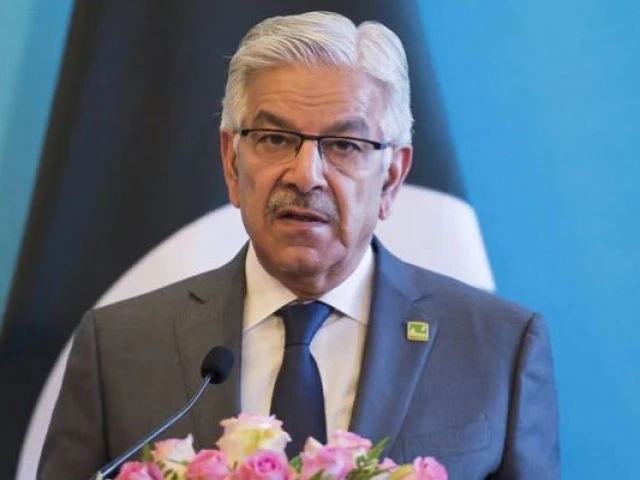
Defense Minister Khawaja Asif. PHOTO: APP/File
Defense Minister Khawaja Asif said on Friday that Pakistan was playing a “critical role” in ending the war between the United States and Israel.
In an interview on a private media outlet’s ‘Naya Pakistan’ programme, he said Egypt, Turkiye and Pakistan were involved in the effort to stop the war and prevent further destruction in the region.
“It is a matter of honor for us that Pakistan’s leadership plays an important and critical role in ending a conflict involving our sister Muslim community.”
He attributed Pakistan’s increased role in mediating the conflict to its “better image and value” internationally and among Muslim countries after last year’s military conflict with India.
The Defense Minister also referred to Pakistan’s intensification of diplomacy after the conflict, saying the country was in a “unique phase” of its history where great trust was present.
“The other side of this coin is our relations with the United States and the direction they have taken,” Asif said, adding that Pakistan had never before achieved the kind of position it currently has in its diplomacy with the United States.
The minister further said Pakistan was in an active state of war with Afghanistan, with “lukewarm tensions” also present with India.
“I think history is in the making. Pakistan’s leadership and the hybrid system… are delivering results. Not just within Pakistan… but the way our prestige has improved internationally, I think both Pindi and Islamabad have realized that Pakistan’s respect is rooted in a joint leadership front.”
Asif said Pakistan was in a position to play a role, adding that it was a historic opportunity for the government to mark its position for future generations to remember.
“We have to take advantage of these opportunities that nature provides. I think staying away is not an option,” he said, adding that there were not many major risk factors for Pakistan in this situation.
“I think the benefits are enormous,” he added.
Asked about the possible entry into force of the mutual defense pact with Saudi Arabia if the Gulf States responded to Iran, the Defense Minister said: “We could be subject to the situation, you are absolutely right. That is why the role of diplomacy is even more important, that is why we do not allow that situation to arise and we avoid it.”
When asked about reports that Pakistan was hosting talks between the US and Iran, Asif said it was better for him not to comment on the situation so that it could come to fruition on its own.
On the Indian leadership’s recent disparaging comments on Pakistan’s role, the minister said: “I think they are tearing their mouths off… it is their failure, there is no doubt about it. Jaishankar and his father were diplomats… diplomacy is their family profession, and he is mocking us as a ‘runner’? He is a ‘runner’ by heritage and he is mocking us.”
He also questioned whether India had not attempted to play a similar role in the Russia-Ukraine war.
“I think India has been defeated both militarily and diplomatically… the face of the butcher of Gujarat has come to the fore.”
On the progress of the operation against Afghanistan, he said Pakistan had managed to create pressure but could not predict the long-term situation. “The offensive we started has not concluded, there was a pause due to Eid and the world’s attention is currently on a larger conflict. We will not give them any respite; there is no doubt about it. We have to conclude this operation to achieve maximum results.”
The minister expressed hope that China’s influence in and within Afghanistan can resolve the crisis conclusively.
Read more: Europeans will press Rubio on Russian support for Iran at G7 meeting
In a potentially game-changing diplomatic signal, Prime Minister Shehbaz Sharif recently publicly offered Pakistan as a venue for US-Iran peace talks, an offer that received an extraordinary boost when President Donald Trump reposted it on his Truth Social platform, a move widely seen in Islamabad as Washington’s tacit endorsement of Pakistan’s emerging role as a mediator.
Trump’s unprecedented new involvement has injected fresh impetus into Pakistan’s mediation attempt, suggesting that the idea of Islamabad as a neutral venue for high-stakes negotiations is gaining ground at the highest levels of Washington.
Pakistan’s cautious public stance came as it quietly emerged as a key player seeking to end the escalating conflict between the United States and Iran. According to American media reports and officials familiar with the developments, Islamabad is being positioned as a potential location for negotiations between Tehran and Washington.
Meanwhile, the country’s military leaders also held talks with Washington. A report in Financial times said that Chief of Defense Forces and Chief of Army Staff Field Marshal Syed Asim Munir held a telephone conversation with President Trump to discuss the evolving situation.
Diplomatic sources said the contacts reflected Pakistan’s attempt to leverage its unique ties with both Tehran and Washington to create space for dialogue.
At the same time, Deputy Prime Minister and Foreign Minister Ishaq Dar led intense diplomatic activity, speaking separately with his Iranian counterpart Abbas Araghchi and Turkiye Foreign Minister Hakan Fidan. In both talks, Dar emphasized dialogue and diplomacy to ensure peace and stability, and all sides agreed to remain in close contact.
These parallel engagements, also involving Turkiye and Egypt, point to a coordinated but still nascent mediation effort, focused largely on secondary messages rather than a formal negotiation process.


