
Pakistan envoy warns that Afghan safe havens have emboldened BLA and TTP after Taliban takeover
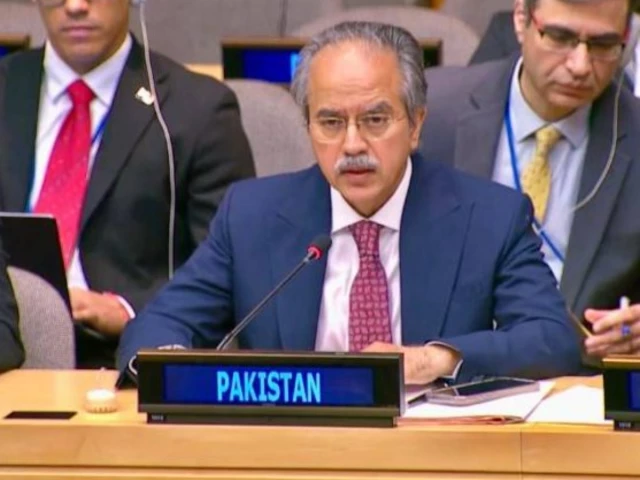
Permanent Representative to the United Nations Ambassador Asim Iftikhar Ahmad Photo: APP
UNITED NATIONS:
A senior Pakistani diplomat has asked the UN Security Council to “act quickly” to designate the “foreign-funded” Balochistan Liberation Army as a terrorist group under its sanctions regime, established by Resolution 1267 in 1999, while renewing Pakistan’s commitment to combating and eradicating terrorists on its soil.
Speaking at a Council debate on “Threats to international peace and security caused by terrorist acts”, Ambassador Asim Iftikhar Ahmad, Pakistan’s permanent representative to the United Nations, said terrorist groups like Fitna al Khawarij (TTP) and Fitna al Hindustan (BLA) and their Majeed Brigade got a “new life” after the Taliban takeover in Kabul.
The United States has already labeled the Balochistan Liberation Army as a “foreign terrorist” organization.
“We hope that the Council will act quickly to designate BLA under the 1267 sanctions regime, granting the listing request currently under consideration,” he told the 15-member Council.
Ahmad said the international community must address the contemporary terrorist threat through a “collective, comprehensive and coordinated response”, including through the balanced implementation of the Global Counter-Terrorism Strategy (GCTS).
“We must effectively address terrorist threats from Afghanistan,” he said, adding that terrorist groups such as BLA and TTP were operating from Afghan soil with the “active support of our eastern neighbor.”
As documented by the Council Monitoring Team, he added, the Afghan de facto authorities (DFA) provide a permissive environment for a variety of terrorist groups, particularly the TTP; Al-Qaeda, ISIL-K (Da’esh) remain active with an external focus, and ETIM/TIP members move freely within Afghanistan.
“These terrorist groups pose a threat not only to Pakistan, but to the entire region and beyond. The recent terrorist activity in Central Asia near the Afghan border has validated earlier warnings,” the Pakistani envoy said, adding: “It has become imperative to prevent billions of dollars of sophisticated weapons and equipment left by foreign forces in Afghanistan from falling into the hands of terrorists.
He said BLA claimed responsibility for a series of terrorist attacks in multiple locations in Balochistan over the past weekend that resulted in the martyrdom of 48 innocent civilians, including 5 women and 3 children.
“As a frontline state,” he said, Pakistan has suffered more than 90,000 casualties and heavy economic losses, citing the country’s role in dismantling Al-Qaeda and the fight against ISIL-Khorasan Province.
Read: “The Armed Forces support Kashmir”
Ahmad also highlighted the need for external destabilizing actors who support, finance and arm these groups, including their representatives in Afghanistan, to be held accountable.
“There must be zero tolerance towards state terrorism, of the kind exhibited in Indian illegally occupied Jammu and Kashmir and other situations of foreign occupation,” he said.
“The occupation and its accompanying repression cannot be disguised as counterterrorism to repress the legitimate, internationally recognized and UN-sanctioned struggles of peoples against foreign occupation and for their inalienable right to self-determination, in accordance with relevant UN resolutions and international legitimacy.”
In this context, Ambassador Asim Ahmad called on the UN counter-terrorism architecture and sanctions regimes to ensure that they adequately respond to current challenges and represent a fair, equitable and comprehensive mechanism to address the global scourge of terrorism.
“Until now, counterterrorism policies have only targeted followers of one religion: Muslims,” he said. “There is a need to cover new and emerging forms of terrorism, including white supremacists, far-right extremists, violent nationalists, fascists, fascist, xenophobic, Islamophobic and anti-Muslim groups, and similar ideologies in various parts of the world.”
“Terrorism can only be defeated through unity and cooperation, without double standards or discrimination, addressing the root causes and preventing its exploitation for politically motivated agendas,” the Pakistani envoy added.
Opening the debate, Alexandre Zouev, Acting Under-Secretary-General of the United Nations Office of Counter-Terrorism, told the Council that Da’esh and its affiliated terrorist groups continued to adapt and demonstrate resilience despite sustained counter-terrorism pressure while presenting the Secretary-General’s latest biannual report on the threat ISIL/Daesh poses to international peace and security.
Da’esh and its affiliates continue to expand in parts of Africa, particularly in West Africa and the Sahel, and the Islamic State’s West Africa Province further strengthens its presence in the Lake Chad Basin region, he said. The group remains active in Iraq and Syria, while ISIL-Khorasan (ISIL-K) continues to pose a major threat in Afghanistan and beyond, having claimed responsibility for the January 19 terrorist attack at a restaurant in Kabul.
Zouev said AI and other technologies are increasingly being used to drive radicalization and recruitment, especially targeting youth and children, while commercial satellite communication systems are exploited for secure, low-cost communications.
Turning to the priorities identified by the Secretary-General, he highlighted three areas of concern: the dire conditions in camps and detention centers in northeastern Syria and the need for safe, voluntary and dignified repatriation; the deteriorating security situation in parts of Africa, which requires political responsibility and coordinated regional responses; and the need for whole-of-government, whole-of-society approaches based on the rule of law, human rights and inclusive, national prevention.
“The intensification of the threat posed by Da’esh and its affiliates, despite significant national and international efforts, underscores the imperative of sustaining global cooperation in the fight against terrorism,” Zouev said. This year’s ninth review of the United Nations Global Counter-Terrorism Strategy provides an opportunity for Member States to reaffirm their commitments, assess progress since 2023, and address emerging and evolving threats.
Read more: Kashmir Solidarity Day will be celebrated today
Natalia Gherman, executive director of the Counter-Terrorism Committee Executive Directorate, said that in 2025, the Directorate conducted assessment visits to Austria, Cameroon, Chad, Hungary, Malta, Norway and Somalia, and this week is leading a visit to Tajikistan. “We work closely with each Member State we visit” to provide tailored support and recommendations, he said, also describing a recent meeting of countries in Kenya aimed at helping combat the increasingly sophisticated use of the Internet by terrorists.
Among other recent work, German said the Directorate published its fourth Thematic Gap Summary, focused on Africa, and is supporting international efforts to disrupt the use of virtual assets and new financial technologies for terrorist purposes. In line with its analytical mandate to identify issues, trends and new developments, it published a report on threats to critical infrastructure in partnership with the Organization for Security and Cooperation in Europe (OSCE). “The threat posed by terrorist use of unmanned aerial systems has become a priority for many Member States,” he said, also citing increasingly advanced digital methods now being used to exploit children.


