
The talks could improve Pakistan’s global standing, echoing its role in Nixon’s 1972 visit to China.
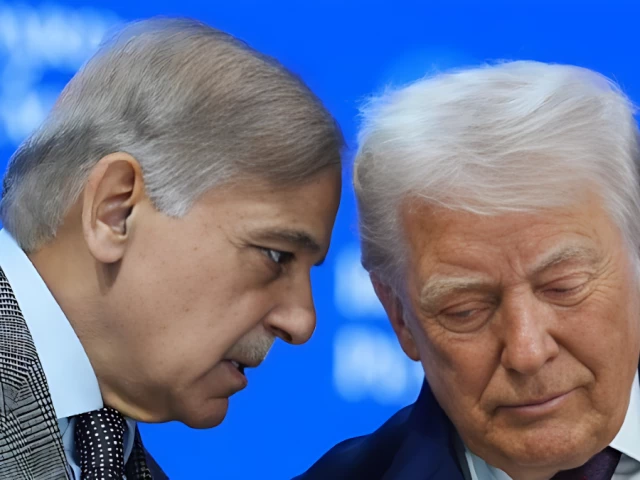
Prime Minister Shehbaz Sharif and US President Donald Trump at the “Peace Board” meeting in Davos on January 22, 2026. PHOTO:REUTERS
Pakistan’s role as a potential host of talks aimed at ending the Iran war rests on its courtship of US President Donald Trump and its reputation as a relatively neutral player with long-standing ties to the neighboring Islamic Republic of Iran.
If talks take place, they could raise Pakistan’s global prominence to levels it has not reached since the country helped mediate the secret diplomatic opening that led to US President Richard Nixon’s visit to China in 1972.
It would cap more than a year of relationship-building with Trump that has involved shrewd diplomacy and crypto deals.
Pakistan, which maintains direct contact with both Washington and Tehran at a time when those channels are frozen for most other countries, would also benefit directly from an end to the war.
The country is home to the world’s second-largest Shiite Muslim population after Iran, and faced nationwide protests the day after US and Israeli strikes killed Ayatollah Ali Khamenei at the start of the conflict on February 28.
The risk of a protracted war in Iran spilling over into Pakistan is one of Islamabad’s biggest fears, analysts and security officials say. Pakistan, which has been involved in a conflict with the Afghan Taliban, has also suffered fuel supply disruptions caused by the war with Iran.
Also read: Dar talks to UK, China and UAE as US-Iran diplomacy intensifies
“Pakistan has unusual credibility as a mediator, maintaining viable ties with both Washington and Tehran, while a history of tense relations with both gives it enough distance to be seen as a credible intermediary,” said Adam Weinstein, deputy director of the Middle East program at the Quincy Institute. Reuters.
Building relationships with Trump
Defense Force Chief and Army Chief of Staff Field Marshal Asim Munir has built a close relationship with Trump to repair years of mistrust. Pakistan joined Trump’s Peace Board just after CDF Munir flew to Davos to meet Trump in January.
Pakistan also struck a deal with a crypto company linked to Trump’s family to use its $1 stablecoin for cross-border payments, while White House envoy Steve Witkoff helped negotiate a deal to redevelop New York’s Roosevelt Hotel, owned by Pakistan International Airlines.
Pakistan has been engaged in diplomacy to end the conflict with Iran since it began, including sending at least half a dozen messages between the United States and Iran, according to five official Pakistani sources.
Before Prime Minister Shehbaz Sharif confirmed the offer of talks on Tuesday, one of the Pakistani sources and a foreign source said officials from both countries could hold talks in Islamabad later this week. The Pakistani source said US Vice President JD Vance, Witkoff and Trump’s son-in-law Jared Kushner were expected to participate.
According to official press releases, over the past month, Prime Minister Shehbaz and Foreign Minister Ishaq Dar have held more than 30 talks with their Middle Eastern counterparts, including half a dozen with Iranian officials. Two took place on Monday, the same day the United States said mediation efforts were underway, and coincided with a phone conversation between CDF Munir and Trump that was confirmed by the White House.
“Pakistan hosting the US-Iran talks represents a significant improvement in Islamabad’s strategic position,” said Kamran Bokhari, resident fellow at the Middle East Policy Council in Washington. Reuters.
Read more: PM Shehbaz says Pakistan ready to host US-Iran talks as FO acknowledges role in de-escalation efforts
“After decades of being a troubled state, Pakistan appears to be re-emerging as an important American ally in West Asia,” he said.
Links with Tehran
Bokhari said Pakistan was Iran’s least adversarial neighbor while maintaining “the closest ties with its historic regional adversary, Saudi Arabia and [being] Washington “trusts him.”
Pakistan shares a sensitive border with Iran along Balochistan. The neighbors clashed along their border in January 2024, but ties have since been repaired.
Iran may perceive him as more neutral than other potential mediators. “Unlike Gulf States like Qatar, Pakistan does not host US military bases and is a military power in its own right,” Weinstein said.
Pakistan can also rely on its historical role as an intermediary: Tehran’s de facto diplomatic mission in the United States has been housed in Pakistan’s embassy in Washington since diplomatic relations between the United States and Iran were severed in 1979.
Islamabad’s mutual defense agreement with Riyadh, signed in September, requires both countries to come to the aid of the other and has therefore weighed on the calculations.
As the US war in Iran entered its second week and Tehran attacked Saudi Arabia, Foreign Minister Dar said he had reminded Iran of the pact and was trying to mediate with Iran.
Security sources in Pakistan said Islamabad was bound by the pact but was working to avoid entering the conflict through its side talks with Tehran.


