
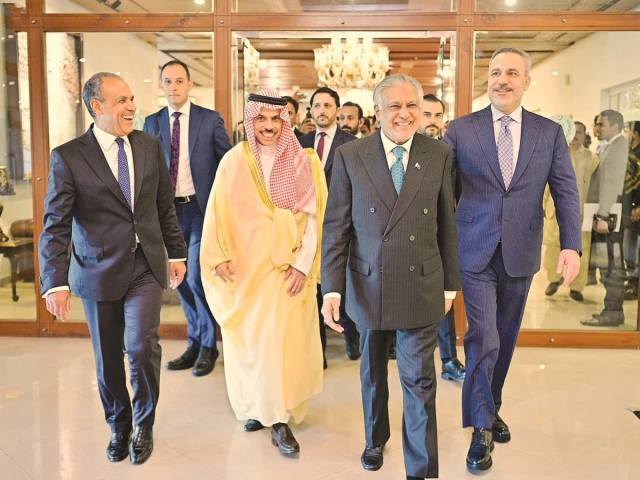
Islamabad hosts Foreign Ministers of key Muslim powers. Participants agree that a prolonged war benefits no one. Beijing and the UN apply pressure
ISLAMABAD:
Pakistan on Sunday marked a major diplomatic breakthrough, when Deputy Prime Minister and Foreign Minister Senator Ishaq Dar announced that Islamabad could host high-stakes talks between Iran and the United States “in the coming days” amid intensified efforts to reduce tension in a rapidly deteriorating regional security situation.
The announcement came at the conclusion of the second round of quadrilateral consultations involving foreign ministers of Pakistan, Saudi Arabia, Turkiye and Egypt, held in Islamabad. This was part of a coordinated effort by key Muslim countries to seek an end to the ongoing conflict in the Middle East.
“I briefed the visiting brother foreign ministers on the prospects of possible US-Iran talks in Islamabad. The visiting foreign ministers expressed their full support for this initiative,” Dar said in a televised statement after the four-party talks.
“Pakistan will be honored to host and facilitate meaningful talks between the two sides… for a comprehensive and lasting agreement,” Dar said, adding that both Tehran and Washington had expressed confidence in Islamabad’s role as a neutral facilitator.
The development marks a significant diplomatic moment for Pakistan, which has quietly positioned itself as a key intermediary between the United States and Iran in recent weeks.
Islamabad had already played a behind-the-scenes role in conveying a 15-point US proposal to Tehran, a move seen as laying the groundwork for possible direct engagement.
The Islamabad meeting brought together the foreign ministers of Saudi Arabia, Turkiye and Egypt at the invitation of Pakistan, following the inaugural session held in Riyadh earlier this month.
Dar said the four countries held “very detailed and in-depth discussions” on the evolving regional situation and explored ways to ensure an early and permanent end to the war.
Ministers expressed deep concern about the “devastating impact on lives and livelihoods” caused by the ongoing conflict, warning that continued hostilities would only lead to further destruction.
“There was a clear consensus that this war does not benefit anyone,” Dar said, underscoring the urgency of collective diplomatic efforts.
Participants also highlighted the importance of unity within the Muslim world during a time of crisis, calling it essential to respond effectively to emerging challenges.
A key highlight of the consultations was the strong support of Saudi Arabia, Turkiye and Egypt for Pakistan’s initiative to facilitate talks between Iran and the United States.
Dar briefed his counterparts on the prospects of such an engagement in Islamabad. All three countries expressed full support for the effort, a fact that lends broader regional legitimacy to Pakistan’s mediation role.
The four foreign ministers also agreed on the need to contain the situation, reduce the risks of further military escalation and create conditions conducive to structured negotiations.
They stressed that dialogue and diplomacy remained the only viable way forward, while calling for adherence to the principles of the United Nations Charter, including respect for sovereignty and territorial integrity.
Pakistan’s diplomatic push has also received support from major international players. Dar revealed that China extended full support to Islamabad’s initiative following his telephone conversation with Chinese Foreign Minister Wang Yi.
Similarly, United Nations Secretary-General Antonio Guterres has supported Pakistan’s peace efforts.
Furthermore, Dar said he had held multiple conversations with foreign ministers of various countries, all of whom conveyed their confidence in Pakistan’s role and pledged support for its mediation efforts.
“All our friends are very appreciative of the efforts Pakistan is making,” he said. The latest initiative reflects Islamabad’s broader strategy of proactive diplomacy in response to the regional crisis.
Pakistan has maintained close engagement with regional and global players, including the United States, in an effort to avoid further escalation.
Officials say Islamabad’s unique position – maintaining working relations with Washington while enjoying close ties with Tehran – has allowed it to act as a credible interlocutor.
Apart from crisis diplomacy, the quadrilateral meeting also focused on strengthening cooperation between the four countries in multiple domains.
Ministers discussed ways to deepen coordination and build a more structured framework for collaboration, noting that the grouping could evolve into a more permanent consultative mechanism.
While Dar’s announcement has generated cautious optimism, diplomatic sources acknowledge that significant challenges remain.
The success of any engagement between Iran and the United States will depend on overcoming deep-seated mistrust and addressing contentious issues that have long defined the relationship between the two adversaries.
However, Pakistan’s emergence as a potential venue for talks reflects a rare moment of diplomatic convergence and a test of its ability to translate facilitation into tangible results.
As the region braces for greater uncertainty, all eyes are now on Islamabad, where a breakthrough, however tentative, could reshape the trajectory of the conflict.


