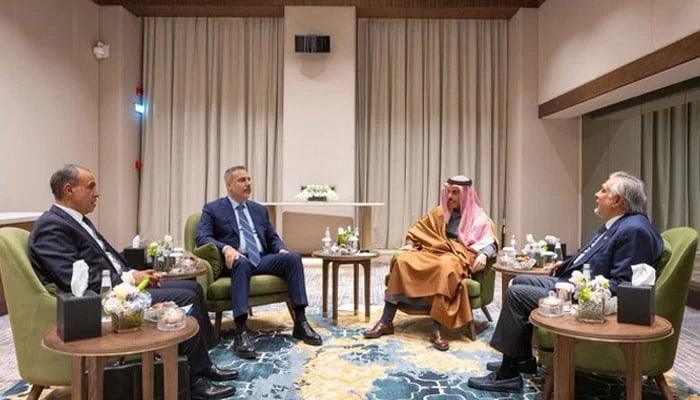
- Meeting to focus on easing tensions amid war in the Middle East.
- Pakistan emerges as a mediator between Iran and the United States.
- Ministers from Turkiye and Egypt arrive, the Saudi minister will arrive in Islamabad.
Pakistan is set to host a quadrilateral meeting of foreign ministers of Saudi Arabia, Turkiye and Egypt from March 29 to 30 in Islamabad to deliberate on a range of issues, including efforts to reduce current tensions in the region amid the US-Israel war against Iran.
Islamabad has become a key facilitator between Iran and the United States as their war drags on, serving as an intermediary for messages between the two sides.
The meeting comes amid efforts to open a window for diplomacy to end a month-long war between the United States, Israel and Iran, which began on February 28 and has affected the entire Middle East.
In this regard, Turkish Foreign Minister Hakan Fidan and Egyptian Foreign Minister Badr Abdelatty arrived in Islamabad a day earlier on an official visit.
Meanwhile, Saudi Foreign Minister Prince Faisal bin Farhan Al Saud is scheduled to arrive today.
The Foreign Ministers of Egypt and Türkiye arrived at the Ministry of Foreign Affairs, where they were warmly welcomed by Deputy Prime Minister and Minister of Foreign Affairs, Ishaq Ishaq Dar.
During the meeting, both sides held talks on tension in the Middle East and strengthening bilateral relations between Pakistan and Egypt.
Two days earlier, MPD Dar confirmed that indirect talks were taking place between the United States and Iran through messages transmitted by Pakistan, with Turkiye and Egypt also assisting in the effort.
These efforts included direct contact between Chief of Defense Forces (CDF) and Chief of Army Staff (COAS) Field Marshal Asim Munir and US President Donald Trump on Sunday, confirmed by the White House.
Pakistan subsequently handed over a US proposal to Iran, a senior Iranian source told Reuters on Wednesday. The source did not reveal details of the proposal or confirm whether it was the US 15-point framework reported by the media.
However, Iran rejected the US proposal, insisting that it will end the current “imposed war” on its own terms and schedule, a senior political security official told Press TV.
Iran outlined five conditions for ending the war: a complete cessation of “aggression and killings”; mechanisms to prevent war from being imposed again; guaranteed payment of repairs; resolution on all fronts and resistance groups; and international recognition of Iran’s control over the Strait of Hormuz.
As part of the preparations, Prime Minister Shehbaz Sharif said he had a detailed telephone conversation with Iranian President Masoud Pezeshkian today (Saturday), which lasted more than an hour.
The call was the prime minister’s second conversation with Pezeshkian in five days, and both focused on de-escalation and dialogue.
“I reiterated Pakistan’s strong condemnation of continued Israeli attacks on Iran, including recent attacks on civilian infrastructure, and conveyed Pakistan’s solidarity with the brave people of Iran,” he wrote in X.
The Prime Minister said he also expressed his condolences for the tragic loss of precious lives and prayed for the speedy recovery of the injured and displaced.
“I briefed him on Pakistan’s current diplomatic approach – involving the United States and brotherly Gulf and Islamic countries – to facilitate dialogue and reduction of tension.”
The Prime Minister’s Office said separately that Pezeshkian “emphasized the need to build trust to facilitate talks and mediation.”
‘Dialogue and diplomacy’
On the other hand, Foreign Minister Dar had a telephone conversation with Iranian Foreign Minister Abbas Araghchi, according to a statement issued by the Ministry of Foreign Affairs.
The two leaders discussed the evolving regional situation and ongoing events.
The deputy prime minister emphasized the need to reduce tensions and stressed that dialogue and diplomacy remain the only viable path to lasting peace.
He also stressed the importance of ending all attacks and hostilities.
Dar said Pakistan remains committed to supporting all efforts aimed at restoring regional peace and stability.