
At least 23 Asian nationals, including four Pakistanis, have been killed or missing in the US-Iran war.
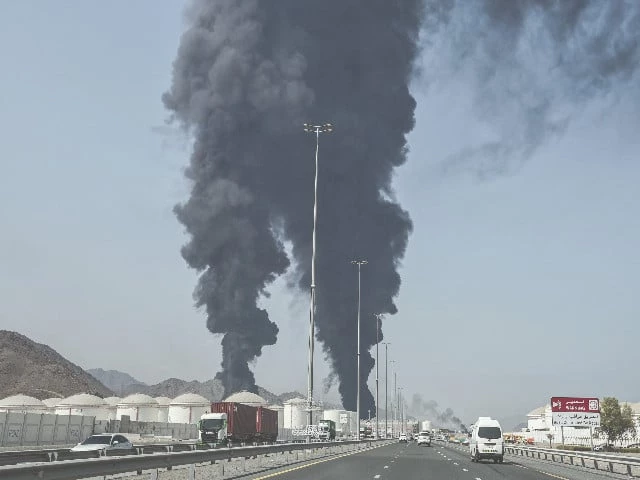
Smoke rises from an energy facility in the Gulf emirate of Fujairah. Photo: AFP
In what should be a time of celebration, families across Pakistan will mark Eid in mourning after loved ones working in the Gulf were killed in the Iran conflict.
At least 23 workers from countries including Pakistan, India and Bangladesh have been killed or are missing since the United States and Israel launched attacks on Iran, according to a report. anadolu account.
Muzaffar Ali, a 28-year-old from Sindh, was among those killed when shrapnel from a missile hit his car in Dubai. He left behind three young children, the oldest only 7 years old.
“He went to Dubai four years ago in search of a better life,” said his uncle Abdul Hakim. anadolu by phone.
“He was paying off the loans he had taken out from his relatives for the move. The last time we spoke, he told me that he had almost paid off everything he owed. Now he could finally settle down.”
Muzaffar was one of three Pakistanis confirmed killed in the Middle East conflict. A fourth Pakistani fisherman died in Iranian waters after being hit by debris from an intercepted Israeli missile.
“The shrapnel hurt his face. He died in the hospital,” Hakim said. “I don’t know who will feed his family. He was the breadwinner.”
The nearly two dozen people from Asian nations killed or missing since the conflict began include six from India, four from Bangladesh and one person each from China, Nepal and the Philippines.
Three Indonesians and three Thais remain missing in waters off Oman and in the Strait of Hormuz.
Immigrant workers on the front lines
Migrant workers make up almost half of the workforce in the Gulf Cooperation Council countries (Bahrain, Kuwait, Oman, Qatar, Saudi Arabia and the United Arab Emirates) and constitute the majority of the population in several of them. They are also present in large numbers in Jordan, Lebanon, Iran and Israel, according to the Coalition for Labor Justice for Migrants in the Gulf.
Many work under the restrictive kafala, or sponsorship, system, which ties them to their employers and often limits their ability to leave the country or even have their own passports. While Saudi Arabia has introduced reforms under its Vision 2030 programme, similar systems remain in place elsewhere.
“This systemic lack of mobility further traps migrant workers in conflict zones, limiting their movement,” the migrant workers coalition says, warning that employers may withhold wages, deny leave or lay off workers without compensation during the crisis, cutting off vital remittances to families across Asia and Africa.
Since the war began, several Gulf countries have introduced remote work and school closures as they face Iranian retaliatory attacks. However, migrant workers are much more likely to remain exposed and continue in jobs that require physical presence.
The coalition also says migrant workers are often excluded from emergency evacuation plans and denied access to shelters.
Read more: Gold prices fall sharply in local and global markets ahead of Eid
Eid without celebration
In Ganz, a small coastal town in Gwadar, the atmosphere is subdued as the family of 17-year-old Mohammad Tayyab struggles to process his death.
Tayyab, the youngest of four brothers, had left school after his father’s death to help support the family by smuggling cheaper Iranian gasoline to Pakistan.
On March 7, while returning home by boat with an assistant, the remains of an intercepted projectile hit his boat in the Arabian Sea.
“I was about to break my fast when I received the news that Tayyab’s ship had been hit. The news hit like a bomb,” said his maternal uncle Asghar Hussain. anadolu.
Since the start of the war, Pakistan has closed its border with Iran, cutting off the livelihoods of thousands of fishermen and informal traders along the Balochistan coast.
“We, especially Tayyab’s mother, are still struggling to overcome this shock. There will be no celebrations this Eid, only mourning,” Hussain said.
Miles away, in the Bannu district of Khyber-Pakhtunkhwa, Nadir Ali, 70, is mourning his son, Murib Zaman, who died when debris from an intercepted missile hit the building where he lived in Abu Dhabi.
Zaman, 48, had worked as a driver in the United Arab Emirates for almost eight years. A father of five, he had recently been discussing Eid preparations with his family.
“He kept asking me about Eid preparations, particularly about clothes and shoes for his daughters and son,” Nadir said. “Don’t worry about the money,” he remembers his son telling him.
“The children were his life. Every time he called, he first asked them about their health, education and well-being,” she said, fighting back tears.
“I don’t know what Eid would be without it.”
Mehran Rashid, Zaman’s future son-in-law, said he had spoken to him just days before his death.
“He reminded me to take the kids shopping before Eid and to the park on Eid day,” Rashid said.
Now, he added, the children refuse to celebrate.
“They don’t want new clothes or anything like that. They just look at pictures of their father several times a day.”


