
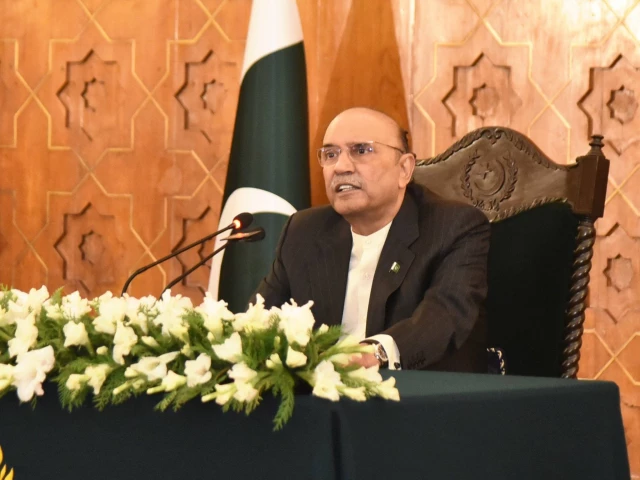
Warns perpetrators that if bloodshed continues inside Pakistan, those responsible will not be left behind
President Asif Ali Zardari on Sunday described Pakistan’s recent attacks in Afghanistan as an inherent right to defend its people against terrorism emanating from across its borders, while warning that if bloodshed continues inside Pakistan, those responsible will not be out of reach.
The statement came after Pakistan carried out intelligence-based strikes against seven terror camps along the border with Afghanistan following a series of attacks and suicide bombings.
In a statement issued by the presidency, Zardari said Pakistan’s recent actions were based on its inherent right to defend its people against terrorism emanating from across its borders and followed repeated warnings that went unheeded.
President Asif Ali Zardari says Pakistan’s recent actions reflect its right to defend its people against cross-border terrorism. Citing the latest UN Security Council report, he warns that those responsible for the bloodshed inside Pakistan will not be left behind.
— The President of Pakistan (@PresOfPakistan) February 22, 2026
Referring to his February 8 statement, the President recalled that Pakistan had warned the international community that “when terrorist groups are allowed space, facilitation or impunity beyond national borders, the consequences fall on innocent civilians around the world.”
He also stated that Pakistan strongly opposes the situation in Afghanistan, where the Taliban regime has created conditions similar or worse than before 9/11.
Calling the actions of the de facto authorities in Kabul a cause for deep concern, he said the regime, which is not recognized by the United Nations, had continued to allow terrorist elements to operate from Afghan soil in violation of its commitments under the Doha Agreement, in which it pledged that Afghan territory would not be used against any country.
President Zardari noted that the latest report by the United Nations Security Council Analytical Support and Sanctions Monitoring Team had reinforced Pakistan’s long-standing position.
The report said: “ISIL-K, Tehreek-e-Taliban Pakistan (TTP), Al-Qaida, East Turkestan Islamic Movement also known as Turkestan Islamic Party (ETIM/TIP), Jamaat Ansarullah, Ittihad-ul-Mujahideen Pakistan and others are consistently reported by a wide range of Member States to be present in Afghanistan. Some groups have used or continue to use Afghanistan to plan and prepare external attacks.”
He noted that this United Nations assessment made it clear that the presence and activities of these organizations posed serious threats to neighboring countries, including Pakistan, and said it was regrettable that, despite clear warnings and repeated commitment, the Afghan authorities had not taken credible and verifiable action against these elements.
Read also: Lieutenant colonel, sepoy martyred, five terrorists killed in Bannu attack
The President further said that Pakistan exercised restraint for a considerable period and limited its response to terrorist hideouts located near the border areas. However, he warned that Pakistan is fully aware of where the planners, facilitators and sponsors of the violence are located. If the bloodshed continues inside Pakistan, those responsible will not be out of reach, he maintained.
The president reaffirmed that Pakistan seeks peace, stability and cooperative relations with all its neighbors. He said peace cannot be based on denial, duplicity or inaction against terrorism. Protection of Pakistani lives remains paramount and non-negotiable, he added.
Pakistan has long accused the Afghan Taliban of providing shelter to TTP leaders and fighters, who regrouped across the border after Pakistan’s military operations in the former tribal areas. While the Taliban has publicly denied giving the group a free pass, Islamabad insists that the TTP’s safe havens in Afghanistan remain intact.
Tensions worsened last year after a series of deadly attacks in Khyber-Pakhtunkhwa, which Pakistan directly linked to militants operating from Afghanistan.
In August last year, Afghan officials claimed that two drone strikes had hit a man’s home in Shinwar district, Nangarhar province. The Afghan government had summoned Pakistan’s ambassador in Kabul to lodge a formal protest against what it claimed were Pakistani military attacks on Nangarhar and Khost provinces.
In November, the Afghan Taliban regime again accused Pakistan of launching airstrikes. Taliban spokesman Zabihullah Mujahid said Pakistan had “bombed” Afghanistan’s Khost province and carried out airstrikes in Kunar and Paktika.
In response, Pakistan vehemently dismissed Kabul’s accusations, insisting that Islamabad did not carry out covert cross-border operations or attack civilians.
The same month, ISPR Director General Lieutenant General Ahmed Sharif Chaudhry issued a warning that the Afghan regime was a threat not only to Pakistan but to the entire region and the world, citing the abandonment of US military equipment worth $7.2 billion during the US withdrawal.
Read also: Terrorist commander and accomplice killed in exchange of fire with CTD Bannu
Lt. Gen. Chaudhry reiterated that the Afghan regime was harboring “non-state actors” that posed a threat to several countries in the region, and pointed to the Taliban’s failure to establish an inclusive state and government after 2021. He stressed that Pakistan’s problem was with the Afghan Taliban regime, not the Afghan people.
More recently, after the terror attacks in Balochistan, Naqvi again blamed India for a coordinated terror campaign in the province. “These were not ordinary terrorists. India is behind these attacks. I can assure you that India planned these attacks along with these terrorists,” he said.
He added that authorities will pursue everyone involved, as well as those who direct them behind the scenes. He further claimed that India was the “main country” behind terrorism and said that it not only provides financial support to terrorists but also helps them in planning and strategizing.
In 2023, a UN report also revealed that the TTP had established a new base in KP by mid-2023. The report sheds light on the close links not only between the TTP and the Afghan Taliban but also with anti-Pakistan groups and Al Qaeda. The report further revealed that some Taliban members had also joined the TTP, perceiving it as a religious obligation to provide support.
Interlocutors reported that TTP members and their families regularly received aid packages from the Taliban. Importantly, the UN report noted a significant increase in Afghan citizens in the ranks of the TTP. This supported Pakistan’s position that a growing number of Afghan nationals were involved in suicide attacks in the country.
More recently, a UN Security Council report said attacks on Pakistan by the TTP from Afghanistan have increased, supporting Islamabad’s long-standing complaints about militant sanctuaries across the border.
The 37th report of the Analytical Support and Sanctions Monitoring Team not only supported Islamabad’s stance that Afghanistan had become a sanctuary for militants using its territory to launch attacks against Pakistan, but also came at a time when the country is facing a renewed wave of violence.


