
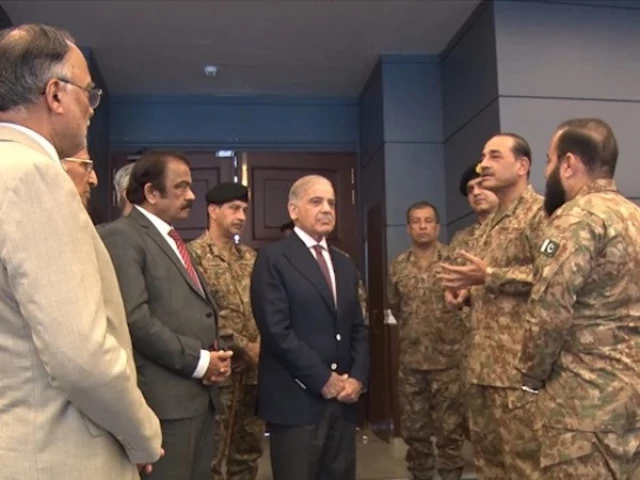
Prime Minister Shehbaz Sharif visits headquarters and is briefed on Pakistan-Afghanistan clashes on Friday.
Prime Minister Shehbaz Sharif on Friday said Pakistan should adopt a “zero tolerance” policy towards the alliance between the Afghan Taliban regime and the banned group Tehreek-e-Taliban Pakistan.
Pakistani forces attacked key military installations of the Afghan Taliban regime in Kabul, Kandahar and Paktia through effective airstrikes early on Friday. The military spokesperson said that the ongoing ‘Operation Ghazab Lil Haq’ against the Afghan Taliban was producing the desired results and was continuing successfully.
He said Pakistan had “effectively repelled” Afghan Taliban insurgents at 53 locations along the border, inflicting heavy losses and exercising restraint to avoid harm to civilians.
The Prime Minister paid a visit to the General Headquarters (GHQ) along with members of the federal cabinet after the situation, where the military leaders gave a detailed report on the situation of the recent conflict with Afghanistan.
Prime Minister Shehbaz reviewed the latest developments along the border with Afghanistan. During the briefing, the military officials presented an overview of the current situation and security concerns related to the Afghan Taliban forces.
“Zero tolerance will be adopted against the alliance of Fitna al-Khawarij and the Afghan Taliban regime and its malicious activities. Actions of the Afghan Taliban regime and Fitna al-Khawarij against Pakistan are unacceptable,” he said in a statement published on state broadcaster X PTV News.
پرائم منسٹر آفس
(میڈیا ونگ)Date of birth: January 27, 2026.
(GHQ) قیادت کی وزیرِ اعظم صورتحال پرمفصل بریفنگ
فتند زیرو ٹالرنس… pic.twitter.com/84KUo5uaAG
– PTV News (@PTVNewsOfficial) February 27, 2026
Read more: ‘Op Ghazab Lil Haq’ against Afghan Taliban continues as Pakistan achieves ‘desired results’: DG ISPR
He further praised the leadership of Chief of Defense Forces and Chief of Army Staff Field Marshal Asim Munir and highlighted the readiness of Pakistan’s armed forces to protect the nation.
“Pakistan knows well how to defend itself against any aggression,” the prime minister said while praising the professional capabilities of the military in thwarting attacks in the border areas of the Afghan Taliban regime and preparing a comprehensive retaliatory response.
“The entire nation stands shoulder to shoulder with its Pakistan Armed Forces for the defense of the motherland.”
The federal government has been constantly raising its voice in international forums against terrorist sanctuaries operating in Afghanistan and using its soil to launch attacks against Pakistan.
Following a series of suicide bombings, Pakistan carried out intelligence-based strikes against seven terror camps along the Afghan border early Sunday morning.
Security sources said Pakistan carried out a major intelligence-based air operation in eastern Afghanistan targeting seven key hideouts, killing several terrorists, including Taliban commander Akhtar Muhammad.
According to sources, jet planes attacked terrorist shelters in Bermal district of Paktika, where loud explosions were heard throughout the area. The facilities used by the terrorists were reported to have suffered serious damage.
Earlier this month, a suicide bomber attacked the Imambargah Khadijah al-Kubra during Friday prayers in Islamabad, killing 36 people and wounding about 169 others. The attack was the deadliest in Islamabad in more than a decade and the deadliest nationwide since the Peshawar mosque bombing in January 2023.
Immediately after the blast, raids were carried out in Nowshera and Peshawar, resulting in the arrest of four facilitators. The mastermind linked to Daesh, an Afghan national, was also captured. Interior Minister Mohsin Naqvi said the network behind the blast was trained in Afghanistan and that authorities had gathered intelligence on the suspects before the attack.
In 2023, a UN report also revealed that the TTP had established a new base in KP by mid-2023. The report sheds light on the close links not only between the TTP and the Afghan Taliban but also with anti-Pakistan groups and Al Qaeda.
Read this: The breeding ground for terror
The report further revealed that some Taliban members had also joined the TTP, perceiving it as a religious obligation to provide support.
Interlocutors reported that TTP members and their families regularly received aid packages from the Taliban.
Importantly, the UN report noted a significant increase in Afghan citizens in the ranks of the TTP. This supported Pakistan’s position that a growing number of Afghan nationals were involved in suicide attacks in the country.
More recently, a UN Security Council report said attacks on Pakistan by the TTP from Afghanistan have increased, supporting Islamabad’s long-standing complaints about militant sanctuaries across the border. The 37th report of the Analytical Support and Sanctions Monitoring Team, dated February 4, not only supported Islamabad’s stance that Afghanistan had become a sanctuary for militants who used its territory to launch attacks against Pakistan, but also came at a time when the country is facing a new wave of violence.


