
Announces electricity tariff cut of Rs 4.04; Drastically cuts the export refinancing plan rate by between 3% and 4.5%; Offers blue passports.
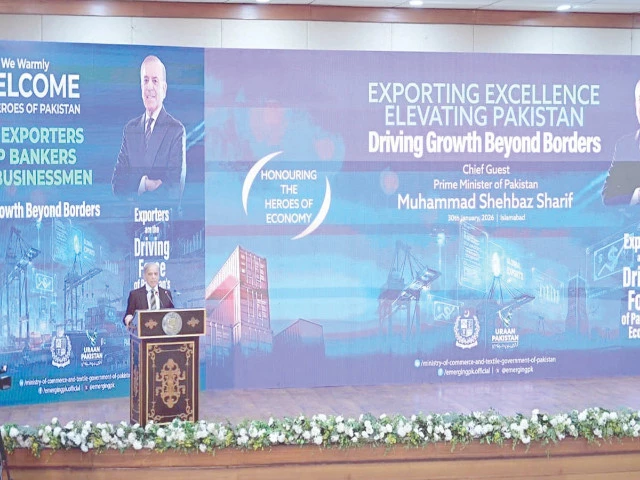
Prime Minister Shehbaz Sharif addresses the country’s top exporters and businessmen at a ceremony in Islamabad. Photo: APP
ISLAMABAD:
Prime Minister Shehbaz Sharif on Friday announced major relief measures for industries and export sectors, including a reduction in electricity tariffs from Rs 4.04 per unit and transportation charges to less than Rs 9 for the industry, along with a significant decrease in the export refinancing scheme rate from the current 7.5 per cent to 4.5 per cent and issuance of blue passports to major exporters for two years.
He said the government had allocated Rs 1,052 billion for the export refinancing scheme, of which Rs 900 billion had already been utilised, adding that under the scheme, exporters were availing three per cent relief on the State Bank of Pakistan’s policy rate, which had now been further reduced to 4.5 per cent.
Addressing the awards ceremony of top exporters for the year 2024-25, he said the government would offer blue passports to exporters awarded during the ceremony for a period of two years as part of its efforts to facilitate and incentivize export-led growth.
The prime minister said Pakistan’s economic revival and long-term stability depends on export-led growth and foreign direct investment (FDI) in export-oriented projects, and emphasized that the business community must play a central role in driving sustainable development.
He said stabilization alone is not enough and the country must now transition to growth that is sustainable, competitive and export-driven. “There is no other way forward. Export-led growth is the only solution for Pakistan’s economic future,” he said.
Prime Minister Shehbaz emphasized that future FDI would be encouraged only in export-led projects, which would help generate foreign exchange and strengthen the country’s reserves. “This is a win-win strategy. It boosts exports and attracts investments at the same time,” he added.
Paying tribute to the exporters, the Prime Minister termed them as the backbone of the national economy and credited their resilience and commitment for helping Pakistan overcome serious economic challenges. He recalled that in June 2023, Pakistan was on the brink of default, inflation was 32 percent and the policy rate had peaked at 22 percent, causing immense difficulties to investors, exporters and the business community.
He said that through collective efforts, the economy had stabilized, with inflation now in single digits, the policy rate reduced to 10.5 percent and foreign exchange reserves doubling compared to three years ago, although he acknowledged that part of the reserves included support from friendly countries.
The prime minister reiterated Pakistan’s determination to reduce its dependence on foreign debt, saying “there is no respect for nations that beg for money.”
The Prime Minister said that right now, in the third quarter, the country’s foreign exchange reserves have doubled, but that also includes loans from friendly countries. He acknowledged the support of China, Saudi Arabia, the United Arab Emirates and Qatar in stabilizing the economy during the crisis.
Prime Minister Shehbaz said that he, along with Chief of Defense Forces and Chief of Army Staff Field Marshal General Asim Munir, went to many countries for help.
He warned that stabilization without growth would not solve structural problems, noting that poverty and unemployment had increased and exports had not met established targets.
He urged the business community to increase investment and assured them that his recommendations would be implemented in letter and spirit.
Highlighting the importance of small and medium enterprises, Prime Minister Shehbaz asked banks to enhance lending to SMEs to promote entrepreneurship and diversify the economy. He said Pakistan must abandon the boom-and-bust economic model, which repeatedly generates balance of payments crises.
The prime minister also stressed on tax compliance and warned industries against withholding taxes collected from consumers. He revealed that the government’s action against sugar mills had resulted in Rp50 billion in additional tax revenue over the past year and promised to continue strict enforcement.
He said the government had also controlled smuggling of petroleum products, which helped collect additional revenue of Rs 125 billion per year as Petroleum Development Levy (PDL).
He attributed the credit of curbing smuggling in the border areas to field martial Syed Asim Munir, who had issued orders for strict action against the smugglers and their supporters.
On the digital economy, he said the government was prioritizing IT exports and had set a target of increasing IT exports to $30 billion from the current $3 billion in five years. He praised IT Minister Shaza Fatima Khawaja for her efforts in this sector.
Prime Minister Shehbaz also acknowledged the contributions of Deputy Prime Minister Ishaq Dar and several cabinet members for their role in economic reforms, privatization and export promotion, terming the progress as a result of teamwork and selfless service.
Commerce Minister Jam Kamal Khan, speaking on the occasion, said Pakistan had emerged from a turbulent economic phase and was regaining international recognition thanks to the Prime Minister’s vision and close engagement with the business community.
At the ceremony, the Prime Minister presented awards to top 30 exporters and leading bankers for their outstanding contribution to the national economy during the fiscal year 2024-25.
Awais Leghari
Federal Minister for Power Division Sardar Awais Ahmed Khan Leghari on Friday said that electricity tariffs for industries have been reduced by Rs 4.04 per unit under a special relief package announced by Prime Minister Muhammad Shehbaz Sharif.
In a statement shared on social media platform
He said removal of this burden would also lead to reduction in transportation expenses, with an average decrease of Rs 4.04 per unit under the cross-subsidy mechanism for industries.
As a result of these measures, Leghari said, electricity would now be available to industrial consumers at approximately 11.5 cents per unit, a move that is expected to improve industrial competitiveness and support economic growth.
The minister credited the leadership and guidance of Prime Minister Muhammad Shehbaz Sharif for the decision, stating that the relief package reflects the government’s commitment to revive the industry and reduce production costs.
Concluding his message, Leghari expressed optimism about the country’s economic direction and said the initiative aligns with the government’s broader vision of “Uraan Pakistan”.


