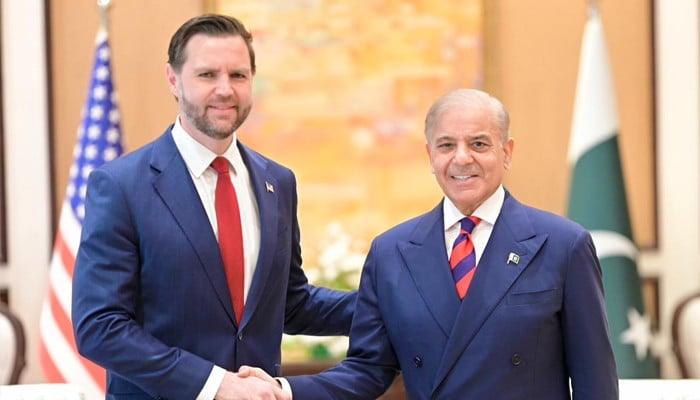
- Shehbaz and Vance hold talks as negotiations begin.
- The US delegation includes Witkoff and Jared Kushner.
- Pakistan promises continued facilitation between both sides.
ISLAMABAD: Prime Minister Shehbaz Sharif met US Vice President JD Vance on Saturday as the Islamabad talks formally began, hoping that these negotiations would serve as a springboard towards lasting peace in the Middle East.
The US Vice President was accompanied by Special Envoy Steve Witkoff and President Donald Trump’s son-in-law Jared Kushner, while the Prime Minister was assisted by Deputy Prime Minister and Foreign Minister Ishaq Dar and Interior Minister Senator Mohsin Raza Naqvi.
The Prime Minister praised the commitment of both delegations to engage constructively and expressed hope that the talks would serve as a springboard towards lasting peace in the region.
He reiterated that Pakistan looks forward to continuing its role in facilitating both sides to move towards sustainable peace.
The meeting comes shortly after a high-level US delegation led by Vice President Vance and comprising Witkoff and Kushner arrived in Islamabad today to participate in the negotiations.
The talks follow a two-week ceasefire announced by President Trump after weeks of conflict in which the United States and Israel attacked Iran.
Despite the pause, tensions remain high, particularly around the Strait of Hormuz and ongoing hostilities involving Israel and Iran-backed Hezbollah in Lebanon.
Earlier, a high-level Iranian delegation led by Parliament Speaker Mohammad Baqer Ghalibaf also arrived in Islamabad ahead of the talks. The delegation includes Foreign Minister Abbas Araghchi, who is expected to play a key role in the negotiations.
Ahead of the talks, Ghalibaf stressed that Washington must honor previous commitments, including easing restrictions on Iranian assets and ensuring a ceasefire in Lebanon, and warned that progress would otherwise be difficult.
Vice President Vance expressed cautious optimism about the outcome, but warned that any attempt by Iran to undermine the process would draw a firm response.
The conflict, which began on February 28 following coordinated attacks between the United States and Israel against Iran’s leadership and infrastructure, has led to more than 2,000 deaths and widespread regional instability. Tehran responded with retaliatory operations, including disrupting shipping through the Strait of Hormuz and attacking Israeli and US targets in the region.
A ceasefire was finally announced on April 8, with Pakistan playing a central role in mediating. However, key disagreements remain. Washington has proposed a 15-point framework focused on nuclear and missile issues, sanctions relief and reopening the Strait of Hormuz, while Tehran has presented a 10-point plan seeking greater control over the waterway, transit fees and a comprehensive removal of sanctions.
The international community has welcomed Pakistan’s diplomatic role, supporting its efforts to reduce tensions and facilitate negotiations aimed at achieving lasting peace.
What’s on the table?
As US and Iranian delegations meet for critical negotiations in Islamabad, a broad but complex issue is expected to dominate the discussion. The news reported.
The negotiations are structured around two competing proposals: a 10-point framework put forward by Iran and a 15-point plan put forward by the United States. Although both parties have expressed their willingness to collaborate, significant differences remain.
At the center of the negotiations is Iran’s nuclear program. Washington is pushing for firm guarantees that Tehran will not develop nuclear weapons, along with strict limits on uranium enrichment and intrusive oversight by the IAEA.
Iran, however, seeks recognition of its right to conduct peaceful nuclear activities, including enrichment, which it considers a matter of national sovereignty.
Economic sanctions are another central issue. Iran demands the immediate and complete lifting of all US and international sanctions, along with the release of its frozen financial assets abroad.
The United States position differs markedly and favors a gradual easing of sanctions directly linked to Iran’s verifiable compliance with nuclear and security commitments.
Control and access to the strategically vital Strait of Hormuz is also a major point of contention. Iran seeks formal recognition of its regulatory role for the passage, citing its geographical and economic importance.
The United States, on the other hand, insists on fully open and secure international sea routes without restrictions, given the importance of the strait to global energy supplies.
Regional influence remains a sensitive issue. Washington is pushing for an end to Iran’s support for allied armed groups across the Middle East, while Iran is demanding a halt to military action against those groups and a broader de-escalation of regional conflicts.
Iran has called for the withdrawal of US forces from the region and a formal guarantee of non-aggression. The United States has not indicated a willingness to reduce its military footprint, citing security commitments to its allies.
Another contentious issue is Iran’s ballistic missile program. The United States seeks limits on missile development and broader defense capabilities, while Iran views such demands as an infringement on its sovereign right to self-defense.
Tehran has also raised the issue of compensation for damage resulting from recent conflicts, while the United States is expected to push for accountability mechanisms that address attacks on its interests and allies.