
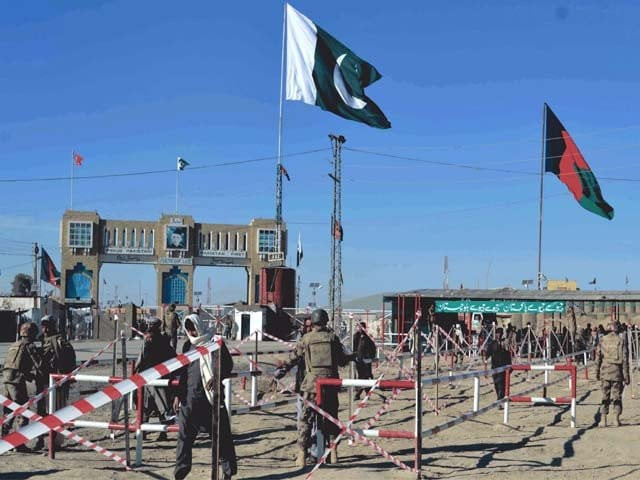
The border between Pakistan and Afghanistan in Chaman. PHOTO: ARCHIVE
ISLAMABAD:
Senior officials from neighboring countries as well as Russia have urged Pakistan and Afghanistan to return to dialogue and resolve their differences through diplomatic means.
The call came Monday at the end of the Tehran conference, a meeting of special representatives from Iran, Pakistan, China, Tajikistan, Uzbekistan, Turkmenistan and Russia.
The meeting aimed to promote regional stability and a coordinated approach to the Afghan situation
Iran’s Foreign Ministry on Monday issued a statement summarizing the deliberations, which reflected broad convergence among regional actors on political, economic and security priorities related to Afghanistan.
But contrary to Pakistan’s stance, other participants apparently took a moderate stance. There was a reference to security concerns, but at the same time, other participants, instead of urging the Taliban regime to eliminate terrorist groups, expressed their willingness to work with Kabul.
According to the statement, participants reviewed the latest developments in Afghanistan and highlighted the importance of regional convergence and a region-centric approach to addressing the country’s challenges.
The meeting took place against a backdrop of continued humanitarian and economic difficulties in Afghanistan, as well as tense relations between Kabul and Islamabad.
In a key regional signal, participants expressed support for all efforts aimed at reducing tensions between Afghanistan and Pakistan.
They underlined their willingness to help strengthen such initiatives and explicitly urged both sides to return to negotiations and resolve outstanding disputes through diplomatic channels.
In terms of security, the envoys reaffirmed their shared concern about the threats emanating from Afghanistan.
While underscoring the need to strengthen stability in the country, they announced their readiness to help Afghanistan achieve this goal if the Afghan side requested support.
They also declared their readiness to cooperate with Afghanistan in the fight against terrorism, drug trafficking and human trafficking, issues that continue to have cross-border implications for the region.
The statement also conveyed a clear message about foreign involvement in Afghanistan.
Participants opposed any efforts by foreign countries to establish a military presence in the country, reflecting long-standing regional sensitivities following decades of external intervention.
They stressed that the countries responsible for the current situation in Afghanistan must contribute to its reconstruction and economic and social recovery, but without turning assistance into a political lever.
Economic stabilization and humanitarian concerns featured prominently in the discussions.
Participants highlighted the responsibility of the international community to lift the sanctions imposed on Afghanistan and unlock its frozen assets.
Warning that continued economic pressure has direct and serious consequences for the Afghan population; They argued that ordinary Afghans should not bear the cost of political disputes.
In this context, the envoys highlighted the importance of continuing economic and trade relations with Afghanistan as a means to improve the livelihoods of its people.
They also stressed the need to integrate Afghanistan into regional political and economic processes, suggesting that isolation would only exacerbate instability and humanitarian suffering.
The statement further called on international organizations to play a more active role, particularly in supporting the return of Afghan citizens from neighboring countries.
Participants emphasized the need to ensure conditions for the dignified, voluntary and sustainable return of refugees, an issue of growing concern for countries in the region that host large Afghan populations.
The participants agreed that the fifth meeting of foreign ministers of Afghanistan’s neighboring countries should be held as soon as possible in Ashgabat, Turkmenistan.
They suggested that such a meeting would help maintain the momentum of regional coordination and provide policy-level guidance on Afghanistan-related cooperation.
Furthermore, the statement welcomed Pakistan’s readiness to host the second round of special envoys meeting in Islamabad in March next year.


