
Court affirms that financial restitution is not discretionary when dismissal is considered unfair
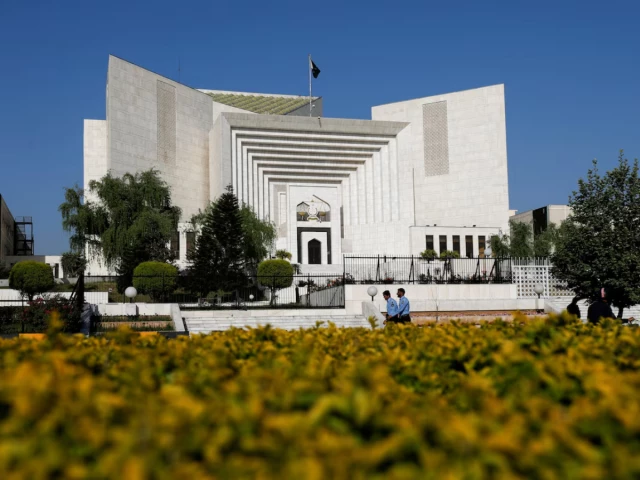
Police officers walk past the Supreme Court of Pakistan building, in Islamabad, Pakistan, April 6, 2022. REUTERS
ISLAMABAD:
In a ruling with far-reaching implications for public service law, the Supreme Court held that a public servant reinstated after wrongful dismissal is, as a general rule, entitled to receive full back pay and benefits for the period he remained out of service.
The verdict, written by Justice Shahid Waheed, came while deciding the issue of whether police officers, by quashing a dismissal order, automatically acquire the right to back pay.
The five-judge court, led by Justice Waheed, issued the 13-page ruling reaffirming that financial restitution is not discretionary when a dismissal is found to be unfair.
“As to the advisability of awarding back pay in cases of unjustified dismissal, a fundamental principle emerges: such pay should, as a general rule, be awarded to the official who has been unjustly dismissed from his position,” the ruling states.
The ruling explained that this directive is fundamentally aligned with the general objective of restoring the public official to his original economic condition, a condition that would have been maintained if the unlawful action had not occurred.
The court observed that wrongful dismissal is not simply an administrative error but a violation of constitutional rights.
The ruling noted that “it is essential to remember that in cases of unjustified dismissal from the service, the responsibility for the injustice falls directly on the authority, while the repercussions are suffered by the official.”
This scenario constitutes what can be considered a constitutional grievance, as it results in a public official being stripped of his or her means of subsistence. This deprivation is directly connected to article 9 of the Constitution, which guarantees the right to life.
Furthermore, he explained that the term “life” encompasses a broader interpretation, encompassing not only mere existence but also the means of sustaining it.
“William Shakespeare, in his famous play ‘The Merchant of Venice’, aptly captures this sentiment with the poignant phrase: ‘You take away my life, when you take away the means by which I live.’ It is therefore unjustifiable to allow the authority to evade responsibility for its unlawful actions by exempting it from the obligation to compensate the official with full back pay.”
The court noted that such compensation is not simply a matter of financial restitution, as it is a necessary step to rectify the imbalance created by the authority’s wrongdoing and to uphold the integrity of the constitutional rights and dignity of the official.
The court further stressed that administrative authorities must act within the limits of law and justice.
“The authority must provide persuasive and convincing grounds for its decisions, and be willing to defend its decisions before the judiciary or other forums when necessary. The authority exercising its discretion must be well aware that, if exercised arbitrarily or capriciously, this power can easily become a mechanism of oppression and injustice.”
Therefore, the court noted, it is up to the authority to exercise its discretion in a fair, reasonable and lawful manner. “To do anything less would not only betray the trust placed in you, but would also undermine the fundamental principles of the rule of law, and that would justify judicial intervention.”
The ruling explains that the annulment of a dismissal usually occurs in four circumstances.
“To fully understand the legal implications, it is crucial to recognize that the decision to overturn a dismissal typically arises in one of four specific circumstances. First, this can occur when it is determined that the punishment was imposed due to a procedural irregularity, meaning that the correct protocols were not followed during the disciplinary process, leading to a de novo investigation.”
“Second, a sanction order can be revoked based on a technicality or a lenient view of the matter. Third, the dismissal can be revoked if this sanction is considered disproportionate to the proven misconduct, suggesting that the seriousness of the action taken against the official does not correspond to the seriousness of his behavior and, consequently, the penalty is modified and replaced by another.”
“Finally, the dismissal is declared void when the alleged misconduct is not proven, indicating that the official did not engage in conduct that warrants such punitive measures.”
The court said these scenarios divide layoffs into two legal categories.
“These scenarios clearly delimit dismissals into two categories: (i) unfair dismissal and (ii) unfair dismissal. The first three circumstances usually fall within the scope of unfair dismissal, highlighting procedural, technical or proportionality issues.”


