
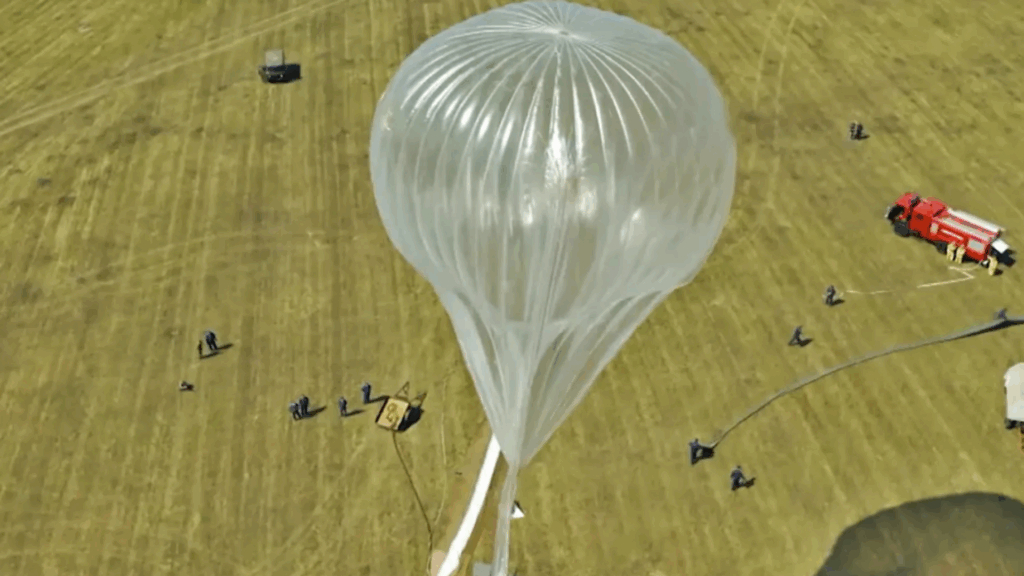
- Russia tests stratospheric balloons for battlefield communications
- Barrazh 1 aims to raise 5G relay equipment
- Wind patterns complicate sustained coverage over Ukraine
Russia is testing a high-altitude balloon system aimed at restoring battlefield connectivity after tighter controls on unauthorized Starlink terminals in occupied Ukrainian territories.
The platform, known as Barrazh 1, is designed to transport communications relay equipment to approximately 20 kilometers in the air.
Russian developers claim that the system is largely based on domestically produced components and can stand up a 5G non-terrestrial network station for extended operations.
A relay network over Russian-controlled airspace
The concept envisions a floating relief layer that can support ground forces when access to satellites becomes unreliable.
According to Ukrainian defense sources, Aerodrommash and Bauman Moscow State Technical University are involved in the project, Defense Express reported.
The balloon includes features such as a removable corner reflector to improve radar visibility, indicating air defense monitoring awareness.
Russian descriptions suggest that altitude adjustments would allow operators to exploit different wind currents to influence drift and maintain coverage over designated areas.
Operating at more than 20 kilometers places such platforms beyond the reach of many conventional air defense systems, although interception remains possible with specialized assets.
Historical precedents show that high-altitude objects can be attacked when necessary: in February 2023, the United States used an F-22 armed with an AIM-9X missile to destroy a Chinese surveillance balloon.
During the Cold War, the Soviet Union also developed the M-17 Stratosphere interceptor for similar altitude regimes.
The main limitation of this technology is not altitude but atmospheric dynamics, since in most of Ukraine, the prevailing upper-level winds flow from west to east, a pattern known as westward transfer.
Balloons launched from Russian-controlled territory would therefore tend to deviate more towards Russia rather than towards Ukrainian positions.
Exceptions may occur in parts of southern Ukraine during winter, where easterly flows are more common, although such conditions are seasonal and geographically limited.
Even with altitude control, stratospheric balloons primarily move with the prevailing air masses.
Maintaining a stable relay network in a fixed operating area would require persistent compensation of wind direction and speed, factors that cannot be fully controlled.
This introduces uncertainty into any plan to maintain continuous communications coverage in the disputed territory.
High-altitude balloons are not new, as they have historically been used for reconnaissance and experimentation, but the placement of modern communications payloads is.
In theory, a balloon relay could provide temporary redundancy when satellite links fail, but in practice there are complexities that must be considered.
Through Unidos24 Media
Follow TechRadar on Google News and add us as a preferred source to receive news, reviews and opinions from our experts in your feeds. Be sure to click the Follow button!
And of course you can also follow TechRadar on TikTok for news, reviews, unboxings in video form and receive regular updates from us on WhatsApp also.


