
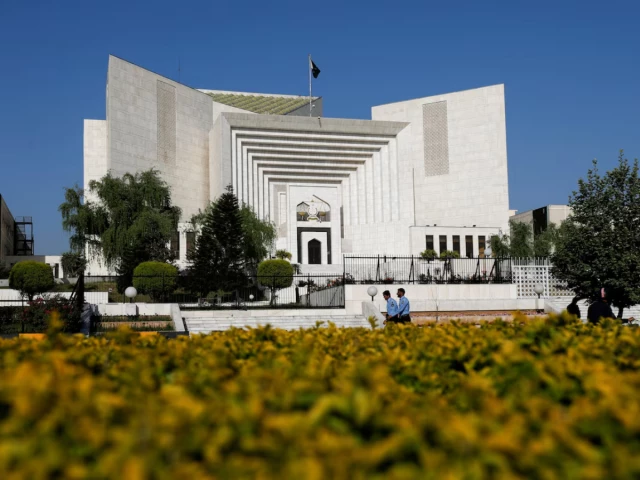
Police officers walk past Pakistan’s Supreme Court building, in Islamabad, Pakistan, April 6, 2022. REUTERS
ISLAMABAD:
The Supreme Court has emphasized the usefulness of deterrent punishment in criminal cases, stating that such punishment balances the severity of the wrong committed by a person and also sets an example for others.
“The purpose behind imposing a sentence is twofold. Firstly, it creates an atmosphere that deters people who have inclination towards crime and secondly, it serves as a means to reform the offender,” reads a 13-page judgment written by Justice Ishtiaq Ibrahim.
Justice Ibrahim was part of a three-member bench headed by Justice Muhammad Hashim Khan Kakar, which upheld the death sentence of a person involved in the murder and rape of a five- to six-year-old girl.
The judgment noted that the trial court awarded death sentence to the petitioner-convict under sections 302(b), 364-A and 376 of the Pakistan Penal Code (PPC), and the same was later confirmed by the high court.
“Kidnapping of a minor girl of five to six years by the petitioner-convict in broad daylight from an open bazaar, then committing rape and sodomy on her inside her house, murdering her, placing her body in a sack and dumping it are acts of such brutality and gruesome that any leniency would amount to extending premium to such criminals and leaving the society under threat.”
The ruling noted that although the accused is the favorite son of the law, the court has a duty to society and to the legal heirs of the victim.
“The penalty imposed on an offender must be such as to act as a deterrent to the commission of crimes. Conceptually, a penalty is imposed on an offender on the basis of retribution, deterrence or reformation.”
He said that deterrent punishment is not only intended to maintain balance with the severity of the wrong committed by a person, but also to serve as an example for others as a preventive measure for the reform of society.
“The concept of lesser punishment in law is an attempt to reform an individual wrongdoer. However, in the present case, where the petitioner-convict kidnapped a minor girl, committed rape and sodomy and then murdered her, no leniency should be shown.”
“The death penalty would create a deterrent effect in society, so that no other person would dare to commit such a crime.
“If a lenient attitude is adopted in such cases, peace, tranquility and harmony in the society would be jeopardized and vandalism would prevail. The courts have been given a very wide discretion in sentencing, which must be exercised judiciously,” the judgment said.
The court held that the prosecution had proved the abduction of the minor girl by the petitioner-convict, the commission of rape and sodomy on her and her subsequent murder by strong and confidence inspiring evidence last seen and circumstantial evidence supported by medical evidence beyond any shadow of reasonable doubt.
The court observed that the cumulative effect of the evidence adduced unequivocally leads to the conclusion that the chain of circumstances is complete and coherent, giving rise to a reasonable and irresistible inference that the petitioner committed the crime.
Each circumstance so established is consistent only with the hypothesis of the guilt of the petitioner-convict and is incompatible with any reasonable hypothesis of innocence.
The court further noted that the petitioner-convict did not choose to appear as a witness in terms of section 340 (2) of the Code nor did he present any evidence in his defence.
“His mere denial in the statement recorded under Section 342 of the code, being a statement not made under oath and not subject to cross-examination, does not by itself refute the evidence of the prosecution nor discharge the burden imposed upon it once the prosecution has succeeded in establishing a prima facie case.”
The court said that if the scene of the incident is such that no witnesses were available and the accused had exclusive knowledge about the incident, a simpler denial on the part of the accused would not be sufficient to nullify the circumstantial evidence directly connecting him to the commission of the accused offence.
“But the accused must present a statement that, when tested by the test of probabilities, justifies a reasonable hypothesis of innocence,” he said.


