
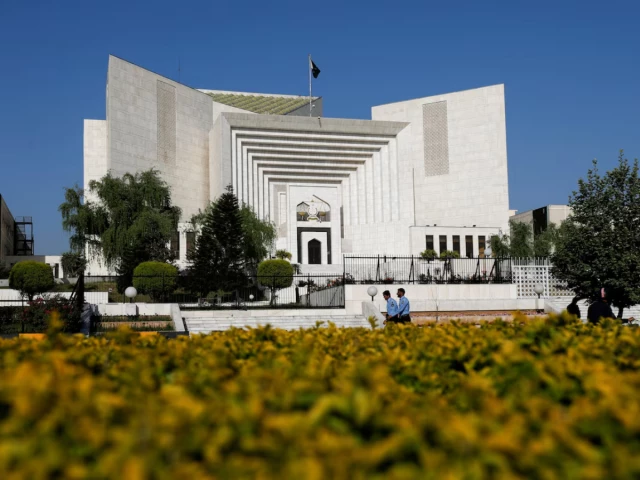
Police officers walk past the Supreme Court of Pakistan building, in Islamabad, Pakistan, April 6, 2022. REUTERS
ISLAMABAD:
The Shariat Appeals Chamber of the Supreme Court on Thursday heard an important constitutional and religious interpretation case concerning the evidentiary status of women’s testimony in legal proceedings.
The five-member bench, headed by Justice Jamal Khan Mandokhail, issued notices to the federation and provincial governments and sought formal responses, noting that the issue has both jurisprudential and social importance.
The court examined the legal, religious and procedural dimensions of the matter. He stressed that a clear and reasoned determination was needed so that future disputes could be addressed with certainty under Islamic constitutional and legal principles.
Sitting on the bench, Justice Irfan Saadat Khan observed during the hearing that guidance on women’s testimony is available in the Holy Quran, referring in particular to verses from Sura Al-Baqarah that describe the circumstances under which women’s testimony is accepted.
The attorney representing the petitioner informed the court that the women who had originally filed the petition had died, prompting the court to consider how best to proceed with the legal issue before it.
Justice Mandokhail noted that the court intended to continue hearing the case to reach a final decision on this delicate legal and religious issue. The court summoned Saira Rajput, finance secretary of the Supreme Court Bar Association, to help in the process.
The judge also invited the journalists present in the courtroom to come closer to the gallery, suggesting that since the case directly concerns the women’s testimony, their perspective could contribute significantly to the discussion.
The court asked whether a woman’s testimony should be treated half or whole in legal matters, noting that the dispute revolves around interpretation rather than social value. Justice Shahid Waheed observed that all participants attending must appear during the next hearing.
Justice Waheed also asked all the participants in attendance to present relevant arguments. The court subsequently issued notices to all interested parties and directed them to file detailed replies before further proceedings. (WITH INPUT FROM THE APP)


