
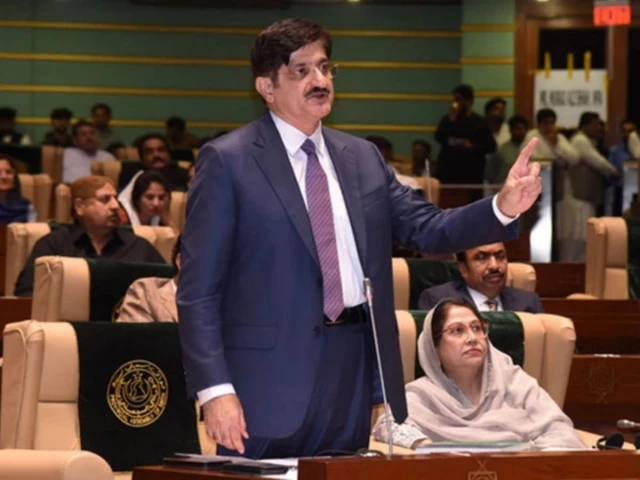
Murad Ali Shah says damaged structure will be demolished and rebuilt in two years
KARACHI:
Sindh Chief Minister Murad Ali Shah on Friday said traders affected by the deadly Gul Plaza fire would be provided with temporary shops within two months, while the damaged commercial structure would be demolished and rebuilt within two years.
“The plaza will have to be demolished, but we will rebuild Gul Plaza within two years, rebuild the shops and return them to the traders,” Shah said, highlighting that the number of shops would not increase and that the reconstruction would follow the plans approved by the Karachi Building Control Authority (KBCA).
Addressing the Sindh Assembly, the chief minister said arrangements for temporary shops would be finalized within two months to enable traders to resume their businesses. He added that the Sindh government had identified two commercial buildings with a total of 850 shops, whose owners had agreed to waive rent for one year, and efforts were being made to extend the rent-free period to two years.
The fire, which started Saturday night, destroyed the multi-story plaza and caused extensive structural damage. Human remains continued to be recovered from the rubble during debris removal and were shifted to Karachi Civil Hospital for medico-legal procedures. Rescue officials said the final sweep of the building was expected to be completed today.
The CM said the Sindh government would provide immediate financial assistance of Rs 500,000 per shop to the affected traders as part of the first phase of compensation. These funds, he said, would be distributed through the Karachi Chamber of Commerce and Industry.
Additionally, each affected trader would be offered an interest-free loan of Rs 10 million through the Sindh Business Development Fund, with the provincial government acting as guarantor and bearing the margin. He also assured security and support to those affected by the tragedy.
Shah said compensation of Rs 10 million had already been approved and released to each family of the deceased victim. He directed Karachi Commissioner Syed Hassan Naqvi to ensure prompt disbursement after identification of the families.
Providing an update on recovery operations, he said 67 bodies had been recovered so far, while 15 people were still missing. However, Amir Hassan, in charge of the identification desk at the Citizens-Police Liaison Committee, said four additional bags containing human remains were brought to the hospital overnight, bringing the death toll to 71.
Shah said 88 people were initially reported missing, but after removing duplications and errors, the verified figure was 82. DNA testing of 15 victims had been completed, while identification of another 52 was underway.
Read more: Gul Plaza fire causes losses of 100 billion rupees and 1,000 shops destroyed
Detailing the chronology of the incident, the prime minister said the fire started at 10:14 p.m. last Saturday on the ground floor of the square. The Firefighters received the first emergency call at 10:26 p.m., while the 1122 Rescue Corps was alerted at 10:36 p.m.
He said that a government representative, Deputy Commissioner South, arrived at the scene 16 minutes after the fire. Shah also criticized unnecessary visits by certain VIPs during rescue operations, saying such appearances for television coverage caused congestion and hampered emergency response efforts.
The CM announced that FIRs would be registered and a full investigation would be carried out into the causes of the fire and any institutional negligence. “Whoever is responsible will be punished. If government institutions were negligent, they will also be held accountable,” he said.
Construction approval history
Addressing the regulatory background of Gul Plaza, Shah said the building was approved in 1979 for a basement, a ground floor and two additional floors. The lease, he added, was extended in 1991 under the Karachi Metropolitan Corporation during the tenure of then mayors Naimatullah Khan and Farooq Sattar.
He said construction irregularities were regularized in 2003, long before the 18th Constitutional Amendment, rejecting claims that devolution was responsible for the tragedy. While the plaza had civilian exits on paper, he said the number of exits was insufficient.
“In 2003, the 18th Amendment was not in force and the Pakistan People’s Party was not in power. At that time an ordinance came which said that all buildings with irregularities should be regularized,” he said, adding that “on paper, the square had civil exits, but there were very few exits.”
Criticizing attempts to politicize the tragedy, he said: “Using such a tragedy for political purposes is tantamount to committing a serious crime. Criticize the government, but do not politicize it,” he said.
Additionally, Shah shared that structural and fire safety audits in Karachi had already begun, with over 300 buildings inspected so far. Buildings that do not meet safety standards will be given a short compliance period, after which non-compliant structures will be sealed, he added.
He also announced plans to bring all emergency response agencies under a unified command and said the Sindh government would push for mandatory legislation on construction insurance, adding that he had raised the issue with the federal minister for commerce.
Sindh CM approves Rs 21.53 billion package for Karachi infrastructure
Separately, Shah on Friday approved a package of Rs 21,530 crore for rehabilitation and improvement of Karachi’s infrastructure, including Rs 13,000 crore for Municipal Corporations (TMC) and Rs 8,530 crore for Karachi Metropolitan Corporation (KMC) projects covering roads, water, sewage, drains and street lights.
According to a press release from the Chief Minister’s Office, the initiative aims to alleviate traffic congestion, improve public safety and boost economic activity in the provincial capital.
The approval came during a meeting at the CM House attended by Local Government Minister Nasir Shah, Karachi Mayor Murtaza Wahab, Chief Secretary Asif Hyder Shah, Karachi Commissioner Hassan Naqvi, Finance Secretary Fayaz Jatoi, CM Secretary Raheem Shaikh and other relevant officials.
Sind CM@MuradAliShahPPPapproves 21,530 million rupees for #Karachi infrastructure improvement, including Rs 13,000 crore for 24 TMCs to repair 409 damaged roads and Rs 8,530 crore for KMC roads, water, sewage, drains and street lights. Funds will be released to improve mobility, security and economic activity pic.twitter.com/FMN6YTykWX
— Sindh Chief Minister House (@SindhCMHouse) January 23, 2026
Briefing the prime minister, Local Government Minister Nasir Shah said the 24 TMCs had requested financial assistance to repair severely dilapidated roads and streets, citing budgetary constraints that prevented them from carrying out the work independently.
Karachi Mayor Murtaza Wahab reported that 409 roads in seven districts of Karachi required attention, with 400 roads scheduled for partial repairs and nine requiring complete reconstruction. District-level estimates show that Malir has the highest number of roads (98), followed by west (81), central (53), south (50), east (49), Korangi (39) and Keamari (39).
Keamari accounted for the highest estimated cost at Rs 2.32 billion, followed by West at Rs 2.31 billion and East at Rs 1.85 billion. The major allocations include Rs 1,750 million for TMC Manghopir, Rs 960 million for TMC Gadap, Rs 944 million for TMC Baldia and Rs 858 million for TMC Mauripur.
Read more: Long-term investment megaprojects for the city: CM
Most of the TMC projects will focus on partial repairs, while selected roads in Gulberg, Gulshan, Jinnah, Sohrab Goth, Orangi, Manghopir, Saddar and Landhi will undergo complete end-to-end rehabilitation.
The total cost of the TMC mega plan stands at Rs 13,320 crore, which includes Rs 10,930 crore for road rehabilitation (Rs 10,680 crore for patching and Rs 248 crore for complete reconstruction), Rs 1,640 crore for sewerage and water supply works, Rs 628 crore for Sindh Board of Revenue charges and Rs 125 crore for contingency expenditure, according to the official statement.
The CM recalled his directives from a meeting on January 7, in which the KMC was tasked with rehabilitating 26 major roads. Mayor Wahab presented KMC’s assessment, estimating Rs 5.53 billion for road reconstruction and resurfacing.
The additional allocations include Rs 1 billion for urgent water and sewage repairs to be carried out by Karachi Water and Sewerage Corporation, Rs 1 billion for construction and reinforcement of storm drain retaining wall, and Rs 1 billion for installation and improvement of street lighting. The total estimated cost of the works led by KMC amounts to Rs 8,530 crore, the statement added.
Also read: Sindh presents Rs 1 trillion development budget for 2025-26
He stressed that prompt rehabilitation of Karachi’s road network was essential for economic growth and public convenience. He directed all departments to expedite approvals and ensure “high-quality and transparent execution of all projects.”
In addition, he ordered the authorities to coordinate the execution of road, sewage and water supply works to avoid repeated excavations and inconvenience to residents. Transparency, quality control and timely completion would be strictly monitored.
This package follows a similar initiative in November 2025, when Shah approved a special package of Rs 25 billion for Karachi to repair infrastructure damaged by heavy rains.


