
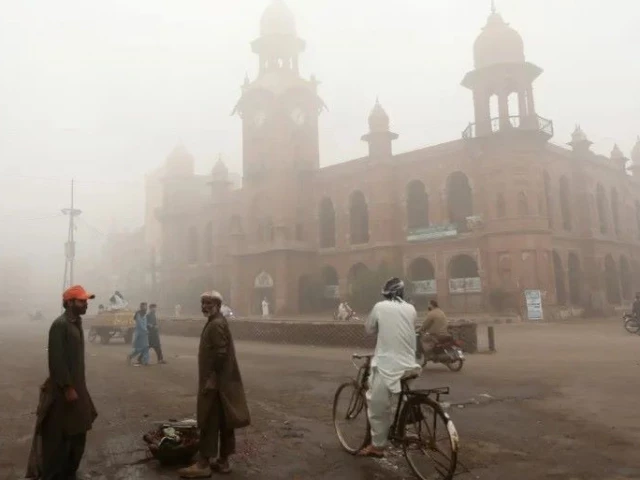
The province records an average AQI of 200 during the morning to afternoon monitoring period
A view of smog in Punjab province. PHOTO FILE: AFP
LAHORE:
A thick blanket of smog continued to choke most parts of Punjab on Saturday, raising air quality to alarmingly dangerous levels in several districts, compounding public health concerns, as dense fog and cold weather persisted across the region.
According to data released by the Punjab Environmental Protection Agency (EPA), the province recorded an average air quality index (AQI) of 200 during the morning to afternoon monitoring period, placing it firmly in the ‘unhealthy’ group.
Several districts fared worse. Muzaffargarh topped the list with an AQI of 291, followed by Rahim Yar Khan with 279 and Lahore with 274, all classified as “very unhealthy”.
Other major urban centers also reported elevated pollution levels. Gujrat recorded an AQI of 214, while Khanewal stood at 204. Cities like Narowal, Faisalabad, Dera Ghazi Khan, Multan and Bahawalpur remained in the upper range of ‘unhealthy’.
Within Lahore, air quality readings varied markedly by location, but overall remained alarming, with some monitoring stations showing extreme pollution. The City Council reported an AQI of 442, UET Lahore 43 and Egerton Road 402 all included in the “hazardous” category. Other hotspots included the Lahore Waste Management Company area at 357 and the Safari Park at 342.
Some areas, considered relatively less contaminated, offered little relief. Shahdara, Kahna Nau Hospital and Punjab University campuses continued to report AQI readings well above safe limits, while peripheral locations such as Wagah and Bedian also remained in the “unhealthy” zone. Environmental experts warn that prolonged exposure to these levels can aggravate respiratory and heart conditions, particularly among children, the elderly, and people with pre-existing conditions.
According to the Pakistan Meteorological Department (PMD), there is a shallow westerly wave over the northwestern parts of the country, but it is not strong enough to significantly disperse pollutants across the plains.
The PMD forecast partly cloudy weather with chances of light rain and snowfall at isolated places in upper Khyber-Pakhtunkhwa and Gilgit-Baltistan on Saturday. Elsewhere, including Punjab, cold and dry conditions are expected to prevail. Moderate to dense fog is likely to persist over Punjab, upper Sindh and plains of KP during morning and evening hours.
A similar forecast was issued for Sunday, with partly cloudy conditions and isolated rain or snowfall in northern regions, while fog is expected to persist in the plains. Forecasters warn that continued fog and stagnant air could trap even more pollutants near the surface, prolonging the smog episode.
Over the past 24 hours, cold and dry weather dominated most parts of the country, with very cold and partly cloudy conditions in mountainous areas. Light rain and snowfall were recorded at isolated places in upper KP and GB including Kalam, Astore and Skardu. Traces of snowfall were also recorded in Gupis.
Minimum temperatures fell sharply in northern regions with Leh recording negative eight degrees Celsius, Gupis negative seven, Bagrote negative six and Parachinar negative four. Skardu, Gilgit and Astore recorded minimums of negative three degrees Celsius.
Health professionals are urging residents, particularly in smog-affected urban centers, to limit outdoor activity, wear protective masks and keep windows closed during peak pollution hours. Meanwhile, environmental officials have reiterated calls for stricter enforcement on smoke-emitting vehicles, industrial emissions and the burning of crop residue, warning that without sustained intervention, air quality is unlikely to improve in the coming days.
For now, with weak weather systems and lingering fog, Punjab appears destined to remain under a thick cloud of smog, leaving millions of people breathing air that experts say is increasingly unsafe.


