
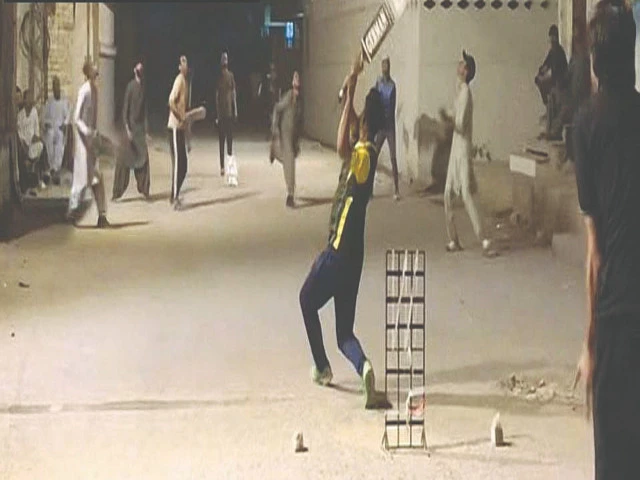
Young people play cricket on a Ramadan night using stolen electricity without considering the ethical or religious implications. Photo: Express
HYDERABAD:
Power theft to host night cricket matches on major highways and busy intersections in Hyderabad has peaked during Ramadan, while the Hyderabad Electric Supply Company (HESCO) has failed to curb this illegal practice.
On the one hand, HESCO has not been able to reduce the duration of load cuts during the holy month, with both scheduled and unscheduled power cuts being prolonged throughout the day, in addition to electricity suspensions under the pretext of breakdowns. On the other hand, the company appears ineffective in preventing open power theft throughout the city.
All over Hyderabad, including Latifabad and Qasimabad, night cricket matches are being played up to Sehri under high-voltage floodlights illegally connected to main power poles. Residents, civic groups and the media report this type of power theft every year during Ramadan.
Although HESCO occasionally carries out token operations (confiscating cables and light bulbs in some places), the practice soon resumes.
Residents fear that the burden of this electricity theft will ultimately fall on law-abiding consumers and they will receive inflated bills with additional charges in the form of line losses. According to consumers, subdivision officials often issue discovery bills to selected users who are not part of any “agreement,” forcing them to make repeated visits to HESCO offices for corrections, despite their modest electricity consumption.
Even though some feeders have been declared “load shedding free”, reports indicate that even these feeders experience power outages, especially in the morning hours.
Apart from electricity theft, night cricket matches also disrupt traffic flow on major roads and intersections. Residents complain of large gatherings of young people and spectators, with loud applause and comments continuing late into the night, causing unrest in the neighborhoods.
Citizens have criticized both HESCO and the district authorities for not taking effective measures. While HESCO frequently issues press releases about ongoing operations against power thieves – sometimes in collaboration with Rangers and the FIA – no significant action has been taken against the dozens of openly organized night cricket events fueled through illegal connections.
Meanwhile, some of the young players claim that not all matches rely on stolen electricity, although they admit that such incidents can occur in certain places. They argue that Ramadan naturally sees an increase in nighttime activity, as many people stay up late and sleep after Sehri and Fajr prayers.
The youth further maintain that the lack of proper sports fields in Hyderabad, Latifabad and Qasimabad forces them to play on streets and main roads. The existing land, they claim, is unusable or lacks adequate facilities. They added that currently not a single field in the city is equipped for night cricket. According to them, if the district administration or the municipal corporation installed projectors at the designated places during Ramadan, the problem could be solved.


