
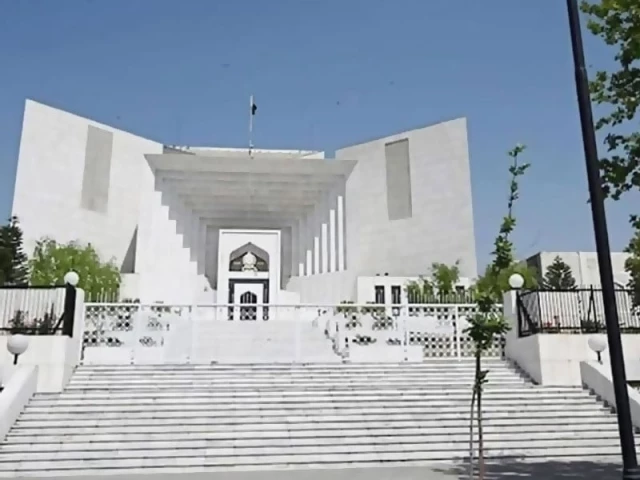
Expresses dismay that two of the decisions of the KP Service Court are based on summonses that do not exist
Supreme Court orders reinstatement of 36 teachers, citing court’s use of ‘mind-blowing’ AI
The Supreme Court has ordered the immediate reinstatement of 36 secondary school teachers in Khyber-Pakhtunkhwa, while expressing concern that the provincial Service Court may have resorted to “mind-blowing” AI to produce fake legal summons.
The ruling, delivered by a bench comprising Chief Justice of Pakistan Yahya Afridi, Justice Muhammad Shafi Siddiqui and Justice Miangul Hassan Aurangzeb, set aside a consolidated judgment dated July 14, 2025 of the Khyber-Pakhtunkhwa Service Court (KP-ST), which had upheld the dismissal of the teachers.
The Directorate of Primary and Secondary Education (DESE) KP had repeatedly attempted to terminate the services of the 36 petitioners (most of whom were appointed or regularized around 2012 and 2013), alleging that their original appointment orders were fake.
Procedural failures and lack of evidence
The Supreme Court (SC) determined that the DESE had violated essential requirements of due process. The teachers had been reinstated during the early stages of the protracted litigation, confirming their status as public officials. Therefore, any sanction for misconduct, such as dismissal based on alleged fraud, required strict compliance with the KP Government Servants (Efficiency and Discipline) Rules, 2011 (KPEDR, 2011).
The court determined that the investigation conducted by management was merely a “fact-finding investigation” and was insufficient to serve as a substitute for a formal departmental investigation ordered by the 2011 KPEDR.
Crucially, the SC highlighted that the internal investigation report, on which the management based its dismissal, did not actually conclude that the petitioners’ appointments were illegal or that the teachers themselves had committed fraud. In fact, the report expressed strong disapproval of DESE’s conduct, noting that allegations of false recommendations by the Public Service Commission (KP-PSC) were “non-specific” and did not show “any lapse or commission of fraud on the part of the appellants.”
Despite this, the KP-ST confirmed the dismissal, resulting in the teachers’ services being terminated.
“Amazing” AI
The SC noted with “dismay” that the KP-ST, in coming to the conclusion that the appointments were void from the beginning, relied on several non-existent legal summons.
The ruling indicated that searches carried out both by citation and by case title confirmed that the cases referred to by the Court were invented. The SC suggested that the KP-ST may have relied on artificial intelligence, which may have “hallucinated” in generating the subpoenas, and reiterated a previously expressed warning about the use of AI in judicial decision-making.
The Court ordered that the petitioners be reinstated in service. While allowing DESE to conduct a new investigation, it ordered that such action be carried out strictly in accordance with the 2011 KPEDR.


