
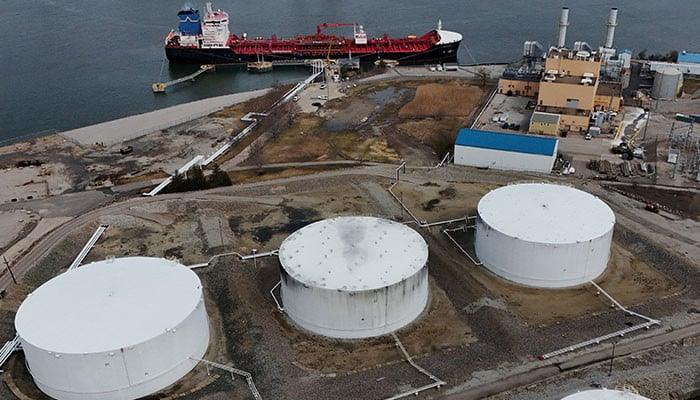
- Qatar rebukes both Israel and Iran, expels Iranian diplomats.
- South Pars is the shared gas field, the largest in the world, between Iran and Qatar.
- More than 3,000 dead in Iran, hundreds of them across the Gulf region so far.
DOHA/JERUSALEM/DUBAI: Iran accused Israel of attacking its facilities at the massive South Pars gas field on Wednesday, in a major escalation in the US-Israel war that has sent oil prices soaring, and retaliated by pledging attacks on oil and gas targets across the Gulf, firing missiles at Qatar and Saudi Arabia.
Qatar’s state oil giant QatarEnergy reported “extensive damage” after the industrial city of Ras Laffan, a hub of the energy industry, was hit by Iranian missiles. Saudi Arabia said it had intercepted and destroyed four ballistic missiles launched toward Riyadh on Wednesday and an attempted drone attack on a gas facility in the country’s east.
South Pars is the Iranian sector of the world’s largest natural gas deposit, which Iran shares with Qatar, a close US ally, across the Gulf. Qatar’s Foreign Ministry rebuked Israel for a “dangerous and irresponsible” attack on Iranian facilities in South Pars, and denounced Iran for what it called “a flagrant violation” of international law, expelling two senior Iranian diplomats.
The escalation comes on top of an unprecedented disruption to global energy supplies that has raised political risks for US President Donald Trump, who joined Israel in attacking Iran nearly four weeks ago. US diesel prices have already surpassed $5 a gallon for the first time since the 2022 inflation surge that eroded support for his predecessor, Joe Biden.
The conflict quickly spread to neighboring countries and has already halted shipping from the world’s most important energy-producing region, and could now cause lasting damage to its infrastructure. Benchmark Brent crude prices rose around 5% to exceed $108. Stock markets turned lower.
In Washington, U.S. spy chief Tulsi Gabbard told Congress that Iran’s government has been downgraded since the war began on Feb. 28, but appears to be intact, with Iran and its proxies still able to attack U.S. military bases and other interests it has in the Middle East.
Producer prices in the United States rose in February to their highest level in seven months, driven by higher costs for services and a variety of goods, and could accelerate further as the war boosts oil prices.
Israel has not publicly claimed responsibility for the attack on South Paris. According to the Wall Street Journal, which cited unnamed US officials, Trump knew about Israel’s plan to attack the gas field in advance and supported it.
Iran’s Fars news agency reported that gas tanks and parts of a refinery had been hit. He said workers had been evacuated and state media later said the fire was under control.
Iran listed several prominent regional oil and gas facilities it called “direct and legitimate targets,” all in nearby states that host U.S. military bases: Saudi Arabia’s Samref refinery and Jubail petrochemical complex, the United Arab Emirates’ Al Hosn gas field and Qatar’s Mesaieed petrochemical complex, Mesaieed Holding Company and Ras Laffan.
He said they should be evacuated immediately before their missiles fell.
The United States and Israel had previously refrained from attacking Iran’s energy production facilities in the Gulf, avoiding Iranian retaliation against its neighbors’ oil and gas industries. International law prohibits states from attacking civilian energy infrastructure.
French President Emmanuel Macron said he spoke with the emir of Qatar and Trump on Thursday and called for a “moratorium on attacks on civilian infrastructure,” especially water and energy facilities.
Iran has already effectively closed the Strait of Hormuz, through which 20% of the world’s oil and liquefied natural gas supply passes, but consuming nations hope the disruption will be short-lived while production infrastructure is saved.
European Union foreign policy chief Kaja Kallas spoke by phone Wednesday with Iranian Foreign Minister Abbas Araqchi and said safe passage through the Strait was a priority for Europe and that the EU supports a diplomatic solution to the war.
Everyone is in the spotlight
The Israeli army also attacked central Beirut, destroying apartment buildings in some of the most intense airstrikes against the Lebanese capital in decades.
Israel killed Iran’s intelligence minister Esmail Khatib on Wednesday, a day after killing powerful security chief Ali Larijani. Israeli Defense Minister Israel Katz said that “no one in Iran has immunity and everyone is being targeted.”
He and Prime Minister Benjamin Netanyahu had authorized the Israeli military to “target any senior Iranian official for whom an operational and intelligence opportunity arises, without the need for additional approval.”
In Tehran, thousands of people took to the streets to attend the funeral of Larijani and other slain figures.
Iran has responded by firing cluster missiles at Israel, which are more difficult to intercept cleanly. Shortly after midnight on Thursday, Israel’s ambulance service said a foreign national had died in Adanim, central Israel, after an Iranian missile attack, raising the death toll in Israel to at least 15 people. Wednesday also saw the first deadly attack in the Israeli-occupied West Bank: three Palestinian women were killed after an Iranian missile attack, the Palestinian Red Crescent said.
Death toll increases throughout the region
In the Bachoura district of central Beirut, Israel warned residents early on Wednesday to leave a building it said was used by Hezbollah, which it later completely demolished.
Abu Khalil, who lives in the area, said he had helped people flee nearby houses following the Israeli warning. “It’s just an operation to hurt, to terrorize people, to terrorize children,” he told Reuters.
The US-based Iranian human rights group HRANA said on Monday that more than 3,000 people are estimated to have been killed in Iran since US-Israeli attacks began on February 28. Authorities in Lebanon say 900 people have been killed there and 800,000 have been forced to flee their homes.
Iranian attacks have killed people in Iraq and throughout the Gulf states. So far, at least 13 US military service members have died.


