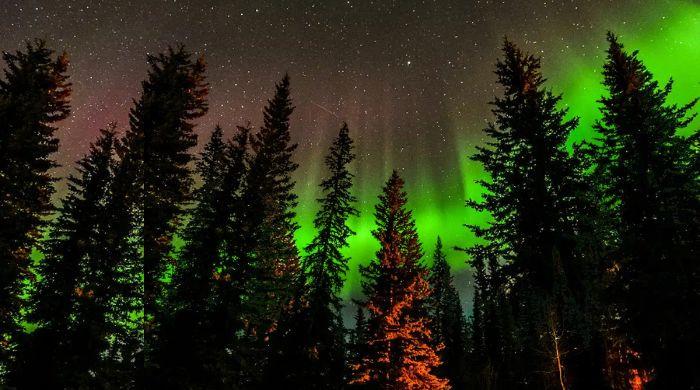
Get ready, stargazers!
The Northern Lights could be visible in US states on Friday, March 6, after the National Oceanic and Atmospheric Administration issued a geomagnetic storm warning.
NOAA has warned that minor G1 class geomagnetic storms are likely.
Geomagnetic effects could include the possibility of auroras being seen in the night sky further south than usual.
The northern lights are caused by geomagnetic storms, when solar particles collide with Earth’s atmospheric gases, producing dazzling light shows in the sky.
This week’s potential display is caused by a fast-moving gust of solar wind flowing from a coronal hole on the sun’s surface.
When this stream of charged particles reached Earth, it generated our planet’s magnetic field, causing the swirling veils of light we commonly know as the aurora.
What is the best time to see the auroras?
The northern lights could be seen on Friday, March 6, after NOAA’s Space Weather Prediction Center issued a class G-1 geomagnetic storm warning.
The forecast hinted at minor geomagnetic disturbances that may push the auroras further south than normal.
However, due to the solar wind traveling at different speeds, it is difficult to forecast a precise time, but experts suggest monitoring real-time aurora forecasts during the afternoon and evening.
Where to see the northern lights tonight?
If geomagnetic activity reaches expected levels, auroras could be visible in northern US states near the Canadian border, including Alaska, the northern regions of Washington, Montana, Idaho, North Dakota, South Dakota, Wisconsin, Minnesota, Michigan and Maine.
If activity peaks, viewing opportunities could extend further south and auroras will become visible in northern areas of Nebraska, Oregon, Iowa, Illinois, New York, Ohio, Vermont and New Hampshire.