
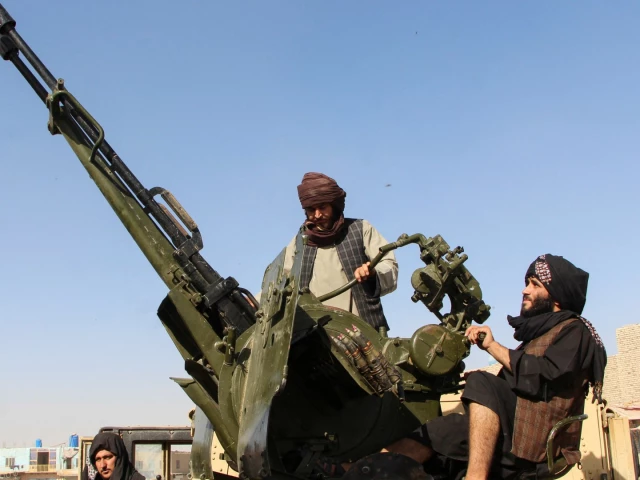
Official says operation will be taken to its logical end; rules out regional overflow
ISLAMABAD:
Pakistan will not hesitate to target top leaders of the Afghan Taliban, including reclusive supreme leader Hibatullah Akhundzada, if credible intelligence becomes available, a senior security source revealed on Monday, as Islamabad presses ahead with an expanded cross-border military campaign.
In a briefing, a security source did not rule out the possibility of eliminating Taliban leaders while responding to a question on whether Pakistan’s ongoing operations would also extend to the Taliban’s political and military leadership.
“If there is actionable intelligence, no target will be ruled out,” the source said. “This includes senior leaders.”
Pakistan is currently carrying out what officials describe as a relentless and calibrated campaign, both through ground offensives and precision airstrikes, aimed at degrading the infrastructure that facilitates cross-border terrorist attacks.
The focus of the operation remains Taliban military bases, ammunition depots and other facilities that support the outlawed Tehrik-e-Taliban Pakistan (TTP) and other anti-Pakistan groups.
The senior official said the military was not operating under artificial deadlines. “Pakistan is in no hurry. This operation will reach its logical end,” the source stressed, indicating a long-term strategy rather than a brief and symbolic response.
According to the source, the campaign will continue until Kabul makes a “clear and irreversible choice” between the TTP and Pakistan. “The Afghan Taliban cannot travel on two ships,” the source commented, calling the Kabul regime a “master proxy” that has allowed anti-Pakistan militants to regroup.
“If they are sincere, they should hand over Noor Wali Mehsud and other Pakistani terrorists sheltering there,” he said, adding that lack of cooperation would invite sustained and intensified attacks. “If you don’t cooperate, we will continue to hit you hard.”
The source said Pakistan’s operations have already significantly undermined the Taliban’s operational capacity. Without revealing details, he suggested that the actual number of casualties inflicted during the recent attacks was “far greater” than publicly acknowledged.
“The impact is substantial. Their infrastructure has degraded to such an extent that they are feeling the strain,” he said, hinting at deeper operational successes than those reflected in official statements.
The comments come amid rising regional tensions and speculation about broader geopolitical effects, particularly in light of the crisis involving Iran. Dismissing concerns that Pakistan could be the next target after Iran, the source said such fears were misplaced. “Unnecessary fear is being created that after Iran, Pakistan will be next. Pakistan is not Iran. Pakistan is Pakistan,” he stressed.
He explained that Islamabad’s foreign policy stance fundamentally differed from that of Tehran. “Unlike Iran, Pakistan has maintained a balanced foreign policy. We have good relations with all major powers. Our foreign policy is not driven by emotions but by a well-calculated strategy. We are not a pariah state. Our worldview is different.”
The source dismissed speculation that the emergence of a hostile government in Iran could create complications for Pakistan.
Drawing a comparison with Pakistan’s long-standing rivalry with India, he said Islamabad was used to navigating adverse relations. “We have been dealing with India for decades. So we should not worry about hypothetical scenarios,” he said.
However, the official acknowledged that the current environment was testing and required unity at home. “In these difficult times, what Pakistan needs most is internal cohesion,” the source stressed.


