
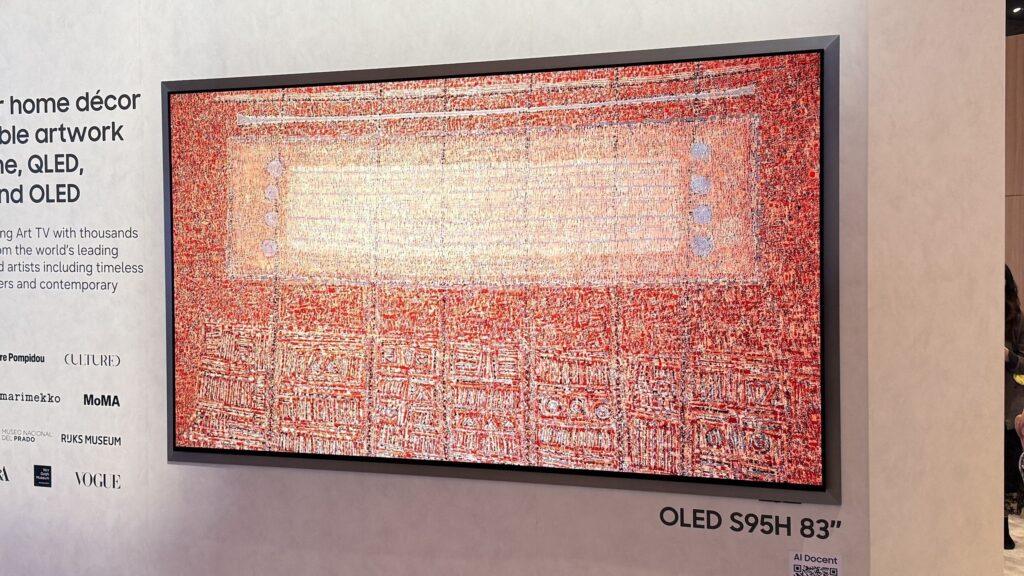
- QD-EL/NanoLED TVs promise exceptional brightness and color
- Uses self-emissive quantum dots, like OLED, but better
- Quantum dot maker Nanosys says technology could be ready in 2029
It is always wise to take technological predictions with a pinch of salt. But when the predictions concern television technology and come from the company that invented quantum dots, we’re all ears. Nanosys has outlined multiple advancements coming to TVs in the coming years, and some of them are quite interesting.
The firm spoke to Insight Media in the video below and explained that the first big development we’ll see is the introduction of brighter QD-OLED TVs this year. This is due (at least in part) to a new version of Quantum Dot Color Converters (QDCC) that allows the panels to offer that greater brightness. We’ve probably already seen the first TV with that improved technology in the form of Samsung’s S95H (pictured at the top of this article), which we got our first information about at CES, which promises to be 35% brighter than the Samsung S95F it replaces.
Those brighter TVs may be just the beginning. According to Jeff Yurek of Nanosys, “By 2030, we want to ship what we consider truly ‘high flux.’ Now we’re talking not just QD-OLED but perhaps microLED for something like an AR application, which would require hundreds of thousands or maybe millions or more nits.”
So that’s less TV and more “a headset so bright it can imitate the look of the sun,” if you’re into that sort of thing.
But Nanosys also mentioned a long-awaited technology that could potentially overtake OLED as the best technology for high-end TVs: QD-EL, also known as NanoLED.
Look
QD-EL NanoLED televisions will arrive at the end of the decade
We’ve already written about QD-EL, also known as QD-LED, EL-QD, EL-QLED and NanoLED: Samsung was investing significantly in the technology last year with the aim of commercializing it “within a few years.” And according to Nanosys’ Yurek, “We think 2029 is a reasonable target for when we start seeing them on the market.”
EL in QD-EL stands for electroluminescent and like OLED, it is a self-emissive technology, meaning each pixel would generate its own light. That means there’s no need for a backlight, as there is with current QLED TVs, and it promises to be very bright and very energy efficient.
As we reported last year, QD-EL prototypes shown at trade shows have been relatively small (less than 20 inches) and reports suggest there are still hurdles to overcome regarding QD-EL’s stability and power efficiency.
QD-EL isn’t the only technology on the way that promises to steal current OLED technology’s crown among the best TVs.
An expert at CES 2026 told us that inkjet-printed OLEDs could begin being used in TV-sized panels within 2 to 3 years, following recent advances in the technology from TCL.
Sonny Ming, general manager of product marketing and stage product operation department at Hisense, also told my colleague Matt Bolton at CES that microLED TVs could finally be ready in mainstream sizes and more realistic sizes within 5 to 8 years.
Assuming these aren’t Elon-Musk flying roadster-type predictions, that means that before the end of the decade we could have multiple new types of TV technology, in addition to the new RGB TV technology arriving in 2026, which will offer exceptionally bright, energy-efficient and immersive displays.
The best televisions for all budgets
Follow TechRadar on Google News and add us as a preferred source to receive news, reviews and opinions from our experts in your feeds. Be sure to click the Follow button!
And of course you can also follow TechRadar on TikTok for news, reviews, unboxings in video form and receive regular updates from us on WhatsApp also.


