Since its inception, the American presidency has linked immense destructive capacity to the temperament of a single individual. It is a position that fuses authority with drive by placing a military giant in the hands of one individual.
Alice Roosevelt distilled this dynamic with biting precision. He joked that his father (President Roosevelt) wanted “to be the corpse at every funeral, the bride at every wedding, and the baby at every baptism.” Beneath the wit lies the accusation of an unleashed ego.
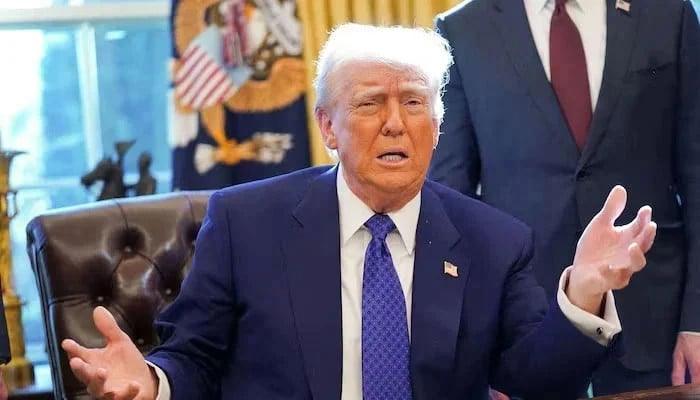
Today, that current of vanity has been eclipsed by Donald Trump. The ego is no longer a trait; It is doctrine. It has turned the art of government into a spectacle, where personal whims are disguised as reality and contradiction is insubordination. What emerges is not only volatility but a corrosive force that destabilizes the very architecture of the international order.
This pathology is not limited to a single geography. In South Asia, Narendra Modi’s initiation of the failed Operation Sindhoor reflected the same instinct that conjured crises to manifest power. Among nuclear rivals, such theater is reckless. They place millions within the blast radius of a narcissist’s need to appear impregnable.
Going further, clinical knowledge offers clarity. Mary Trump is a psychologist and the niece of Donald Trump. She describes a “monstrous ego” that has reduced the Oval Office to an arena of drive and domination. She describes the cabinet not as a collection of peers but as a congregation of “weaker, more cowardly and just as desperate” enablers. Loyalty is measured by the willingness to echo.
Governance, inevitably, becomes a spectacle. Their logic is laid bare in self-inscribed displays of power, such as Trump’s commemorative gold coins and his signatures adorning future banknotes. Contagious, it results in loyalists selecting the same iconography. Kash Patel’s personalized sneakers with his and the FBI’s initials and Pete Hegseth’s eye-catching tattoos; Governance is transformed into an orbit of narcissism.
The most dangerous manifestation of this dogma is what psychologists call narcissistic injury. It is when reality refuses to submit. In ordinary individuals, the damage is contained. In a president, it detonates outward. Slights are magnified and setbacks are personalized. Decision making degrades to a reflex. Actions are calibrated to preserve the ego and become increasingly indifferent to consequences.
The purge within the Pentagon is the clearest expression of this pathology: a punitive action to cauterize wounded pride. At such moments, governance ceases to be an instrument of statecraft and becomes an apparatus of psychological self-preservation. Senior leaders are not dismissed for failing but for resisting one.
Downed planes, missing crew members, and an adversary unwilling to settle vindicate professional reluctance. The prospect of capturing staff threatens to turn a setback into a spectacle. At a time like this, containment becomes impossible.
Escalation is no longer a choice but a compulsion, a violent need to overcome failure with force. What follows is not a strategy but an increasingly dangerous raising of the stakes to save pride. This is the true logic of an egocracy.
Under such conditions, truth inevitably becomes malleable. It is distorted, diluted or discarded outright. The pattern is not new. The WMD claims that started the 2003 invasion of Iraq were completely made up. The tragic reality that saw more than a million people die was a clear testimony of what happens when deception is used as a weapon in the service of self-justification.
This paradigm is again clearly visible in the narratives that allowed the Gaza genocide and the attacks against Iran. Selected intelligence reports and ever-changing justifications make a mockery of established facts. Reality is no longer a limitation; It is an inconvenience that must be managed.
In ‘The Second Coming’, Yeats captured the birth of disorder: “What rude beast, when at last its hour has come, creeps to Bethlehem to be born?” In his vision, the disintegration of order heralded not a new one but the emergence of something unbridled and primal. The destruction caused by narcissism is much more insidious. It does not arise from chaos; designs it. Conflict and disorder become an affirmation of the self.
History offers a harsher mirror. The Roman emperor Caligula ruled by spectacle and fear. He was known for his cruelty in prolonging the suffering of his victims. Throughout his ordeal, he had on his lips these words from the Roman tragic Lucius Accius – oderint dum metuant – let them hate me, as long as they fear me. It captures the essence of power stripped of legitimacy and sustained only through fear.
In the modern era, that mentality carries unprecedented risks. Merging personal volatility with nuclear capability makes miscalculation existential. John Kennedy warned of such a world imposed by the American war machine. He called it “peace of the grave or security of the slave”: subjugation or annihilation.
This is the calamitous binary we see invoked from Gaza to Iran. The world remains fascinated with Iran. Gaza, with its continued suffering, has become a marginalized tragedy. In one case, resistance draws attention; in the other, the resistance is lost from sight.
The chilling distillation is that prudence has been subsumed by an unlimited ego. He simply cannot retreat, give way, and, most dangerously, cannot stop. This is the maximum manifestation of the Empire of the Ego.
The writer explores the forces that shape power, beliefs, and society. He can be contacted at: [email protected]
Disclaimer: The views expressed in this article are those of the writer and do not necessarily reflect the editorial policy of PakGazette.tv.
Originally published in The News