
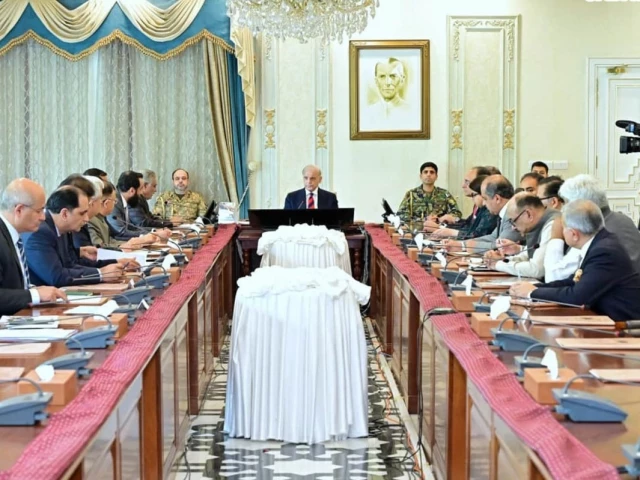
Prime Minister Shehbaz Sharif on Tuesday chairs a meeting to review the implementation of the austerity measures announced by the government in light of the current regional situation. Photo: PID
Prime Minister Shehbaz Sharif on Tuesday approved declaring Friday as an additional weekly holiday as part of the government’s austerity and energy conservation measures, while directing all ministries and federal divisions to strictly implement the policy.
Chairing a review meeting at the Prime Minister House, the prime minister said the government was making all-out efforts to keep the national economy stable despite the prevailing global and regional challenges.
He informed the meeting that a special committee headed by Deputy Prime Minister and Foreign Minister Ishaq Dar had been constituted to review the implementation of austerity and energy conservation measures on a daily basis and submit reports.
The prime minister also ordered that austerity measures adopted by government departments be subject to a third-party audit to assess their impact and ensure transparency and effectiveness.
He instructed ministries and institutions to send photographs to the Cabinet Division of vehicles taken out of service under the austerity policy, while each ministry was also ordered to submit reports to the Prime Minister’s Office on measures taken to improve work-from-home arrangements.
The meeting was informed that all federal ministries and divisions will submit daily and weekly reports to the special committee on the implementation of energy saving measures and workforce management.
In a separate meeting to review the affairs of the Federal Board of Revenue (FBR), the prime minister directed authorities to bring most productive sectors under automated monitoring systems to improve tax collection and curb tax evasion.
He highlighted the need to strengthen enforcement mechanisms and thanked the economic team for adding experts to the executive team of Pakistan Revenue Automation Limited (PRAL) for merit in transforming the organization into a more efficient institution.
Officials informed the meeting that technology-based monitoring systems had already been implemented in sectors such as sugar, cement, cigarettes and fertilizers, contributing to higher tax collection.
Similar schemes are being introduced in the textile, leather, paper, automobile and beverage sectors, which are expected to generate billions of rupees in additional tax revenue.


