
Despite the notification, the court continues to function from IHC; FCC to take up supertax case tomorrow
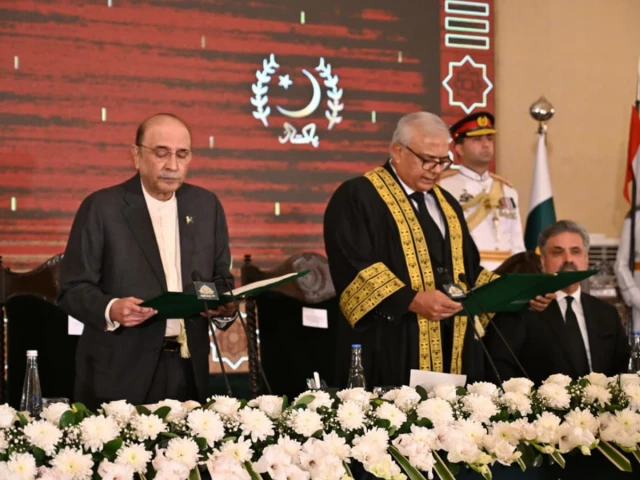
President Asif Ali Zardari swears in Justice Aminuddin Khan as the President of the Federal Constitutional Court during a ceremony at Aiwan-i-Sadr on Friday. Photo: APP
ISLAMABAD:
The Federal Constitutional Court (FCC), formed under the 27th Constitutional Amendment, commenced the proceedings on November 18 from its temporary premises – the Islamabad High Court (IHC).
However, despite the passage of more than 40 days, the court has not been moved to new facilities.
A December 11 notification stated that the FCC would be based at the Federal Shariat Court (FSC) building, while the FSC would operate from the IHC.
The FSC has moved to the IHC, but the FCC has not yet started its work at the notified location.
It is known that renovation work is currently underway at the FSC building. It will take at least one more week for the FCC to begin its work on the new facility.
The FCC will also continue its work on the IHC next week.
The source said the FCC faces several logistical problems, including a serious staffing shortage. The Supreme Court approved the transfer of only 20 officials for the operation of the FCC.
Even 40 judicial officers have been transferred to the FCC from the Punjab judiciary. Some retired officials of the Supreme Court have also been incorporated into the constitutional court.
Of 56,608 cases, 22,910 have been transferred to the FCC from the Supreme Court.
Some experts believe that in order to handle more than 22,000 cases transferred to the courts, a large number of officials should also have transferred to the FCC.
It has also been noted that the proportion of cases filed at the FCC is higher than that at the Supreme Court.
A senior government official said the FCC could have easily worked from the Supreme Court premises as three courtrooms could be reserved for the FCC in the SC building.
Currently, seven judges work at the FCC. Despite the huge number of pending cases, there is no indication that new judges will be appointed to the new court.
A senior government official said new judges will be appointed to the FCC soon after logistical problems are resolved.
FCC will take up the supertax case tomorrow
Meanwhile, a three-member FCC bench headed by Chief Justice Amin-ud-Din Khan will hear the supertax case on Monday.
Before the adoption of the 27th Constitutional Amendment, the Constitutional Chamber of the Supreme Court held almost 50 hearings in this case. The proceedings were nearing completion when the case was transferred to the FCC. Of the three judges, two FCC members were part of the SC court hearing the matter.
The controversy surrounding Sections 4B and 4C of the Income Tax Ordinance 2001 constitutes one of the most significant fiscal and constitutional disputes in the recent history of Pakistan.
It involves tax implications running into hundreds of billions of rupees and raises fundamental questions about the taxing power of Parliament, equality before the law and the scope of judicial review in tax matters.
Section 4B was introduced by the Finance Act, 2015, which imposes a “super tax” on high-income earners, particularly banking companies and other earners with incomes exceeding Rs 500 million.
Hafiz Ahsaan Ahmad Khokhar, lawyer for the Federal Board of Revenue (FBR), giving the background of the case, said the tax was initially justified as a temporary fiscal measure aimed at generating funds for the rehabilitation of temporarily displaced people.
Although introduced for a specific financial year, the supertax provided for in Section 4B was expanded by subsequent financial laws, leading to constitutional challenges before several high courts.
However, on multiple occasions, the Lahore High Court (LHC), Sindh High Court (SHC), IHC and Peshawar High Court (PHC) have consistently upheld the validity of Section 4B, affirming that double taxation is not per se unconstitutional.
They noted that Parliament enjoys wide freedom in tax legislation under Articles 73 and 77 of the Constitution.
Despite constant validation of Section 4B by all the high courts, the taxpayers finally took the matter to the Supreme Court for its final decision.
The challenge remained pending before the SC for several years, with provisional agreements allowing for conditional recovery.
While no nationally consolidated figure was officially disclosed for collections under Section 4B, audit and tax records indicated substantial exposure, and sample audit observations alone reflect non-collection of super taxes, illustrating the significant fiscal risks involved.
While the challenge to Section 4B was already pending before the SC, Parliament enacted Section 4C through the Finance Act, 2022, substantially expanding the scope and scale of the super tax regime.
Section 4C imposed an additional tax on individuals and companies that earned income over Rs 150 million, with progressively higher rates levied on designated sectors identified as having earned windfall profits.
For certain sectors – including banking, oil and gas, fertilizers, cement, sugar, iron and steel, LNG terminals, textiles, automobiles, beverages, chemicals, airlines and cigarettes – the super tax rate reached 10%, significantly increasing the effective tax burden on banks and large corporations.
The fiscal magnitude of Section 4C was unprecedented. The FBR officially projected that the tax would generate approximately Rs 250 billion in additional revenue for the 2022-23 fiscal year alone.
Budget documents and contemporaneous reports further indicated that the government expected between Rs 215 billion and Rs 247 billion specifically from the super tax regime, including an estimated Rs 180 billion from corporate entities and around Rs 87 billion from public sector and state-owned enterprises.


