
The information minister says forces destroyed 182 posts and airstrikes were carried out at 46 locations inside Afghanistan.
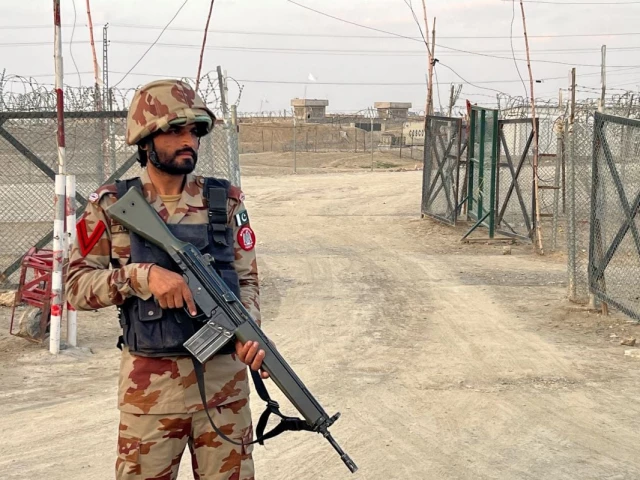
An army soldier stands guard at a deserted entry point at the Friendship Gate, following exchanges of fire between Pakistani and Afghan forces, at the border crossing between the two countries, in Chaman, Pakistan, on February 27, 2026. Photo taken with a mobile phone. REUTERS/Abdul Khaliq Achakzai
Security forces killed 415 Afghan Taliban in a major military operation launched in response to “unprovoked cross-border attacks” from Afghanistan, Information Minister Attaullah Tarar said on Sunday.
‘Operation Ghazab-Lil-Haq’ was launched on Thursday night following fresh clashes along the Pakistan-Afghanistan border.
The operation is ongoing and will continue until all objectives are achieved, sources confirmed. The Pakistani armed forces remain fully committed to defending national security and decisively responding to any unprovoked aggression, they added.
Operation Ghazb lil Haq
Update 1600 hours March 1✅ Summary of Afghan Taliban losses
▪️ 415 dead,
▪️580+ injured,
▪️182 Check destroyed posts,
▪️31 post captured,
▪️185 tanks, armored vehicles and art cannons destroyed
▪️46 Locs via Afg eff tgt by air– Attaullah Tarar (@TararAttaullah) March 1, 2026
In a statement published in X, Tarar said that as of 4pm on Sunday, at least 415 Afghan Taliban terrorists had been killed and more than 580 wounded.
He added that Pakistani forces had destroyed 182 Taliban posts, captured 31 others and disabled 185 tanks and armored personnel carriers. Airstrikes were carried out at 46 locations inside Afghanistan, the minister said.
The latest escalation follows a series of tit-for-tat actions over the past year.
Last week, Pakistan carried out airstrikes against Tehreek-e-Taliban Pakistan (TTP) camps and the Islamic State’s Khorasan province inside Afghanistan after a wave of attacks in Pakistan, including a suicide bombing in Islamabad. Pakistani security sources said more than 80 terrorists were killed in those attacks.
The federal government has been constantly raising its voice in international forums against terrorist sanctuaries operating in Afghanistan and using its soil to launch attacks against Pakistan, a fact witnessed by the United Nations Security Council.
Earlier this month, a suicide bomber attacked the Imambargah Khadijah al-Kubra during Friday prayers in Islamabad, killing 36 people and wounding about 169 others. The attack was the deadliest in Islamabad in more than a decade and the deadliest nationwide since the Peshawar mosque bombing in January 2023.
Immediately after the blast, raids were carried out in Nowshera and Peshawar, resulting in the arrest of four facilitators. The mastermind linked to Daesh, an Afghan national, was also captured. Interior Minister Mohsin Naqvi claimed that the network behind the blast was trained in Afghanistan and that authorities had gathered intelligence on the suspects before the attack.
Russia, China and Iran on Friday called for restraint and dialogue as the airstrike between Pakistan and Afghanistan intensified following Pakistani airstrikes and the seizure of border posts.
Russia urged both sides to immediately stop cross-border attacks and resolve their differences through diplomatic means, the RIA news agency reported, citing the Foreign Ministry. The ministry said Moscow would consider offering mediation if both sides request it.
Read more: Pakistan continues decisive attacks against the Afghan Taliban under ‘Operation Ghazab Lil Haq’
Iran offered to help “facilitate dialogue” after Islamabad declared “open war” on the Taliban government and carried out airstrikes on Kabul following border clashes.
“The Islamic Republic of Iran is ready to provide all necessary assistance to facilitate dialogue and enhance understanding and cooperation between the two countries,” Iranian Foreign Minister Abbas Araghchi said in a post on X.
China said it was “deeply concerned” about the fighting and called for a ceasefire.
China “calls on both sides to remain calm and exercise restraint…achieve a ceasefire as soon as possible and avoid further bloodshed,” Foreign Ministry spokeswoman Mao Ning said at a regular news briefing.
The Ministry of Foreign Affairs and Chinese embassies in Pakistan and Afghanistan were “working with relevant parties of both countries on this matter,” he added.


