
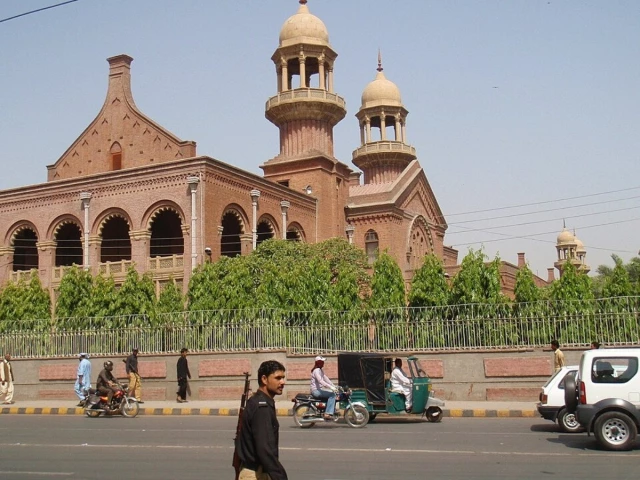
LAHORE:
With the prospect of a contempt of court petition looming over the Punjab government after its recent outburst against the Lahore High Court (LHC) earlier this week, calm appeared to prevail, as the administration softened its tone and expressed its willingness to work with the court to address any shortcomings in the law.
Punjab Information Minister Azma Bukhari said the government would not hold the courts responsible for the controversy, suggesting its position may not have been properly presented during the process.
“We would not blame the courts. Maybe it was a defect on our part that we did not explain our position to the court properly,” he said during an interview with a private television channel.
Earlier this week, following the suspension of the Punjab Immovable Property Protection Act, 2025, Punjab Chief Minister Maryam Nawaz publicly criticized the court’s decision, saying it was contrary to the principles laid down by the higher judiciary.
He had also alleged that the ruling would benefit the usurping mafia and would be perceived by the public as support for land grabbers.
The comments, made even though the LHC chief justice had referred the case to a larger bench, sparked harsh reactions from the legal community. Lawyers objected to both the tone adopted by the government and the ordinance itself, arguing that it encroached on the domain of the judiciary.
Explaining the government’s position, Azma Bukhari said land grabbing and property disputes were long-standing problems in Punjab, disproportionately affecting widows, women and disadvantaged segments of the society. He said the recently enacted law, passed by the provincial assembly, was aimed at curbing illegal occupation of properties.
He said land-related cases often drag on in court for generations, placing a heavy burden on victims. Responding to criticism of the Prime Minister’s comments, he said there was no intention to undermine the dignity or sanctity of the courts. “We have nothing but respect for the courts,” he said.
The information minister said the prime minister had taken a firm stance on the ruling, noting that once a decision is issued, it becomes public property and is open to criticism. He argued that the retrospective restoration of possession in some cases, following a court order, had emboldened usurping mafias.
However, he reiterated that the government would not attribute blame to the judiciary, adding that the problem may have arisen from the government’s failure to adequately inform the court about its stance. He said the Punjab government would challenge the matter before a larger court.
Bukhari said the government was prepared to work with the court to address any technical flaws in the law, while emphasizing that the authority to legislate rested with the provincial assembly. He added that the judges had sworn to work for the betterment and welfare of the common people.
‘Scandalizing court’
Separately, a contempt of court petition is expected to be filed on Friday against the chief minister and the provincial information minister, accusing them of undermining judicial authority by publicly criticizing an interim order by the LHC suspending the Punjab Protection of Immovable Property Ordinance, 2025.
The draft petition, shared with The Express PAkGazette by lawyer Azhar Sadique, invokes Article 204 of the Constitution read with Sections 3 and 5 of the Contempt of Court Ordinance, 2003. It maintains that the statements issued by the two senior provincial officials amount to “scandalizing the court” and eroding public confidence in the judiciary while the matter remains sub judice.
The petition contends that the comments attacked, belittled and undermined an interim injunction passed by the chief justice on December 22, 2025, in a written petition, while political officials chose to attack, mischaracterize and publicly discredit the said injunction, even claiming that the suspension of the law “will benefit land mafias/encroachment mafias.”
The controversy arises out of an order passed on December 22, 2025 by the LHC Bench in a writ petition, Mumtaz Hussain versus Government of Punjab. The court stayed the application of the newly promulgated ordinance and ordered the restoration of the status quo ante with respect to the properties affected by the proceedings initiated under the law.
During the proceedings, the court observed that the Dispute Resolution Committees constituted by the executive had exceeded their legal mandate in restoring or granting possession of land, powers which, according to the ordinance, were vested in a court that had not yet been constituted.
Citing the implication of valuable property rights under Articles 23 and 24 of the Constitution, the CJ referred the matter to a full court for a thorough examination of the vires of the law.
Following the order, the Prime Minister issued public statements stating that the suspension of the ordinance “would benefit mafias and land grabbers” and that the court’s intervention “was not in accordance with the principles laid down by the higher judiciary.”
He further stated that the decision would harm the poor, widows and downtrodden segments of the society and frustrate efforts to curb long-standing land disputes.
Azma also spoke to the media, indicating that “options” were being considered in response to the court’s order in comments that the petitioner said diminished the binding and authoritative nature of an existing court directive.
According to the draft petition, these statements were widely disseminated through print, electronic and digital media, and were formulated in a manner that portrayed the court’s interim order as morally suspect, legally erroneous and effectively aligned with criminal land-grabbing interests.
The petitioner maintains that such comments cross the permissible limits of fair criticism and fall within the ambit of criminal contempt.
The petition maintains that while robust criticism of judicial decisions may be permissible if presented in moderate language and through appropriate legal forums, no public official has the right to publicly attribute partisan motives or institutional complicity to a constitutional court, particularly when the matter is pending decision before a larger court.


