
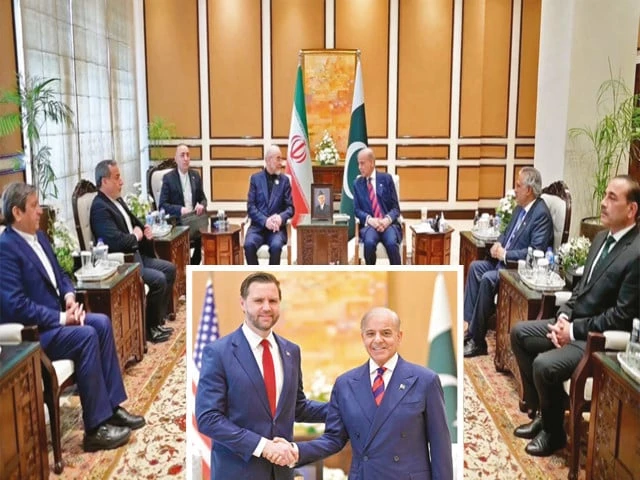
The United States and Iran are holding their first face-to-face meeting in decades, marking a significant moment for two countries.
ISLAMABAD:
Brokered by Pakistan, senior figures from Iran and the United States held 14-hour talks on Saturday, including the first face-to-face meeting at the highest level since 1979, in Islamabad, seeking to iron out key differences ranging from the Strait of Hormuz to a host of broader strategic issues; However, the marathon negotiations have not yet reached their logical end.
As a result, talks would continue today (Sunday), confirmed by the official Iranian government official early on Sunday.
A brief statement issued by the Iranian government hinted at progress during the high-stakes negotiations, brokered by Pakistan.
“The talks between Iran and the United States mediated by Pakistan concluded after 14 hours. The technical teams of both sides are now exchanging expert texts. The negotiations will continue despite some remaining differences,” the statement said.
The US delegation included Vice President JD Vance, President Trump’s special envoy Steve Witkoff and senior adviser Jared Kushner. While the Iranian side was headed by the Speaker of Parliament, Mohammad Bagher Ghalibaf. Foreign Minister Abbas Araghchi was also part of the delegation.
However, there was no statement from the host country Pakistan on the status of the negotiations till the filing of this report.
Some observers believe that the fact that the talks were extended to the third round was seen as progress. In addition, the first direct meeting at the highest level between Iran and the United States is also considered a significant development.
A White House confirmed that trilateral talks involving Pakistani interlocutors had taken place and called the process “historic” considering Islamabad’s role as mediator.
The talks held entirely behind closed doors and under tight security marked the highest-level face-to-face engagement between Tehran and Washington since the 1979 Islamic Revolution.
Iranian state media reported that during the talks both sides exchanged drafts and some proposals. Iranian media close to the IRGC said the stalemate persisted in the Strait of Hormuz.
The United States wanted joint control of the key waterway through which 20 percent of the world’s oil supply passes.
Since the war, Iran has effectively controlled the Strait and Tehran insisted it will make no concessions on the issue.
The second phase of the talks involved direct engagement at the leadership level, followed by a third phase in which technical experts from both sides took over to deliberate on the finer details of the competing proposals.
Despite cautious optimism, Iranian state media acknowledged that differences persist, particularly on sensitive issues such as maritime security in the Strait of Hormuz.
Sources also confirmed that negotiations continued late into the night between Saturday and Sunday, underscoring the intensity and urgency surrounding the diplomatic effort.
The officials maintained that Islamabad would continue to play its role as a facilitator and expressed hope that the current engagement would mark a step towards reducing tensions and the eventual resolution of a long-standing conflict that has had far-reaching regional and global implications.
In Washington, US President Donald Trump told reporters that it doesn’t matter to him whether a deal is reached with Iran. “No matter what happens, we win,” Trump said as he left the White House for Florida, later adding: “It doesn’t matter to me whether we make a deal or not.”
Vice President JD Vance is in Pakistan negotiating with Iranian officials, which the president acknowledged has been going on “for many hours.”
“We’ve totally defeated that country, so let’s see what happens,” Trump said. “Maybe they’ll reach an agreement, maybe they won’t, it doesn’t matter. From the United States’ point of view, we win.”
Ahead of the negotiations, separate meetings were held between the visiting delegations and Prime Minister Shehbaz Sharif, who expressed hope that both sides would move forward in a “constructive manner”.
The capital has been effectively placed under a security lockdown, with limited access to key areas and an unusually high presence of law enforcement personnel.
The flow of information remained strictly controlled and journalists, despite arriving in large numbers from all over the world, received minimal official information.
A media facilitation center has been set up at the Jinnah Convention Centre, where local and international reporters are stationed while awaiting updates on the evolving situation.
Meanwhile, US President Donald Trump took to social media to claim that Iran was “losing badly” and claim that the Strait of Hormuz would “soon open”, a remark that analysts see as part of Washington’s negotiating posture.
On the other hand, Iranian President Masoud Pezeshkian said in a post on


