
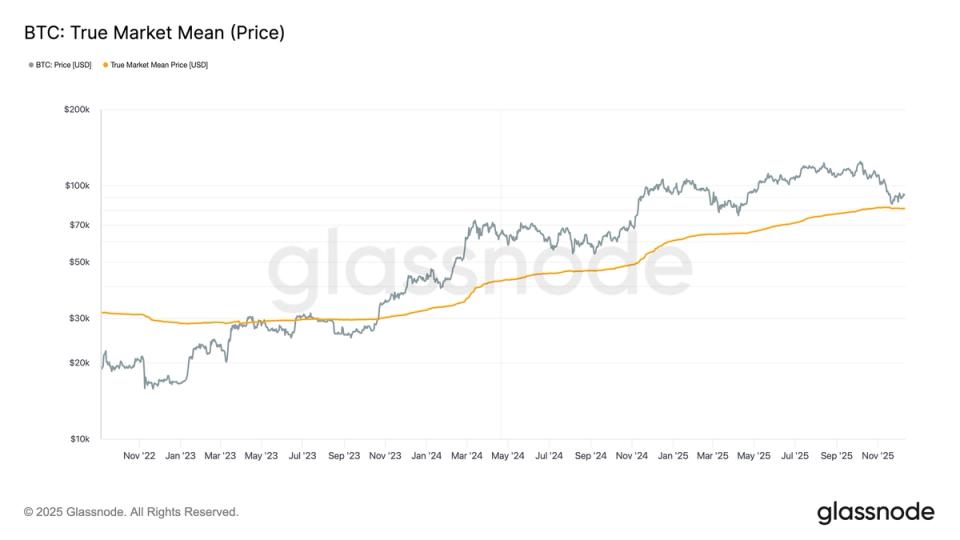
bitcoin It has so far bounced above $90,000, up 15% from its Nov. 21 low of around $80,000, with the price finding confluence support in three important cost metrics: the 2024 annual volume-weighted cost base, the true market average, and the US spot exchange-traded fund (ETF) average cost base.
These metrics help identify where investors are most likely to defend their positions during drawdowns. The support area proved vital as it closely aligned with the average acquisition prices of multiple investor cohorts.
First, the true market mean represents the average on-chain purchase price of bitcoins held by active market participants. It focuses on coins that have moved recently, filtering out long-dormant supply and therefore reflects the cost base of investors who are most likely to trade.
During this pullback, the True Market Mean stood near $81,000 and acted as clear support. Notably, bitcoin surpassed this level for the first time in October 2023 and had not traded below it since, reinforcing its importance as a structural threshold of the bull market.
Second, the US spot ETF cost basis reflects the weighted average price at which bitcoin has flowed into US-listed spot ETFs. Glassnode calculates this using the combined daily ETF inflows with the market price.
The average cost basis currently sits at around $83,844, according to Glassnode, and bitcoin once again bounced off this level, which it did similarly during April’s tariff-driven sell-off.
The third metric, the 2024 annual cost base, tracks the average price at which coins purchased in 2024 were withdrawn from exchanges. CoinDesk Research has demonstrated a pattern where annual cohort cost bases tend to act as a support during bull markets.
In this case, the 2024 cost base near $83,000, according to checkonchain, provided additional confirmation of demand, and was again also seen as support during the April correction.

These metrics highlight the depth of support demand in the $80,000 region.


