
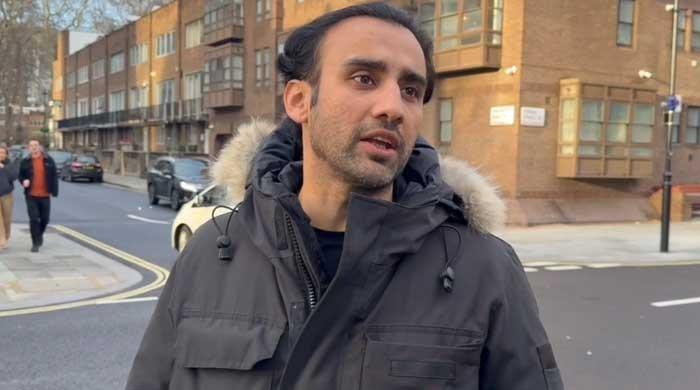
LONDON: Pakistan’s rapid push to regulate virtual assets is emerging as one of the fastest-moving reforms in the global digital financial landscape, positioning the country as a serious and credible player in the next phase of financial innovation, Pakistan Virtual Asset Regulatory Authority (PVARA) Chairman Bilal Bin Saqib said.
In an interview in London, Bilal said Pakistan has taken decisive steps to provide structure, oversight and legitimacy to a sector that had long operated without a formal framework, despite its scale and widespread adoption.
He cited recent visits to Pakistan by Steve Witkoff, representatives of World Liberty Financial, Binance founder Changpeng Zhao, and TRON founder Justin Sun, as evidence of the global community’s receptiveness to Pakistan’s efforts to modernize its digital financial ecosystem.
“These commitments are not symbolic,” he said. “They note that Pakistan is now being taken seriously as a jurisdiction that understands both the risks and opportunities of digital assets.”
Bilal, who previously advised an international crypto firm linked to the Trump administration, World Liberty Financial, while in London, said his experience working with global institutions has been instrumental in projecting Pakistan as a credible and forward-thinking market.
Bilal pointed to Pakistan’s underlying fundamentals, including its young, tech-savvy population and large user base, as reasons why regulatory clarity became a strategic necessity rather than a choice.
“For years, this market existed without rules,” he said. “The real risk was in doing nothing. Now we are building safeguards, systems and institutions at great speed.”
He also clarified that his role in PVARA is entirely pro bono. “It’s about developing national capacity,” he said. “Pakistan’s youth should not be limited to low-value roles in global digital economies. We must enable them to build, innovate and create value from within Pakistan.”
According to Bilal, Pakistan is already among the largest crypto markets in the world, a reality that underlines the urgency of regulation. PVARA’s mandate, he explained, is to convert scale into credibility by aligning national oversight with international standards on anti-money laundering, consumer protection and market integrity.
“PVARA represents the first comprehensive attempt to bring order to a space that had grown faster than the State’s response capacity,” he said. “Currently, we are licensing exchanges with a risk-based approach that protects users while enabling responsible innovation.”
He said governance in rapidly evolving digital markets must evolve alongside technology, including artificial intelligence. PVARA, he explained, is being structured to systematically use AI in licensing, supervision and market surveillance, ensuring that regulatory processes move at the speed of innovation.
He added that Pakistan issued its first No Objection Certificates for crypto exchanges in less than five months, a process that has taken close to two years in many comparable jurisdictions. “Speed matters,” he said. “Capital, talent and platforms move quickly. Regulation must be able to keep pace.”
Reflecting on his personal journey, Bilal said his approach to policymaking and strategy was shaped during his years in the United Kingdom, where he worked as a consultant.
Bilal is an alumnus of the London School of Economics, where he received the Most Commendable Masters Student of the Year award. During his Masters in Social Innovation and Entrepreneurship at LSE, he also served as a Sabbatical Officer.
During the Covid-19 lockdowns, he played a leading role in the One Million Meals campaign supporting frontline workers, an effort that earned him national recognition in the UK, including the Points of Light award and the Member of the Order of the British Empire (MBE). Bilal was also part of the Forbes 30 under 30 list for his contributions to entrepreneurship and innovation.
When asked about his political ambitions, Bilal said his focus remains firmly on building systems rather than holding office. “I work on creating frameworks that outlast individuals,” he said. “Once institutions are functional, you move on and build the next one.”
He concluded by saying that Pakistan’s digital asset reforms are still in their early stages, but the direction is clear. “It’s about preparing the country for the future,” he said. “We’re laying the groundwork, not chasing headlines.”


