- Trump says Iran wants deal as US forces draw closer.
- Iran says defense program is non-negotiable.
- The US military concentration in ME increases regional tensions.
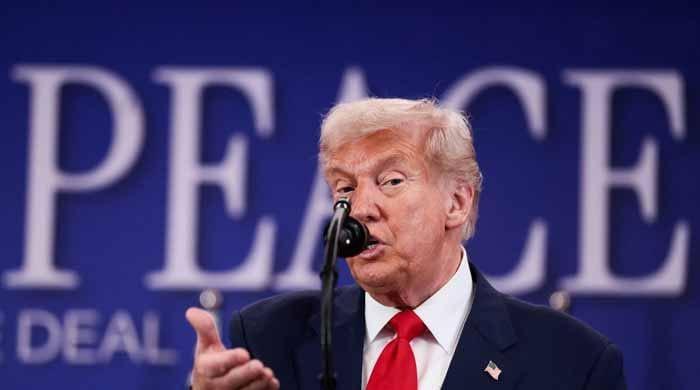
WASHINGTON: President Donald Trump predicted Friday that Iran would seek to negotiate a deal rather than face U.S. military action, even though Tehran warned that its missile arsenal would never be up for discussion.
“I can say this: They want to make a deal,” Trump told reporters in the Oval Office.
Asked if he had given Iran a deadline to engage in talks on its nuclear and missile programs, Trump said “yes, I have,” but declined to say what it was.
“We have a huge armada, flotilla, call it what you want, heading toward Iran right now,” Trump said, referring to a group of U.S. naval aircraft carriers in waters off Iran.
“Hopefully we can reach an agreement. If we reach an agreement, it will be good. If we don’t reach an agreement, we will see what happens.”
Trump cited what he said was Iran’s decision to halt executions of protesters — after a crackdown in which human rights groups say more than 6,000 people were killed — as evidence to show Tehran was ready to negotiate.
Do the right thing
Washington’s allies in the region are concerned that any US attack on Iran could cause instability and economic chaos.
A senior Gulf official in contact with the Trump administration said the United States was very cautious about what it had planned.
“We hope that whatever happens, it will lead to stability. That outcome could be achieved if the Iranians did the right thing, and we hope that happens,” the official said, speaking on condition of anonymity.
Meanwhile, the head of Iran’s top security body – Supreme National Security Council Secretary Ali Larijani – met in Moscow with Russian President Vladimir Putin, an ally of Tehran.
Details of their talks were not revealed, but Moscow offered to mediate between Washington and Tehran.
Iran’s top diplomat said Friday that his country’s defense and missile capabilities would “never” be on the negotiating table.
Meanwhile, in a post on American social media company
“The European Union certainly knows that, according to a resolution of the Iranian parliament, the armies of the countries that participated in the recent EU decision against the Islamic Revolutionary Guard Corps will be considered terrorists,” Larijani said.
He added that “the consequences of such action will therefore fall on the European countries that took this step.”
Foreign Minister Abbas Araghchi said Tehran was “ready to start negotiations if they are conducted on an equal footing.”
But, he stressed, “Iran’s missile and defensive capabilities will never be subject to negotiation,” adding that there were no plans to meet with US officials to resume talks.
Former IAEA chief criticizes US threats
Nobel Peace Prize laureate and former Director General of the International Atomic Energy Agency (IAEA), Mohamed ElBaradei, condemned growing US threats of military action against Iran.
In his Thursday post on
“The continued unilateral threats of a military attack against Iran in the absence of any clear and present danger and in violation of international law, bring to mind the same grim scene before the illegal and immoral Iraq war with its lies and horrible consequences. Human life and regional destruction do not seem to matter. We never learn…” he tweeted.
US news site Axios reported this week that Washington officials say any deal would have to include a limit on Iran’s long-range missile arsenal, the removal of the country’s enriched uranium and a ban on independent enrichment.
Serhan Afacan, director of IRAM, the Ankara-based Center for Iranian Studies, told AFP that trying to link a nuclear deal to other issues would probably “be impossible.”
“For now, the ballistic missile program remains a red line, as it is at the center of Iran’s defense architecture,” he said.
Reduce tensions
Iran has warned that it would respond instantly with missile attacks against US bases, ships and allies, particularly Israel.
“We do not limit the geography of the confrontation only to the sea and we have prepared for broader and more advanced scenarios,” the head of Iran’s Defense Council, Ali Shamkhani, said on Friday, according to the Tasnim news agency.
At a joint news conference with Araghchi in Istanbul, Turkish Foreign Minister Hakan Fidan said Israel was pushing for the United States to attack Iran and urged Washington “not to let this happen.”
Iran has blamed the United States and Israel for the economically motivated protests that erupted in late December and peaked on Jan. 8 and 9, accusing the two countries of fueling a “terrorist operation” that turned peaceful demonstrations into “riots.”