
New attacks in the Gulf follow the statement by the president of Iran; Water desalination plant attacked on the island of Qeshm
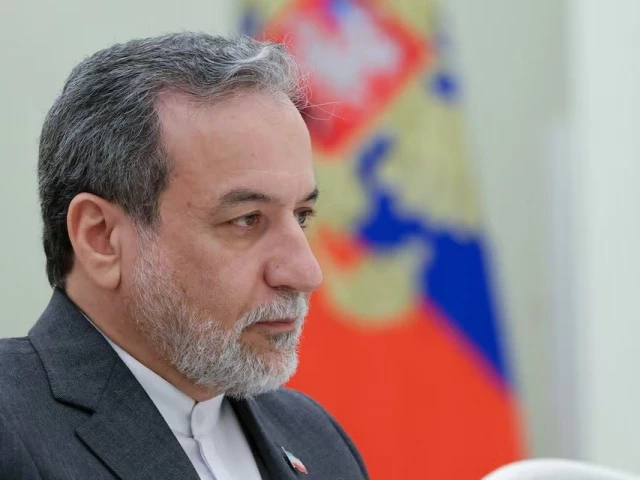
Iranian Foreign Minister Abbas Araqchi. Photo: Reuters
Iranian Foreign Minister Abbas Araghchi accused US President Donald Trump of effectively ending Tehran’s commitment not to attack neighboring countries after Washington used regional bases to carry out attacks against Iran.
In a statement published in
However, he said that gesture was quickly undermined by Washington’s actions.
“President Pezeshkian’s openness to reducing tensions within our region, as long as our neighbors’ airspace, territory and waters are not used to attack the Iranian people, was almost immediately destroyed by President Trump’s misinterpretation of our capabilities, determination and intentions. If Mr. Trump seeks escalation, that is precisely what our powerful military has long been prepared for, and what he will get.”
He said responsibility for any intensification of the self-defense exercise by Iran will lie squarely with the US administration.
“Mr. Trump’s week-long misadventure has already cost the U.S. military $100 billion, plus the lives of young soldiers. When markets reopen, that cost will skyrocket and be passed on directly to ordinary Americans at the pumping stations,” the statement read.
“Mr. Trump’s own National Intelligence Council, which represents input from all 18 US intelligence agencies, determined that the war against Iran is doomed to failure.”
“I also warned Mr. Trump’s envoys that war will not improve their negotiating position. Were these warnings conveyed?”
He noted that the American people voted to end their involvement in costly Middle East quagmires. “Instead, they ended up with an Administration that Netanyahu, after decades of failed attempts, finally managed to trick into waging Israel’s wars.”
“This is a war of choice pursued by a small ‘Israel first’ clique, and ‘Israel first’ always means ‘America last,'” he added.
Larijani warns regional states
Separately, senior national security official Ali Larijani warned countries in the region about using their territory for attacks against Iran.
In a message posted on X, Larijani said Iran would continue to respond to attacks coming from bases in neighboring states.
“When the enemy attacks us from bases in the region, we respond, and we will continue to respond. This is our right and a permanent policy. Countries in the region must prevent the United States from using their territory against Iran, or we will have no choice but to do it ourselves.”
Iranian officials have repeatedly argued that using regional bases for attacks risks widening the conflict and dragging neighboring countries directly into confrontation, as tensions continue to rise across the Middle East.
Israel and Iran traded attacks as the Middle East war entered its second week on Saturday, as Tehran made an uncharacteristic apology to neighboring states, apparently seeking to calm regional anger over Iranian attacks on civilian targets in the Gulf.
“I personally apologize to neighboring countries that were affected by Iran’s actions,” said Iranian President Masoud Pezeshkian, urging them not to join US-Israeli attacks on Iran.
He dismissed US President Donald Trump’s demand for an unconditional surrender of the Islamic Republic as “a dream” but said his temporary leadership council had agreed to suspend attacks on neighboring states unless attacks on Iran originated on its territory.
Trump, however, described Iran’s apology as a surrender, although he said the country would be “badly hit” on Saturday and warned that the United States could expand its strikes to areas and groups of people that were not previously designated targets.
Pezeshkian’s comments caused a political stir in Iran, prompting his office to reiterate that the Iranian military would respond firmly to attacks from US bases in the region.
Hamid Rasai, a hardline cleric and lawmaker, wrote on X: “Mr. Pezeshkian, your stance was unprofessional, weak and unacceptable.” Hours after Pezeshkian’s announcement, Iran’s Revolutionary Guard said its drones attacked a US air combat center at Al Dhafra air base near Abu Dhabi, capital of the United Arab Emirates. Reuters could not independently verify that report.
The Revolutionary Guards also attacked US forces at a base in Bahrain, Iranian state media said. Explosions were also heard in Doha, a Reuters witness said.
Gholamhossein Mohseni-Ejei, head of Iran’s judiciary, said evidence from Iran’s armed forces indicated that the territory of some countries in the region was being used to carry out attacks against Iran.
Heavy attacks on those targets will continue, said Mohseni-Ejei, who is also a member of the interim leadership council created after Supreme Leader Ayatollah Ali Khamenei was killed in an airstrike on his compound early in the conflict.
Huge explosions were heard in several parts of the Iranian capital, state media reported.
Loud explosions were heard in Dubai, Qatar’s capital Doha and Bahrain, while attacks were later reported in the United Arab Emirates, Saudi Arabia, Qatar and Kuwait, where the national oil company announced a “precautionary” production cut.
United Arab Emirates President Mohammed bin Zayed Al Nahyan said in a rare televised speech that the Emirates were in “a period of war” and “will emerge stronger” from the war, which has entered its second week.
Earlier in the day, Dubai closed its main airport, the world’s busiest for international traffic, after authorities said an unidentified object was intercepted nearby. A witness told AFP of a loud explosion in the area followed by a cloud of smoke, while images authenticated by AFP recorded the sound of a drone followed by a loud explosion and columns of smoke near an airport concourse.
The government stated that there had been “a minor incident due to falling debris following an interception”, without directly mentioning the airport. He said there were no injuries.
Tracking website Flightradar24 earlier showed planes circling above the airport in an apparent holding pattern.
In a statement deleted from X, Emirates, the Middle East’s largest airline, announced it would suspend all flights to and from Dubai until further notice, but later said it had resumed operations.
The United Arab Emirates, a U.S. ally and home to U.S. military installations, has been the most targeted nation in the Gulf during the war.
The Defense Ministry said that of the 16 ballistic missiles fired at the country on Saturday, all but one were intercepted and that missile fell into the sea.
Of the 121 drones detected, 119 were shot down, while two fell in Emirati territory.
The bombing brings to 221 the number of ballistic missiles detected by the United Arab Emirates since the start of the war last Saturday, the Defense Ministry said, while the number of drones exceeds 1,300.
Iranian strikes also hit Abu Dhabi airport, the exclusive Palm Jumeirah resort and the Burj Al Arab luxury hotel over the past week, while drone debris caused a fire at the US consulate in Dubai on Tuesday.
Elsewhere in the Gulf, Qatar’s Defense Ministry said on Saturday that its military had intercepted two missile attacks aimed at the country.
In Saudi Arabia, the Defense Ministry said it had destroyed three ballistic missiles headed for Prince Sultan Air Base, which hosts US troops, as well as 17 drones over the Shaybah oil field in the southeast.
Kuwait also reported the interception of a drone, while the country’s national oil company announced a “precautionary” cut in its crude oil production due to Iranian attacks and threats to the Strait of Hormuz, a key transit point for Gulf hydrocarbons.
Further north, Jordan accused Iran of directly attacking sites in the kingdom, saying Tehran had fired 119 missiles and drones last week.
“These missiles and drones were targeting vital facilities inside Jordan and did not pass through our territories,” said military spokesman Brigadier General Mustafa Hayari.
Iran’s foreign minister accused the United States of attacking a freshwater desalination plant on the island of Qeshm, disrupting supplies to more than two dozen villages.
“The United States committed a flagrant and desperate crime by attacking a freshwater desalination plant on Qeshm Island,” Seyed Abbas Araghchi wrote in a post on the microblogging site X.
“The water supply in 30 villages has been affected. Attacking Iran’s infrastructure is a dangerous measure with serious consequences,” he further stated, warning that “The United States sets this precedent, not Iran.”


