- NATO will enhance its presence in the Arctic under the framework agreement with the United States.
- Trump’s ambitions in Greenland strain transatlantic ties.
- EU leaders distrust the reliability of the United States after the Greenland episode.
President Donald Trump said Thursday he had secured full and permanent U.S. access to Greenland in a deal with NATO, whose chief said allies would need to step up their commitment to Arctic security to protect against threats from Russia and China.
News of a framework agreement came as Trump backed down on tariff threats against Europe and ruled out taking Greenland by force, providing some respite in what was shaping up to be the biggest break in transatlantic ties in decades.
Trump’s U-turn triggered a rally in European markets and a return to record levels for Wall Street’s main indices, but also raised questions about how much damage had already been done to transatlantic ties and business confidence.
The details of any agreement were unclear and Denmark insisted that its sovereignty over the island was not in question. EU foreign policy chief Kaja Kallas said the bloc’s relations with the United States had “taken a big hit” last week, when EU leaders met for an emergency summit.
Greenland Prime Minister Jens-Frederik Nielsen welcomed Trump’s comments but said he was still in the dark on many aspects.
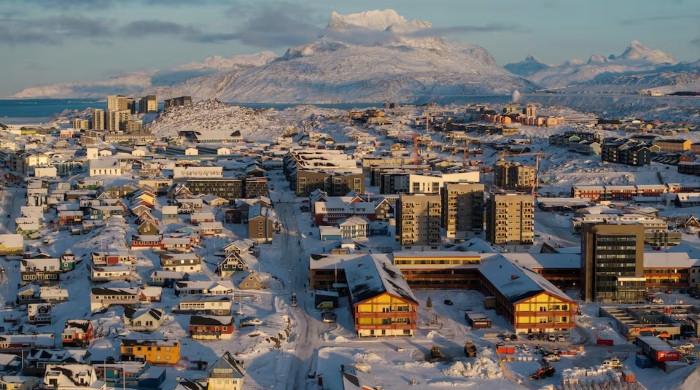
“I don’t know what’s in the deal or the deal about my country,” he told reporters in the capital, Nuuk.
“We are ready to discuss a lot of things and we are ready to negotiate a better partnership and so on. But sovereignty is a red line,” he said, when asked about reports that Trump was seeking control of areas around US military bases in Greenland as part of a broader deal.
Speaking to reporters aboard Air Force One upon his return from the World Economic Forum in Davos, Switzerland, Trump said a new deal was being negotiated that would be “much more generous to the United States, much more generous.”
He dodged questions about sovereignty but said: “We have to have the ability to do exactly what we want to do.”
Earlier, Trump told Fox Business Network that the deal would essentially provide “full access” to the United States.
“There is no end, there is no time limit.”
A source familiar with the matter said Reuters NATO Secretary General Mark Rutte and Trump agreed in Davos on new talks between the United States, Denmark and Greenland to update a 1951 agreement governing US military access and presence on the Arctic island.
The framework they discussed also calls for banning Chinese and Russian investments in Greenland, the source said.
Another source familiar with the matter said what was agreed upon was “a framework to build on,” adding that “any information reported on specific details is speculative.”
Rutte said Reuters In Davos it was now up to senior NATO commanders to work out the details of additional security requirements.
“I have no doubt that we can do this pretty quickly. I certainly hope it will be by 2026, I hope even early 2026,” he said.
Denmark says situation remains difficult
Trump’s ambition to seize sovereignty over Greenland from NATO member Denmark has threatened to blow up the alliance that has underpinned Western security since the end of World War II and reignite a trade war with Europe.
Danish Prime Minister Mette Frederiksen said no negotiations had been held with NATO over the sovereignty of Greenland, a semi-autonomous territory of Denmark.
“It remains a difficult and serious situation, but progress has also been made in the sense that we now have things where they need to be. That is, we can discuss how to promote common security in the Arctic region,” he said.
Speaking later, ahead of the emergency summit of EU leaders, Frederiksen called for a “permanent NATO presence in the Arctic region, including around Greenland.”
Kallas said that “the disagreements that allies have among themselves, such as Europe and the United States, are only benefiting our adversaries who watch and enjoy the view.”
Finnish President Alexander Stubb said he hoped allies could come up with a plan to boost Arctic security before a NATO summit in Ankara in July.
British Prime Minister Keir Starmer told Rutte on Thursday that the United Kingdom was ready to play its full role in ensuring security in the Arctic, a spokesman said.
After meeting with Rutte, Trump said there could be a deal that satisfies his desire for a “Golden Dome” missile defense system and access to critical minerals while blocking what he says are Russia and China’s ambitions in the Arctic.
Rutte said mineral exploitation was not discussed in his meeting with Trump. Specific negotiations on the Arctic island would continue between the United States, Denmark and Greenland itself, he said.
The 1951 agreement established the right of the United States to build military bases in Greenland and to move freely through Greenlandic territory. This will remain the case as long as Denmark and Greenland are informed of their actions. Washington has a base at Pituffik, in northern Greenland.
“It is important to clarify that the United States had 17 bases during the Cold War and much greater activity. So that is already possible now under the current agreement,” said Marc Jacobsen, a professor at the Royal Danish Defense College.
“I think there will be concrete discussions about the Golden Dome, and I think there will be concrete discussions about Russia and China not welcoming Greenland.”
Greenlanders and EU leaders cautious
The president of the European Parliament said the European Union will likely resume work on a trade deal with the United States after Trump backed off his tariff threats. Parliament decided this week to suspend work on the agreement due to Trump’s threats.
However, diplomats said Reuters EU leaders will reconsider relations with the United States as the Greenland episode has seriously shaken trust in transatlantic relations. Governments remain wary of a new change of heart by Trump, who is increasingly seen as a bully that Europe will have to confront, they said.
Residents of Greenland’s capital, Nuuk, are also cautious.
“It’s all very confusing,” says pensioner Jesper Müller.
“One hour we were, well, almost at war. The next hour everything is fine and beautiful, and I think it’s very difficult to imagine that anything can be built on top of that.”