
Iran will not submit to ‘lawless aggression’ Saudi source dismisses NYT report on fomenting protracted war
DUBAI/ GENEVA/ TEHRAN/ WASHINGTON:
President Donald Trump on Monday demanded that U.S. allies join an effort to secure the Strait of Hormuz, as European powers ruled out a NATO mission to reopen the vital waterway closed by Iran during the Middle East war.
Trump criticized the lukewarm response to his call for world powers to send warships to escort oil tankers through the strait, which normally carries a fifth of the world’s crude oil, and demanded a more enthusiastic response.
Trump said he thought Britain and France would get involved, but only reluctantly.
“We strongly encourage other nations to engage with us and to do so quickly and with great enthusiasm,” Trump told reporters at a White House event.
“The level of enthusiasm matters to me.”
NATO allies and other Western nations earlier rejected Trump’s call, made over the weekend, for military equipment.
British Prime Minister Keir Starmer said London was working with its allies to draw up a “viable” plan to reopen the strait, but ruled out a NATO mission, while Berlin also said it “has been clear throughout that this war is not a NATO matter.”
German Chancellor Friedrich Merz said that “the question of how Germany could contribute militarily does not arise. We will not do it.”
Japan, Australia, Poland, Spain, Greece and Sweden also distanced themselves from any military involvement in the Strait of Hormuz.
EU foreign ministers discussed the war in Brussels on Monday but showed “no interest” in extending their naval mission in the Red Sea to help reopen Hormuz, the bloc’s top diplomat said.
Trump told the Financial Times on Sunday that it would be “very bad for the future of NATO” if they refused to help, and threatened to delay a planned summit with Chinese leader Xi Jinping.
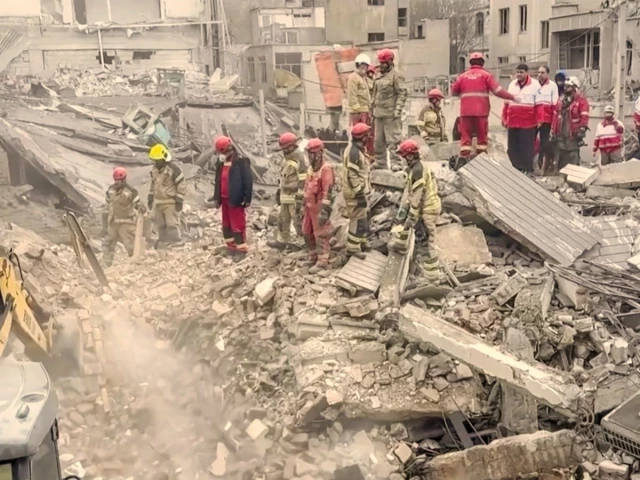
Explosions rocked the Iranian capital on Monday as air defense systems were activated, an AFP journalist said, and Israel claimed it had also attacked the cities of Shiraz and Tabriz, but Tehran’s foreign minister struck a defiant tone.
“By now they have…understood what kind of nation they are dealing with, one that does not hesitate to defend itself and is willing to continue the war wherever it takes it, and take it as far as necessary,” Abbas Araghchi told reporters in Tehran.
Iran’s Revolutionary Guard threatened to attack US companies in the region and warned employees to evacuate, after the Iranian foreign minister issued a defiant warning to Washington.
A drone caused a fire in a fuel tank near Dubai airport, disrupting travel, while a missile killed a civilian in his car in Abu Dhabi, and another drone caused a fire in an area hosting oil infrastructure in the eastern emirate of Fujairah.
“It has been a difficult few weeks hearing explosions regularly, but the Iranian attacks followed me in the last few hours before I could fly back home,” a witness at Dubai airport told AFP.
The UAE’s state energy giant ADNOC halted loading oil into storage tanks in Fujairah, but oil prices retreated as the International Energy Agency said more strategic oil reserves could be released.
Call from Saudi Arabia and the United Arab Emirates
War has engulfed much of the region, and Iran has attacked at least 10 countries hosting U.S. forces. Its Revolutionary Guards say they have fired some 700 missiles and 3,600 drones.
Saudi Arabia intercepted more than 60 drones overnight, its Defense Ministry said Monday, and Iraqi authorities said rockets wounded five people the previous day at Baghdad airport, which houses a U.S. diplomatic facility.
Despite the violence and a 17-day internet blackout, some Iranians have tried to restore a sense of normality, with cafes and restaurants reopening and the popular Tajrish bazaar busy over the weekend before the upcoming Persian New Year.
There is little sign of a popular uprising inside Iran, where security forces killed thousands of people during January protests.
Judiciary chief Gholam Hossein Mohseni said there should be no leniency in issuing “final verdicts” against opponents of the regime during the war.
More than 1,200 Iranians have been killed by US and Israeli strikes, according to the latest figure provided by Iran’s Health Ministry on March 8, which could not be independently verified.
The UN refugee agency says up to 3.2 million people have been displaced in Iran.
United Nations
Iran vowed at the United Nations on Monday that it would not submit to “unlawful aggression,” saying 90 million citizens were in “grave danger” from US and Israeli attacks.
At the U.N. Human Rights Council in Geneva, where countries were discussing the rights situation in Iran, U.N. experts highlighted Tehran’s deadly crackdown on protesters in recent months and warned that the crackdown was likely to worsen amid the Middle East war.
Iran’s ambassador, Ali Bahraini, responded by insisting that attention should be focused on the aggression against his country, “carried out by some of the most illegal and unscrupulous actors on the international stage.”
“The most urgent and fundamental human rights issue affecting Iran is the imminent threat to the lives of 90 million people whose lives are in serious and immediate danger under the shadow of reckless military aggression,” he told the council.
Bahraini said that if such “reckless militarism” were met with indifference, “Iran will surely not be the last country to suffer such treatment.”
NYT report
A Saudi Arabian source on Monday dismissed an alleged New York Times report about the kingdom’s leadership encouraging the United States into a long, drawn-out war with Iran, Al Arabiya reported.
The NYT claimed in a report a day ago that Saudi Crown Prince Mohammed bin Salman was advising US President Donald Trump “to continue hitting the Iranians hard.”
However, Al Arabiya reported that a “Saudi source” told the outlet today that the NYT report was “false.”
departure from the UAE
The United Arab Emirates’ daily oil production has more than halved as the conflict with Iran and the effective closure of the Strait of Hormuz forced state oil giant ADNOC to implement widespread production shutdowns, two sources told Reuters.


