The interdiction highlights the vital role of cooperation in tackling the rapidly evolving illegal drug trade.
In its 2025 Annual Report, the International Narcotics Control Board (INCB) said authorities used its pre-export notification platform to stop the diversion of three tons of the precursor 1-boc-4-piperidone, a chemical intermediate used in the manufacture of fentanyl.
Had the shipment not been intercepted, it could have been used to manufacture between 1.4 and 3.3 tons of fentanyl. – between 700 million and 1.6 billion doses of this deadly street drug.
The case, which occurred in March 2025, is one of several examples cited by the INCB to illustrate what it calls an “international success story” in terms of cooperation.
“The fight against drug trafficking and abuse, while ensuring the availability of essential medicines, has been carried out effectively for the last 60 years through the drug control conventions, a strong framework for working together with almost universal support,” said Board President Professor Sevil Atasoy.
“Our role is to strengthen the cooperative efforts of countries and territories through our work.”
A system based on cooperation
The INCB is an independent, quasi-judicial body with the mandate to monitor the implementation of the three international drug control conventions – adopted in 1961, 1971 and 1988 – that form the backbone of the global drug control system.
Under these treaties, governments provide estimates and statistical reports to monitor the cultivation, manufacturing and trade of controlled substances, with the goal of ensuring their availability only for medical and scientific purposes.
According to the report, the efficiency of this system has maintained the diversion of legitimately produced narcotics to illicit markets.very low”, while the diversion of psychotropic substances – such as heroin and other opioids – has “practically stopped.”
In 2025 alone, more than 190 countries and territories cooperated through the online pre-export notification (PEN) platform, monitoring more than 34,000 planned shipments of internationally controlled drug precursors.
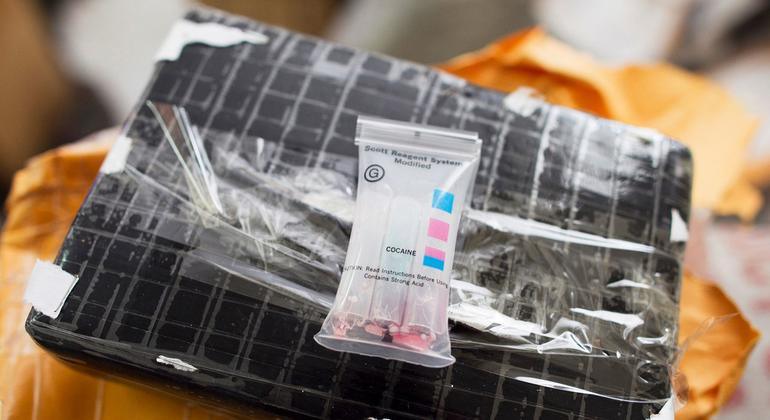
Packages containing cocaine seized by authorities in Ecuador. (file photo)
What is the INCB?
The International Narcotics Control Board (INCB) is an independent, quasi-judicial body established under the Single Convention on Narcotic Drugs of 1961.
It oversees national compliance with the three international drug control conventions (1961, 1971 and 1988), overseeing the global system that regulates narcotic drugs and psychotropic substances for medical and scientific use while preventing their diversion into illicit markets.
Its 13 members are elected by the UN Economic and Social Council for five-year terms. The Board is based in Vienna and is supported by a secretariat linked to the United Nations Office on Drugs and Crime (UNODC).
Read more about the Board here.
New threats, changing markets
Despite this cooperation, the Board warns that Traffic networks are adapting rapidly.
Cocaine trafficking remains the fastest growing illicit drug marketwith increased production in South America driving expansion into Asia and Africa.
In Europe, Cocaine trafficking into Western and Central Europe has “increased dramatically.” while the illicit manufacture of synthetic drugs continues to increase.
In North America, Synthetic drug overdoses decreased by 17 percent in Canada and 27 percent in the United States.but the Board warned that it is “too early to assess whether the decline will become a sustained trend.”
In Africa, trafficking in pharmaceutical opioids – including substandard products – is described as the drug-related problem of greatest concern, while The South Asian region accounts for one-third of the world’s estimated opioid users..
Methamphetamine remains the main synthetic drug threat in East and Southeast Asiawith record seizures reported.
Unequal access
Although the global supply of opioid analgesics remains stable, the Board highlighted Persistent inequalities in access to painkillers, especially in low- and middle-income countries..
Many countries continue to report difficulties in acquiring morphine-containing medicines, and increasing the availability and affordability of psychotropic substances remains a priority.
“Protecting the health of people around the world from the dangers of illicit drugs is a common and shared responsibility,“Professor Atasoy said.
“The international drug control system depends on the willingness and ability of countries to work together.“