
ISLAMABAD:
Pakistan said on Thursday that the latest report of the UN Security Council’s 1267 Sanctions Committee has “broadly supported” its long-standing position that terrorist groups, particularly Tehreek-e-Taliban Pakistan (TTP), continue to operate from Afghan soil with operational space and support.
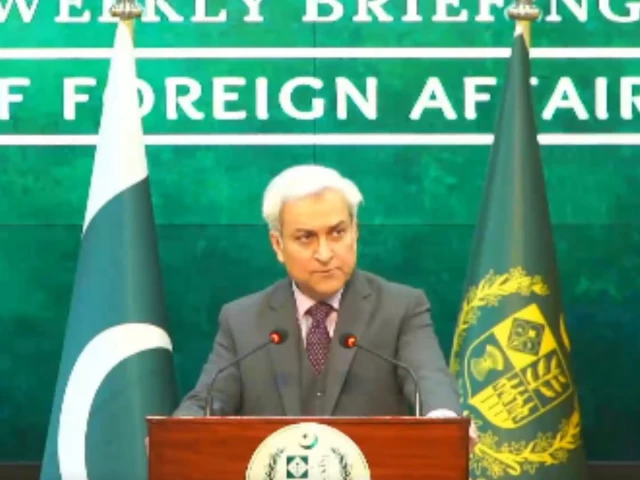
Responding to questions during his weekly press briefing, Foreign Ministry spokesperson Tahir Andrabi said the February 4 report corroborates Pakistan’s narrative of the TTP’s resurgence following the 2021 takeover of power by the Afghan interim government.
“We have seen and studied the report. We believe it broadly supports Pakistan’s narrative on the TTP and Afghanistan,” Andrabi said.
He noted that the report highlights the continued presence of the TTP and Al Qaeda in Afghanistan and notes what it describes as a “permissive environment” for a variety of terrorist groups, particularly the TTP.
According to the spokesperson, the report highlights that the TTP has been granted “greater operational freedom” and has benefited from the support of the de facto authorities, allowing it to carry out attacks inside Pakistan.
He said the report also refers to Al Qaeda as a “multiplier and service provider” for other armed groups in Afghanistan, particularly the TTP, in terms of training and advisory support. Al Qaeda in the Indian Subcontinent (AQIS) was reported to be active in southeastern Afghanistan.
Andrabi further noted concerns raised by several UN member states about deepening cooperation between groups aligned with Al Qaeda and the TTP, warning that such links could pose extra-regional threats beyond Pakistan to other neighboring states.
The report, he added, also mentions the presence of ISIL-K in northern Afghanistan and refers to an alleged collaboration between TTP, ISKP and BLA/Fitna Al Hind through shared training camps, coordinated attacks and meetings between commanders.
“If we summarize all this, the report corroborates Pakistan’s position that the TTP’s resurgence is linked to post-2021 developments in Afghanistan,” he said, reiterating that Pakistan remains the primary target of TTP attacks and continues to bear the brunt of terrorism emanating from across the border.
He said Pakistan would follow up on the findings with the UN Secretariat, members of the Security Council and other relevant stakeholders.
Confirming media reports, the spokesperson said Prime Minister Shehbaz Sharif will attend the next Board of Peace (BoP) meeting scheduled for February 19 in Washington.
“Yes, I can confirm that the Prime Minister will attend the next BoP meeting. He will be accompanied by the Deputy Prime Minister/Foreign Minister,” Andrabi said, adding that details of the broader delegation and engagements in the United States would be shared later.
Responding to a question about concerns about the representation of Gaza and the forum’s credibility, Andrabi said Pakistan had joined the initiative “in good faith” as part of a collective voice of eight Arab Islamic countries.
“Our collective voice is echoing in the Peace Board,” he said, referring to the joint statements issued by the eight countries on Gaza and the West Bank.
He reiterated Pakistan’s support for a long-term solution to the Palestinian issue, including the establishment of an independent Palestinian state based on the pre-1967 borders with Al-Quds Al-Sharif as its capital.
On the Indus Waters Treaty (IWT), Andrabi said Pakistan’s legal team participated in the Court of Arbitration proceedings held in The Hague on February 2 and 3, seeking clarity on the interpretation and application of the treaty in relation to certain design elements of India’s run-of-the-river hydropower projects.
He noted that the Court of Arbitration invited India to participate, but decided not to appear.
“The IWT remains a binding international instrument,” he said, adding that no unilateral action could alter its legal status.
Regarding the proposed Svalkot project on the Chenab river, the spokesperson said Pakistan’s Indus Water Commissioner had written to his Indian counterpart seeking information and consultation as provided in the 1960 treaty.


