
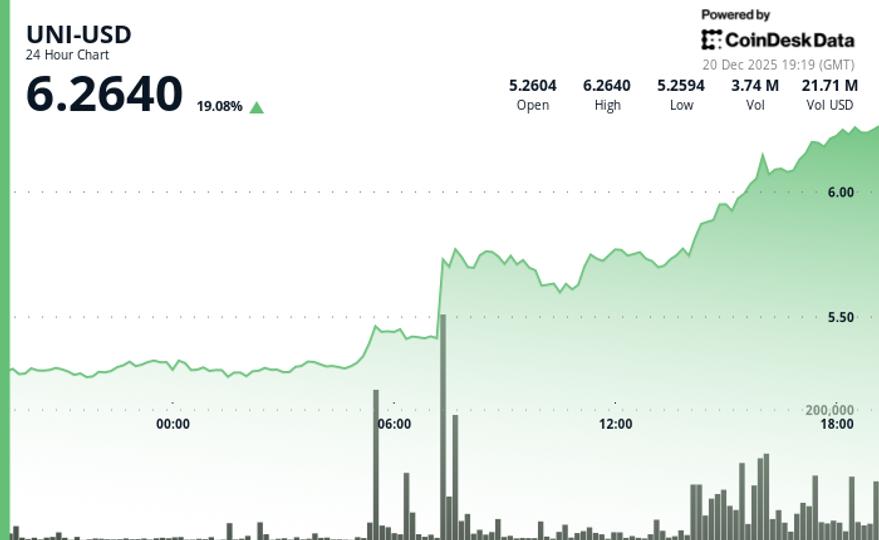
Uniswap’s UNI token rallied around 19% in the past 24 hours as on-chain voting began on a major governance proposal that would trigger protocol fees and introduce a long-discussed UNI burning mechanism.
UNI began rising shortly after the voting period opened at 03:50 UTC on December 20, according to Uniswap governance data. A one-day UNI-USD chart from TradingView shows the steepest leg of the rally that developed during the early hours of the voting window, with the price breaking out of the $5.40 to $5.50 range and continuing an uptrend throughout the day, along with an increase in trading volume.
At around 19:30 UTC, UNI was trading near $6.27, up about 19% on the day. The move stood out in a relatively quiet broader market, with bitcoin consolidating near $88,300 and ether trading slightly lower around $2,976. The overall crypto market capitalization increased by around 1% over the same period, underscoring UNI’s relative outperformance.
The vote centers on a broad governance proposal known as “Unification,” a name that reflects its goal of aligning Uniswap’s economic incentives, governance structure, and development efforts into a single framework. If approved, the proposal would implement protocol fees in Uniswap v2 and select v3 pools, routing those fees to a programmatic mechanism that burns UNI tokens.
The proposal also includes a retroactive burn of 100 million UNI from the treasury, intended to approximate the amount that could have been burned if protocol fees had been active since the early years of Uniswap. Additional components would direct Unichain sequencer fees to the same burning mechanism and introduce new auction-based systems designed to internalize MEV while improving returns for liquidity providers.
Beyond fee activation, the proposal formalizes closer operational alignment between Uniswap Labs, the Uniswap Foundation, and on-chain governance. Under the plan, Labs would focus on the development and growth of the protocol, while eliminating fees from its interface, wallet, and API. Development and ecosystem initiatives would be funded through a growth budget approved by governance.
Although Uniswap governance has debated activating the protocol’s fees for years, previous efforts to do so have stalled amid regulatory uncertainty and disagreements over incentive design. The opening of formal on-chain voting appears to have catalyzed renewed interest in the market, with traders positioning themselves around the possibility of direct value accumulation tied to Uniswap’s dominant trading volumes.
Early voting data showed overwhelming support for the proposal, although voting remains open until 6:14 pm UTC on December 25. While the outcome is not yet final, the timing of UNI’s rally suggests that the market is responding to the start of the governance process itself and the prospect of a structural change in how value flows back to UNI holders.


