
“Any sufficiently advanced technology is indistinguishable from magic,” noted Arthur C. Clarke’s Third Law. We tech journalists like to trot out the saying when we’re impressed… but on Wednesday afternoon in a hotel suite in Las Vegas, I saw something that finally helped me understand what Clarke was referring to.
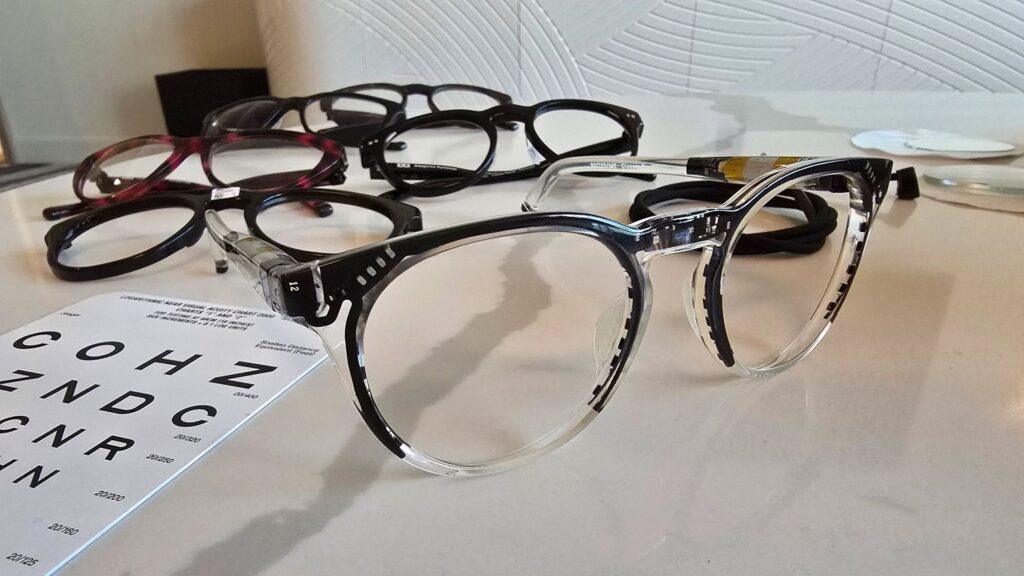
On the table in front of me was an array of glasses, indistinguishable enough from the selection you might see at Warby Parker or Luxottica or on the shelves of your local optical shop. There was notable technology in the frames that allows the lenses to automatically change their focus depending on what you’re looking at. If it’s close to your eye, it will be enlarged for those of us who need readers. If it’s far away, it will remove the magnification so you can see clearly.
It is the result of more than four years of technological wizardry, some $45 million in research and development, and a technology that is just one step away from rocket science, because it was invented by a real rocket scientist.
“We are redefining eyewear at a really high level,” Niko Eiden, co-founder and CEO of Finnish startup IXI, told me. “I like to use a camera analogy: fixed focus, manual focus, and then autofocus. What we’re trying to do is autofocus, as opposed to fixed focus, which is what we have today.” As one of the estimated 78 million Americans who wear progressive lenses (only my mom still calls them bifocals, you know), the concept is immediately appealing.
The graveyard of legs, lenses, and glasses of all kinds of shapes and colors before me was meant to help explain the manufacturing process. But it took me a second to realize the reality: Eiden was wearing a functional pair, 22 grams of incredible. This is not a hypothetical product, CES vaporware. It’s real and it’s spectacular.
Inside the world’s first autofocus glasses
How does it work? I’m glad you asked. There are three parts to the company’s new product, which will eventually be called IXI and could probably be sold later this year: lenses that can be adjusted, thanks to a unique liquid crystal material sandwiched within two plastic panels; an autofocus capability, thanks to an eye-tracking system that can detect where you’re looking and adjust accordingly; and a frame that looks and feels like a regular pair of glasses.
And let’s get this out of the way: Yes, you’ll need to charge your glasses with a USB cable that magnetically attaches to the frame. I promise you it will be worth it.
A pair of 35mAh batteries sit in the hinge pins, small enough to go unnoticed but powerful enough for about 18 hours of use. That’s about 10 times less than what’s in the Ray Ban Meta Gen 2, which means the IXI needs to drink water as sparingly as a stranded sailor saving his last jug of water on a desert island.

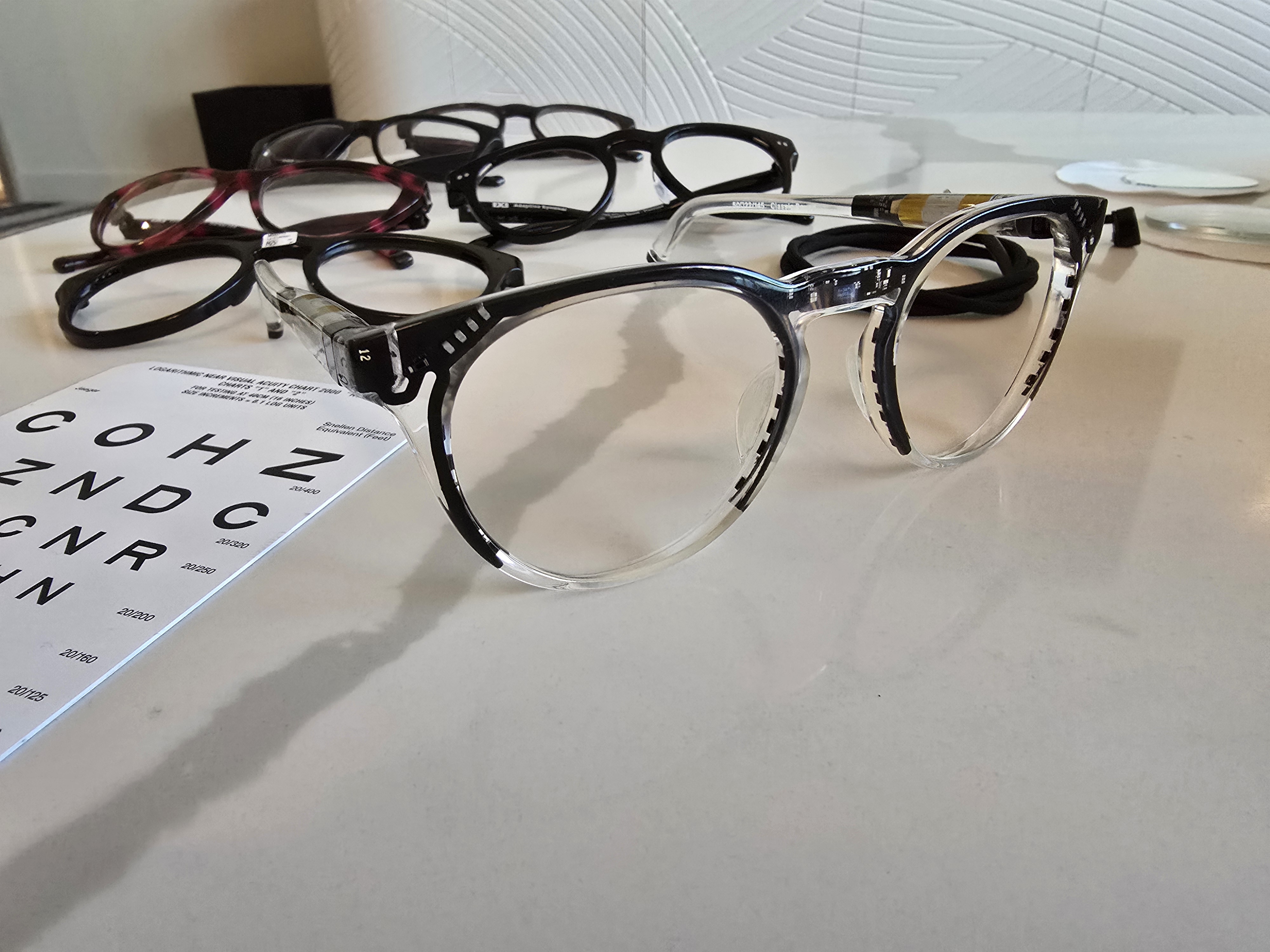

The electronics that make that sip are part of a printed circuit board fabricated inside the frame of the glasses: there’s a computing unit over the bridge of the nose, circuitry carefully hidden in the outer corners, and a series of imaging components for eye tracking. There is no camera. Instead, the system relies on the reflectivity of the eye itself to measure where you are looking.
“When an eye rotates relative to the frame, its fingerprint changes,” Eiden explained. An array of LEDs emit IR light to the eye and a complementary array of photodiodes generate images of the returning reflection, all at about 60 frames per second, standard speed for eye trackers, he said.
This light spectrum easily passes through the plastic frame but bounces back to the eye, so it can be hidden out of sight, like the electronics in your AV cabinet. Because our eyes are quite slow (taking 200 to 300 milliseconds to refocus), 60 fps is much faster. In other words, you won’t have time to notice the tuning.
Eyes on IXI
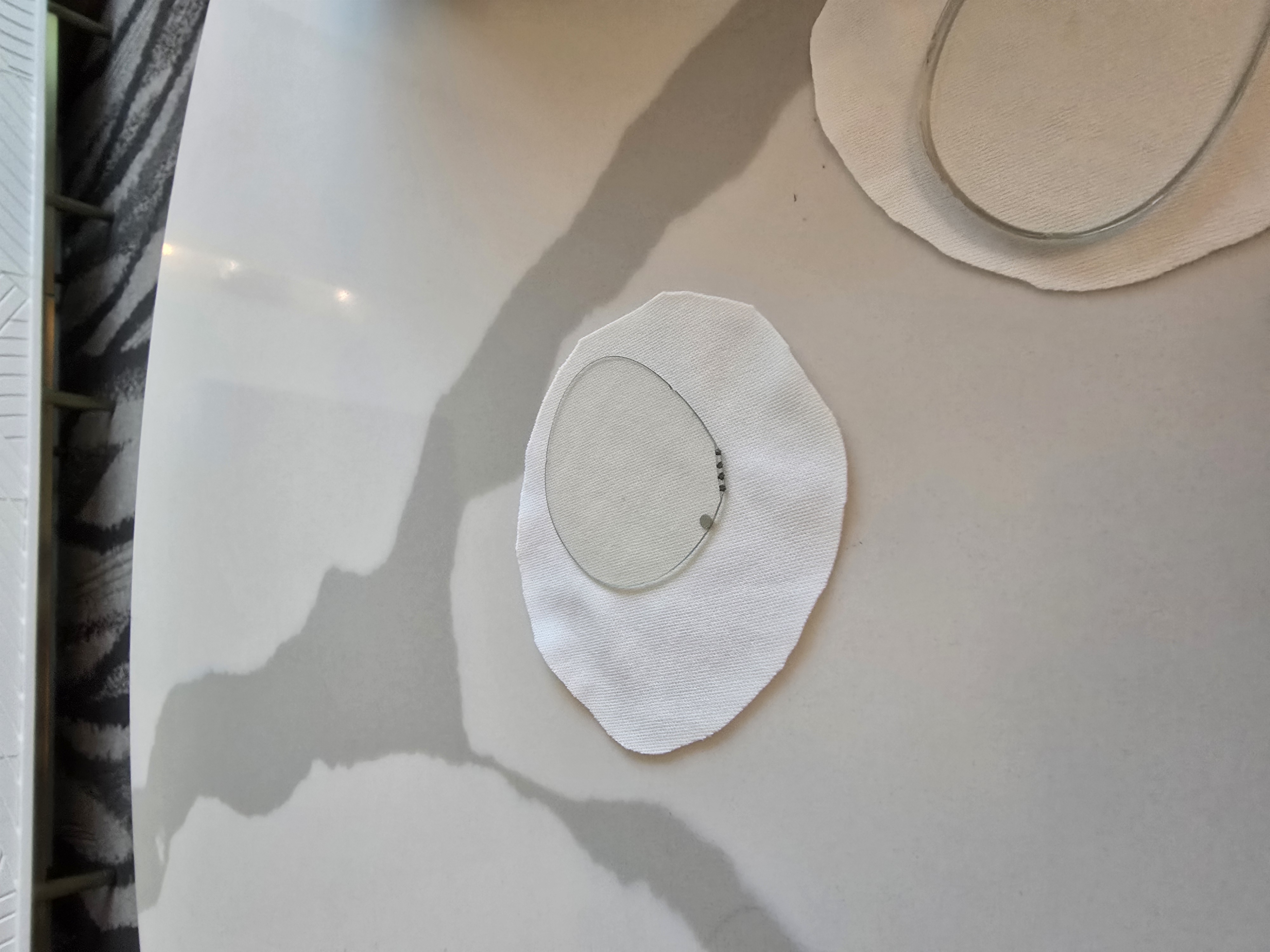
To demonstrate, Eiden placed a sample lens on an arm and transmitted a signal to it. A bright disk appeared in the center of the lens. With a separate order he disappeared, leaving no signs of having been there. I held a lens up to the light and studied it carefully: at just the right angle, I could detect the faintest trace of electrical circuits sending their tiny commands to the twisting liquid crystal matter, a series of concentric rings that look a little like a CD, the sort of thing you’d never notice when wearing a pair of IXIs, of course.
“In some specific reflections you can see something. It’s a Fresnel pattern,” Eiden told me, “but a very special one. It’s nothing you can find in research.”
In September, IXI acquired lens manufacturing and development facilities Finnsusp in Finland and has entered into a long-term strategic partnership with Optiswiss, one of Europe’s leading independent lens manufacturers. This followed a $36.5 million funding round. In November it presented the 22 gram prototype. At CES, it was finally ready to show off.
It is a Fresnel pattern. But a very special one.”
Niko Eiden, co-founder and CEO of Finnish startup IXI
“At first, we thought about licensing the technology, but there was no one to license it to. The existing industry is not equipped to achieve this level of sophistication… so we thought we had to do it all ourselves,” he said. Eiden himself has a master’s degree in aeronautical engineering and began his career at the CERN particle physics center in Switzerland, before coming to Nokia, and now IXI. Oh, and he’s also a certified pilot (outstanding!).
The eyetracker data is fascinating in itself. Blink intervals, for example, provide an intriguing window into behavior and alertness.
“I’ve been wearing these for five minutes,” Eiden said, checking the screen of a tablet connected wirelessly to his glasses. “I’ve been 73 percent anxious, 20 percent relaxed and focused, with no daydreaming. When you’re working or writing, your blink rate decreases. That’s why your eyes get dry.”
“Initial blink rate” is not necessarily information you will need as a human, nor is posture information that can also be extracted. It’s also unlikely to appear in the app you’ll receive with the product. But for now, it sure is interesting to see.
A pair of IXI glasses won’t be cheap, but they shouldn’t be too expensive either. Eiden said they will be in the high-end glasses range, which can cost 1,000 euros, he said. A small price to pay for magic, right?
TechRadar covers this year’s edition extensively CESand bringing you all important announcements as they happen. Go to our CES 2026 Live News page for the latest stories and our hands-on verdicts on everything from 8K TVs and foldable screens to new phones, laptops, smart home devices and the latest in artificial intelligence.
You can also ask us a question about the show on our CES 2026 Live Q&A and we will do our best to answer it.
And don’t forget follow us on tiktok and WhatsApp For the latest from the CES fair!


