
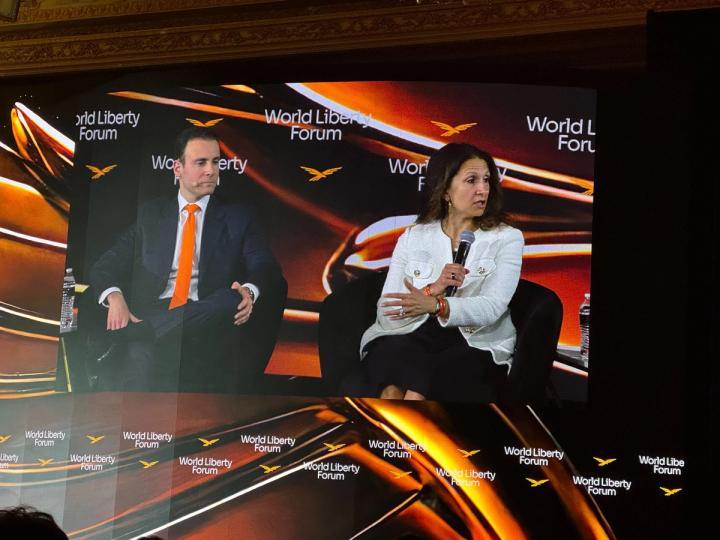
PALM BEACH, Fla. — Prediction markets are starting to play a role in the way traditional financial markets move, New York Stock Exchange President Lynn Martin said Wednesday at the World Liberty forum in Palm Beach.
“It was very clear to us… that prediction markets [were being used] as a contribution to traditional markets,” he said at the Mar-a-Lago event, pointing to a moment during the 2024 US presidential election when S&P futures unexpectedly soared. According to Martin, the move was later explained by cryptocurrency-based prediction platform Polymarket, which had shown Donald Trump as the likely winner ahead of other sources.
The commentary highlights a growing awareness among institutional actors of how on-chain information can influence market behavior. Unlike traditional surveys or slow forecasts, Polymarket’s real-time prices offer a sort of crowdsourced probability feed that traders may find useful.
The interest of the New York Stock Exchange goes beyond observation. Intercontinental Exchange (ICE), owner of the New York Stock Exchange, made a $2 billion strategic investment in Polymarket in October, indicating that the world’s largest stock operator sees a future in blockchain-based forecasting tools.
CFTC Chairman Michael Selig, who took office late last year, echoed Martin’s comments about the role of prediction markets in society, saying they have national security implications and act as a brake on traditional news journalism. He also referenced its role in entertainment and sports, the latter being an area that state regulators are paying special attention to.
“States have really led this open war campaign against the markets that are under the CFTC’s jurisdiction,” Selig said. “The CFTC has spent decades [overseen] prediction markets.”
He referenced the amicus brief the CFTC filed earlier this week in the Ninth Circuit Court of Appeals in a case, which hours later denied prediction market provider Kalshi’s request for a stay against the state of Nevada’s efforts to shut down its sports-related prediction markets.
“We are going to fight this, we are going to make sure that our markets are free, fair and have integrity,” he said. “We won’t have state gaming commissions telling us how to regulate our markets.”


