
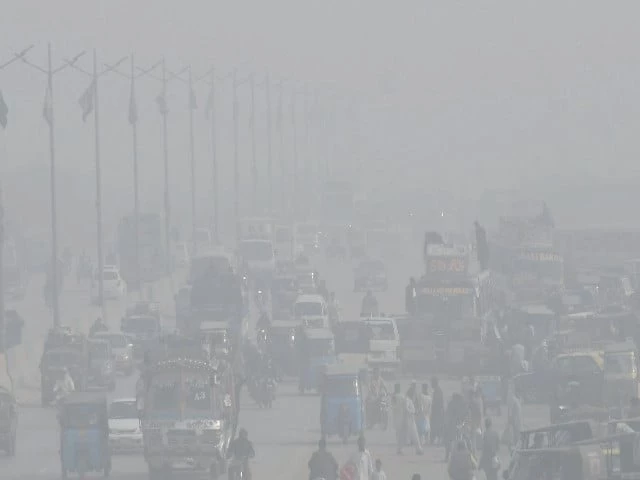
Travelers cautiously make their way through a thick blanket of fog on a winter morning, as the provincial capital slowly wakes up with low visibility, turning a normal trip into a silent test of patience and concentration. Photo: ONLINE
KARACHI:
Dense fog engulfed the metropolis on Sunday morning, reducing visibility and disrupting flight operations at the Jinnah International Airport.
According to officials, this was the first period of heavy fog recorded in the metropolitan city this winter. Visibility, which was previously about six kilometers, dropped to almost zero early in the day. Even after dawn, it remained limited, gradually improving to about 200 meters in the morning, two kilometers at around 12:30 p.m. and only three kilometers at 2 p.m., still well below normal levels. The fog clouded visibility in several areas, causing inconvenience to motorists. Localities like Gulshan-e-Maymar, Surjani Town, Superhighway, Sohrab Goth, Gulistan-e-Jauhar, Gulberg, II Chundrigar Road, Clifton and DHA are among the worst affected.
At Jinnah airport, adverse weather conditions led to the diversion of six international flights. A Pakistan Airports Authority (PAA) spokesperson said flights operated by Pegasus, Etihad and Gulf Air were diverted to Muscat. A Pakistan International Airlines (PIA) flight from Medina to Karachi was also diverted to Muscat, while a private airline flight from Jeddah was diverted to Islamabad.
PAA officials said diverting flights during periods of limited visibility was a routine safety measure.
Meanwhile, the Pakistan Meteorological Department (PMD) predicted that fog could also persist on Monday, which would continue to affect visibility. The weather is expected to remain dry for the next three days, with cold nights and mornings. The minimum temperature in the city on Sunday was recorded at 17.5°C.
The PMD added that the sea breeze could remain suspended in the coming days, while winds could blow from various directions, with speeds exceeding 18 kilometers per hour.
The longest night of the year marks the winter solstice
The night that lasted 13 hours and 25 minutes was recorded as the longest of the year, while today (December 22) marks the shortest day of 2025. Astronomers confirmed that the phenomenon, known as *winter solstice*, occurred on the night between Sunday and Monday throughout the northern hemisphere. Experts explained that the winter solstice occurs annually in December, normally between the 20th and 23rd of the month. This year, it fell on December 22. The solstice is the point at which the tilt of the Earth’s axis, tilted at 23.4 degrees, moves furthest from the Sun in the Northern Hemisphere, resulting in the longest night and shortest day of the year.
Astronomers observed that the Earth’s axis wobbles slightly, like a top, during its rotation. As the planet orbits the Sun, there comes a time when the northern tilt moves as far away from the Sun as possible. Immediately after this point, the tilt begins to recede, gradually orienting the northern hemisphere toward the Sun once again. As a result, after the winter solstice, the nights begin to become shorter and the days become longer. This astronomical event has been observed and celebrated across cultures for centuries, symbolizing the transition from the darkest period of the year to increasing daylight.


