
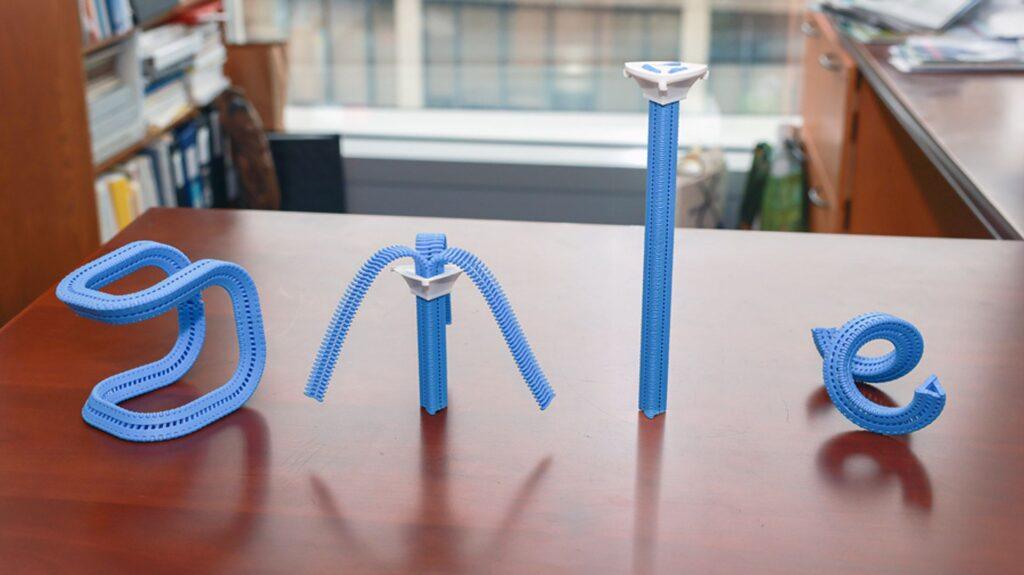
- Y-zipper is a 3D printed three-size zipper
- It is flexible when the zipper is unzipped but rigid when the zipper is pulled up.
- This 40-year-old concept was brought to light by researchers using software and a 3D printer.
Let’s make zippers cool again. Right now, they’re just part of your fashionable coat, pants, or bag, but what if a zipper could serve as a frame for a cast on your broken leg or help you build a tent in a minute? That’s the kind of zipper we could all get behind, and apparently it exists as something called a Y zipper.
Y-zipper is the real-world realization of a 40-year-old design dream. Forty years ago, former Polaroid engineer and current MIT professor William Freedman, PhD, envisioned a three-sided zipper. It would be like a traditional zipper in that it would have pieces that would interlock to form a strong joint, but by adding a third side and zipping them together, you could create a potentially rigid structure that could be opened back to a flexible shape.
However, according to a report in MIT’s News Journal, Dr. Freeman’s design was rejected in 1985 by a prestigious design competition.
Article continues below.
Over the years, new materials and 3D printing arrived, allowing automated assembly to be created and the idea of the Y-zipper revived.
A second chance for this innovative Y zipper
Look
In a project led by MIT postdoc and CSAIL researcher Jiaji Li, they created a 3D-printable version of the Y zipper. Each zipper starts as a design on the computer where Li and his team connect triangular and zipper primitives, bending and curving them however they want.
Once they have the rigid layout of a Y zipper, they divide it into three printable flat zipper panels. They then print them, remove them from the printing table, and use a custom-designed slider to join them together. Each of the three sections goes into one of the three slots and, just like the traditional zipper slider, as you pass the three pieces through this slider, they lock and come out as a rigid shape on the other side. That shape can be a rod, a curve, or even a corkscrew (it all depends on how each side was printed and the angles it contains). When you move the pieces back through the slider or reverse it, the three pieces cascade apart like
It looks great, but there are even more attractive and practical applications.
In a video produced by MIT, we see how the team designed a Y-zipper brace. They started on the computer with CAD software, created a rigid shape that would curve around the hand, and, in the app, separated it into three flat zipper pieces that would eventually fit together.
On a 3D printer they printed a flat section of a fabric glove that, when worn, remained completely flexible. The researchers then used a small slider to join the two remaining sides. The resulting Y zipper is a glove with a rigid gusset. Imagine how this could be used, for example, in a full cast for a broken leg.
Elsewhere in the video, a small robot has four Y-zipper legs that slide in and out, allowing it to walk under obstacles. Inside the robot, four sliders allow the flexible parts to coil back into the robot body.
Lastly, the Y zipper is used as a frame for a tent. The four flexible sides are sewn at all four seams, and when the two sides are zipped together at the spines, each one becomes firm and fully supports the tent frame. And if you’re particularly lazy, apparently you can attach a small actuator to the slider and it will close the sections for you. In the video, this reduced the time it takes to set up the tent to one minute. Imagine all the time you will have to light a campfire.
The team is still working on mass production of materials and production, but it seems quite likely that one day we’ll see Y zippers everywhere, except maybe on the fly.

Follow TechRadar on Google News and add us as a preferred source to receive news, reviews and opinions from our experts in your feeds.


