
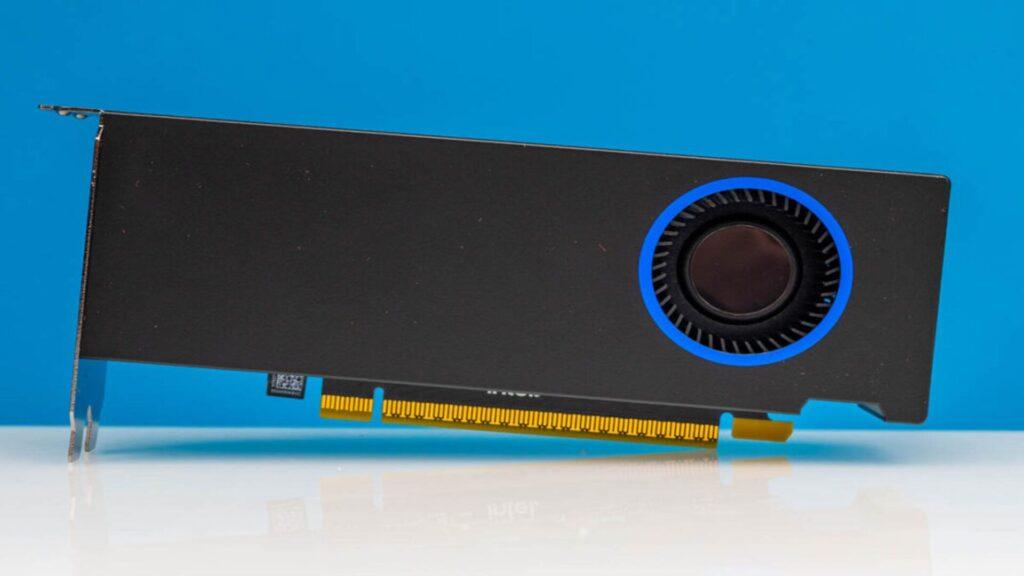
- Intel B50 completes first AI token tasks comparable to 4000 Blackwell performance
- Blender renders with the B50 are still functional, suitable for entry-level workflows
- Topaz Video AI tasks complete consistently with consistent performance across all scenes.
The professional GPU market has expanded rapidly in 2025: Nvidia launched its Blackwell generation and AMD updated its Radeon PRO line.
Intel has also entered the market and offers the B50 as a surprisingly capable option for budget-conscious professionals.
The performance of this chip doesn’t match that of high-end Blackwell cards, but it provides enough power to be relevant in certain professional workflows.
Performance across all benchmarks
For around $300, many mini PC brands may find this chip attractive due to its lower cost and modest power requirements.
In synthetic benchmarks, the Intel B50 achieves first-token generation times in MLPerf comparable to a Blackwell 4000, demonstrating that single-query AI tasks can be executed efficiently.
The sustained performance brings it in line with the Blackwell 2000 and Radeon W7600, providing a usable foundation for lighter machine learning workloads.
Blender’s cycle rendering benchmark shows the B50 lagging behind high-end GPUs, but still capable of completing scenes, highlighting functional performance for entry-level 3D work.
For real-time engines like Unreal and Unigine, the B50 produces playable frame rates suitable for basic visualization and preview tasks, while mid-tier Ada and Blackwell GPUs naturally outperform it.
In media editing applications, the card accelerates 2D workflows in After Effects and handles standard DaVinci Resolve timelines seamlessly.
GPU-intensive 3D effects show the expected differences versus more powerful cards, but the B50 still allows creative work to be carried out in compact configurations.
Topaz Video AI completes scenes at a moderate pace, and stability remains consistent across tasks.
CPU usage becomes a factor in certain AI-assisted and GPU-intensive effects, although the B50’s efficiency allows for experimentation in machine learning and video inference at low cost.
AMD’s RDNA3 cards continue to deliver higher performance for a similar price, but Intel offers a viable option for creators looking for functionality without a significant investment.
Users who require modest acceleration can achieve practical results without requiring thousands of dollars of hardware.
Intel’s B50 occupies an unusual niche in professional GPUs. It can’t rival Blackwell or high-end AMD GPUs for raw performance, offline rendering, or sustained AI workloads.
However, its $300 price tag and low power consumption make it suitable for entry-level content creation or building compact PCs.
For budget-conscious or space-constrained users, the B50 offers a surprisingly capable alternative, capable of handling lighter professional workloads efficiently.
Via PugetSystems
Follow TechRadar on Google News and add us as a preferred source to receive news, reviews and opinions from our experts in your feeds. Be sure to click the Follow button!
And of course you can also follow TechRadar on TikTok for news, reviews, unboxings in video form and receive regular updates from us on WhatsApp also.


