
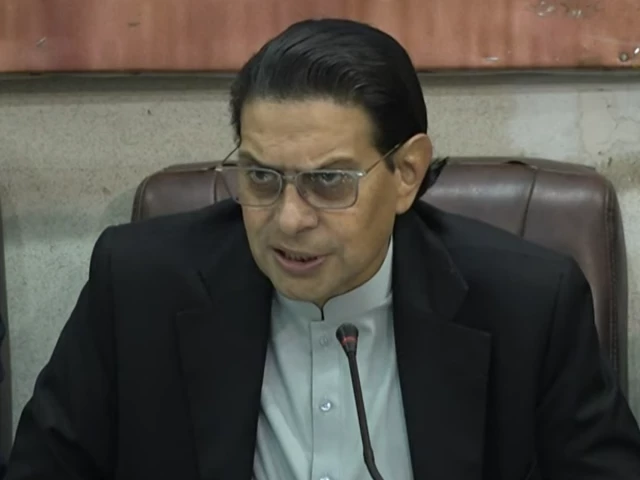
Opposition leaders express alarm over economic decline, rising poverty and the erosion of democratic institutions.
PTI Central General Secretary Salman Akram Raja addresses a press conference on Sunday. SCREEN CAPTURE
KARACHI:
Pakistan Tehreek-e-Insaf (PTI) Central General Secretary Salman Akram Raja said that “the day the nation decides that it will no longer accept a life of subjugation, this oppression will automatically come to an end.”
He made these remarks during a press conference at the Karachi Press Club along with former Sindh Governor Mohammad Zubair, economic spokesperson of Tehreek Tahaffuz-e-Aain Pakistan and other party leaders, where they expressed deep concern over the deteriorating economic and political situation in the country.
Mohammad Zubair said the government’s claims about economic stability were contradicted by its own official reports, which show a sharp decline in living standards and a rapid rise in poverty.
և ہوا ہے لوگوں نے پیغام دیا ہے کہ وہ امن پسند اور جمہوری قوتوں کے ساتھ کھڑے ہیں ۔
بیریسٹر سلمان اکرم راجہ@salmanaraja pic.twitter.com/Vo42XXrefv
– Haleem Adil Sheikh (@HaleemAdil) January 11, 2026
He said that according to government surveys, 80 percent of citizens have experienced a deterioration in their quality of life, while a similar proportion have reduced spending on food due to inflation. He added that the urban middle class has been the most affected: 23 percent of the urban population has experienced a drop in their income and living standards.
Questioning the government’s performance, Zubair said: “When people’s lives have gone downhill in the last four years, one must ask: what exactly has the government achieved?”
He criticized the Special Investment Facilitation Council (SIFC), stating that it had failed to attract investments and that total investment had fallen by 50 per cent, calling it proof of the institution’s failure.
Read more: CM Afridi’s convoy delayed en route to Bagh-e-Jinnah as PTI denounces ‘blocked’ roads
Zubair further revealed that 30 million people had fallen below the poverty line in the last three years. He said foreign investment from the United States and the Middle East was not coming due to absence of rule of law, adding that even Pakistani investors were now demanding the right to international arbitration before investing.
Holding Prime Minister Shehbaz Sharif as the main person responsible for the economic crisis, Zubair recalled that the Prime Minister had promised to fix the economy within six months, a promise which he said had not been fulfilled.
He also highlighted the decline in foreign exchange reserves, noting that reserves stood at more than $17 billion at the time of the no-confidence vote, but had fallen to $2.9 billion by January 2023. He said the threat of default in June 2023 arose after the IMF program was damaged.
تحریکِ عدم اعتماد کے وقت ایک بہانہ یہ بنایا گیا کہ پاکستان تھے۔ 2022 فیصلہ ارب ڈالر ارب ڈالر تھی جو اۤج جا کر 16 ارب… pic.twitter.com/TWVips3Gm3
— Kismat Khan (@KismatZimri) January 11, 2026
On corruption, Zubair demanded clarification on NAB’s claims of recovering Rs5.3 billion, asking from whom the money was recovered and who had been punished. He pointed out major scandals including the Rs 300 billion wheat scandal, the Rs 300 billion sugar scandal and admitted losses of Rs 300 billion annually through oil smuggling, as acknowledged by the Oil Minister.
Addressing the political restrictions, Salman Akram Raja said that despite the issuance of a NOC for a public rally, the police cordoned off the area, made arrests and harassed stage and sound system providers. “Despite all this, the demonstration will continue,” he said.
He said PTI supports privatization of PIA in principle, but warned that there are serious concerns regarding transparency and workers’ rights, and that exploitation in the name of privatization would not be tolerated.
Raja further stated that those responsible for the destruction of state institutions and those involved in corruption must be held accountable. He lamented that the courts and parliament had become mere facades and that the country had effectively become “a prison.”
He said that Article 15 of the Constitution, which guarantees freedom of movement to all citizens, was being violated, and stressed that the fight for public rights and freedoms had become inevitable.
“The day the nation decides it will no longer accept a life of subjugation,” he concluded, “this oppression will come to an end of its own accord.”


