
Five peace committee members martyred; Police claim to have recovered attacker’s severed head; Maximum alert declared in hospitals
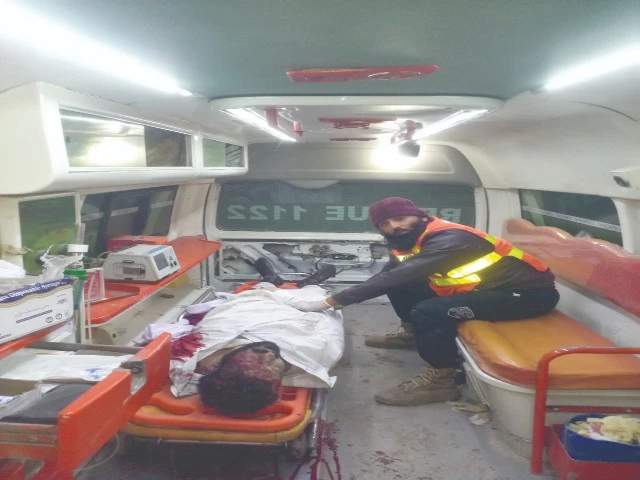
The body of a suicide bombing victim is being taken to a hospital. Photo: Express
DERA ISMAIL KHAN:
A suicide bomb attack devastated a wedding ceremony at the residence of peace committee leaders near Qureshi Mor in Dera Ismail Khan, killing five members of the peace committee and wounding seven others, police confirmed on Friday night.
District Police Officer Sajjad Ahmed Sahibzada, while sharing initial details with the media, said the attack took place during an ongoing wedding ceremony at the house of the peace committee leaders.
He confirmed that five people died on the spot, while seven others suffered injuries and were rushed to hospital for immediate medical treatment.
According to police and security officials, the severed head of the suicide bomber, believed to be 17 years old, was recovered from the explosion site and taken into custody for forensic examination and identification.
Investigation teams and forensic experts remained at the scene, collecting evidence to establish the identity of the attacker and trace the network behind the attack.
The explosion occurred at the height of the wedding festivities, suddenly throwing the family into mourning.
Police and rescue teams quickly cordoned off the scene, while hospitals were put on high alert to ensure uninterrupted treatment of the injured.
Authorities said investigations were underway to determine the motives behind the dastardly act of terrorism.
KP Chief Minister Sohail Afridi strongly condemned the explosion and termed the incident deeply regrettable.
He requested a detailed report from the provincial police chief and ordered that the injured receive the best possible medical care. He further ordered security agencies to carry out immediate investigations and identify those responsible for the attack.
Afridi expressed his solidarity with the families of the victims, assuring that all possible support will be provided to them.
KP Governor Faisal Karim Kundi has requested a detailed report on the explosion, according to a statement by his spokesperson Dr Fazal Rahman. He contacted senior officials for updates on the incident and ordered that all possible medical assistance be provided.
Kundi expressed grief over the loss of lives in the explosion and called for immediate help and support for the victims and their families.
This is not the first time Mehsud, head of the Mehsud Peace Committee in South Waziristan, has been attacked.
In 2022, two suicide bombers attempted to attack him in his DI Khan office. Both attackers were killed in front of the office and volunteers from the peace committee managed to thwart the attempt.
Last month, three police officers were killed in a bomb attack targeting a police vehicle in DI Khan.
The district suffered one of the worst attacks in recent times in November last year when six police officers, including students, were martyred, while 12 other police officers and a civilian were injured following a terrorist attack on the Police Training School.
DI Khan, strategically situated at the junction of Balochistan, Punjab and KP, has long been a hotbed of militant violence.
The district has witnessed a rise in attacks since 2020, with 111 incidents reported resulting in the death of 71 police officers and the injury of 100 others.
Between 2020 and 2025, DI Khan witnessed a fluctuating pattern of attacks. In 2020, six attacks killed four police officers and injured two. The following year, 13 attacks left three dead and four injured.
Violence increased in 2022, with 24 attacks killing 19 officers and wounding 27, and peaked in 2023 with 39 attacks claiming seven lives and wounding 27. Although attacks dropped to 17 in 2024, casualties remained high and, in December 2025, 12 attacks killed 15 officers and injured 16.
The Saraiki-speaking district of five tehsils borders Dera Ghazi Khan, Zhob district of Balochistan and South Waziristan. After the attacks of September 11, 2001, when terrorism spread across Pakistan, Dera Ismail Khan was among the worst affected areas.
Sectarian violence began here in 1987 and continues today. Since 2007, terrorist incidents have claimed numerous lives, including senior police officials.
Last year, Pakistan witnessed a more than 25% increase in overall violence, recording at least 3,187 violence-related deaths and 1,981 injuries among civilians, security personnel and criminals, according to the Center for Security Research and Studies.
KP was the worst affected region, accounting for almost 68% (2,165) of the country’s total violence-related deaths and more than 62% (732) of all incidents of violence.
In KP, security forces dominate the operational landscape. Deaths during security operations (1,370) exceeded those from terrorist attacks (795) by 72%, highlighting that large-scale anti-terrorism campaigns are the main cause of casualties in the province.


