
LAHORE:
Senior political leaders across the spectrum on Saturday warned of an “emergency-like” climate, shrinking democratic space and the dangers of a security-dominated state, while urging political unity and public resistance to protect the constitutional regime.
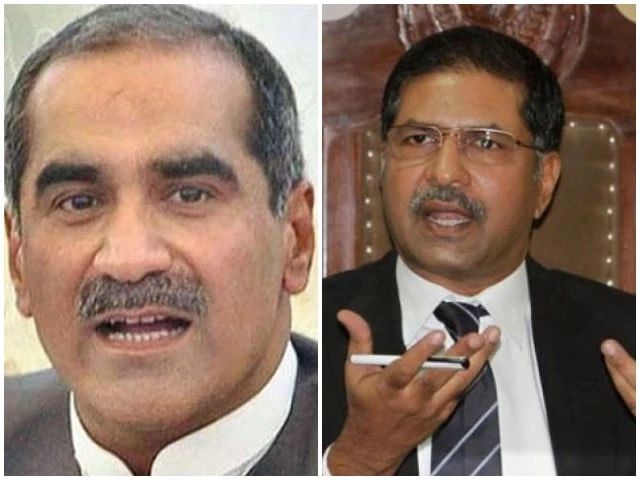
Speaking in candid terms, PTI’s lawyer Ali Zafar deplored the current situation calling it similar to the prevailing martial law, PPP’s Farhatullah Babar sharply criticized a “security-driven state” that represses dissent.
Meanwhile, PML-N’s Khawaja Saad Rafique urged parties to regain their political space through dialogue instead of confrontation.
The remarks were made during a session titled “Halqa-e-Zanjeer Mein Zubaan” at the 10th Faiz Festival, currently underway at the Alhamra Arts Council.
The discussion brought together Farhatullah Babar of the PPP, Khawaja Saad Rafique of the PML-N and lawyer Ali Zafar of the PTI, with journalist Talat Hussain moderating the exchange.
Lawyer Ali Zafar said that in practical terms, conditions similar to martial law prevailed. “In a way, martial law is in effect today,” he said, adding that the country is no longer in a waiting phase. “The waiting time has passed. We are in an emergency.”
He warned that democracy must be defended with wisdom and determination. “If we fail to save democracy, we will be like a corpse,” he said. He warned that silence was the biggest threat and added that speaking was the most powerful tool at citizens’ disposal.
Farhatullah Babar argued that the suffocating atmosphere was a result of Pakistan’s evolution into a “security-driven state”, where the dominant security narrative determined who could speak freely.
“If your narrative aligns with the security-driven state, you are allowed to say whatever you want. If not, you are not allowed to speak,” he lamented.
Urging a transition to a welfare state, he highlighted that while Pakistan does not lack intellectuals, writers and academics, it lacks people willing to raise their voices. “Everyone will have to become voices of conscience,” he said, adding that while suffocation may not disappear completely, it could at least be reduced.
Khawaja Saad Rafique, whose party is in government, said the country’s condition had not fundamentally changed, adding that the environment described decades ago by Faiz Ahmed Faiz still persists.
He observed that all political parties had drawn from the same source but were seeking an exclusive advantage.
He deplored the repeated military interventions in politics and noted that no army chief had apologized for such interference. “All the parties have drunk from the same river, they have been bitten by it and, nevertheless, they want to drink from it again,” he stated.
Rafique maintained that unless political parties began to question their own internal errors, freedom would remain confined to paper. He said political actors must collectively reclaim their political space instead of waiting for external validation.
Farhatullah Babar recognized that politicians had made serious mistakes and had paid for them with executions and imprisonment. He said some elements in the country had never accepted the Constitution and stressed the need for political parties to sit together.


