
Delegation briefed on Pakistan’s diplomatic efforts and initiatives, says PMO
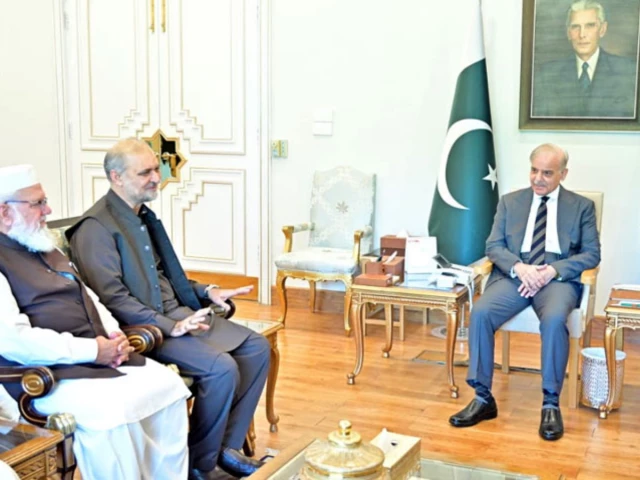
Prime Minister Shehbaz Sharif held a closed-door briefing with a delegation of Jamat-e-Islami at the Prime Minister’s Office PHOTO: RADIOPAK
Prime Minister Shehbaz Sharif held a closed-door briefing with a Jamat-e-Islami delegation led by Emir Hafiz Naeemur Rehman on Thursday at the Prime Minister’s Office to discuss the current geopolitical situation, according to a statement from the Prime Minister’s Office (PMO).
The delegation included Liaqat Baloch, Mian Muhammad Aslam and Asif Luqman Qazi.
The PMO said the delegation was given a closed-door briefing on the current situation in Afghanistan, Iran, the Middle East and the Gulf region. “The delegation was briefed about Pakistan’s diplomatic efforts and initiatives,” the statement added.
The officials also briefed the delegation about the measures taken by Pakistani embassies in Iran and Gulf countries to facilitate assistance to Pakistani citizens.
The meeting was attended by Deputy Prime Minister and External Affairs Minister Senator Ishaq Dar, Federal Ministers Azeem Nazir Tarar, Ahsan Iqbal, Attaullah Tarar, Rana Mubashir Iqbal, Prime Minister’s Advisor Rana Sanaullah and State Minister Talal Chaudhry, the PMO confirmed.
A high-level meeting, chaired by Prime Minister Shehbaz Sharif, to discuss the current geopolitical tensions in the region was held in Islamabad on Wednesday, attended by all major parties and leaders from both sides of the aisle. The Pakistani group Tehreek-e-Insaf was absent from the meeting.
The meeting included a detailed briefing to ensure that parliamentary leaders were fully informed about the country’s foreign policy approach and regional security posture, the PMO said.
Read: Pakistan proceeds cautiously in the Gulf conflict
“A detailed briefing was also provided to parliamentary leaders at the meeting, highlighting Pakistan’s diplomatic efforts during the recent tensions. Parliamentary leaders of political parties expressed their views openly. Participants emphasized the need for national unity, consensus and solidarity in the current situation.” Radio Pakistan reported.
Regional tensions
Pakistan and Afghanistan have clashed along the border since last week, when Afghanistan launched a border offensive in response to Pakistani airstrikes. ‘Operation Ghazab Lil Haq’ was launched late on Thursday following fresh clashes along the border, when Afghan Taliban forces fired at multiple locations, prompting swift military retaliation.
Islamabad accuses Afghanistan of failing to act against terrorist groups carrying out attacks in Pakistan, which the Taliban government rejects. Border fighting has affected several Afghan provinces. The violence of recent days is the worst since fighting in October killed more than 70 people on both sides, and land borders between the neighbors have since been virtually closed.
The meeting also discussed the escalation of the conflict in the Gulf after the United States and Israel continued their military attacks against Iran, following a joint operation on Saturday that killed Supreme Leader Ali Khamenei and several high-ranking officials. Iran said schools and hospitals have also been attacked, killing hundreds of civilians.
Read more: Israel attacks Beirut as Iran fires new barrage of missiles at Israel
In the first wave of attacks, some 163 girls were killed when a school in southern Iran was hit by Israeli and American strikes.
Tehran responded by attacking Israel as well as US military assets throughout the region, disrupting trade travel, disrupting oil routes and raising global energy prices.
The Islamic Revolutionary Guard Corps said it attacked more than 500 US and Israeli locations using 700 drones along with hundreds of missiles.


