
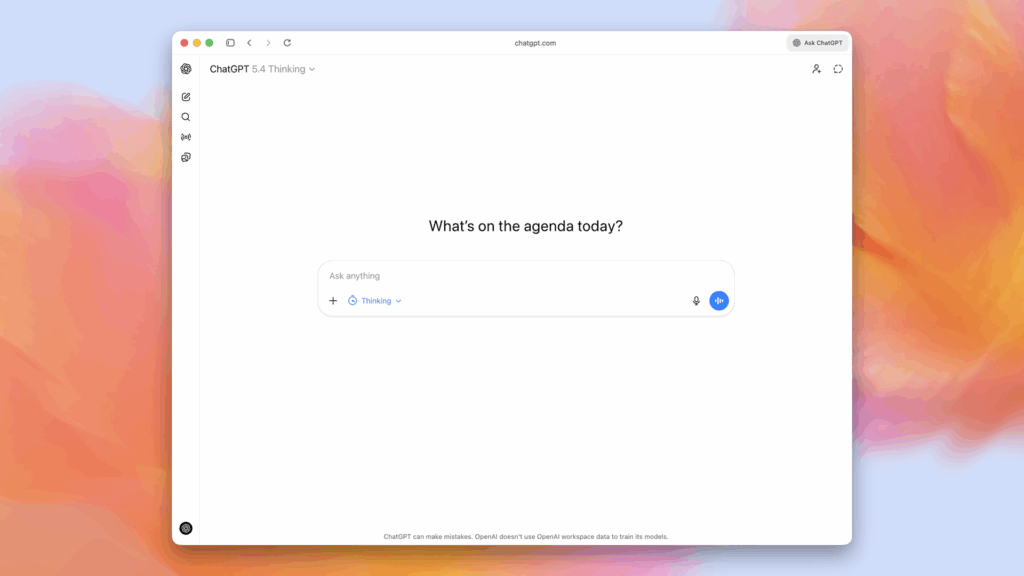
- OpenAI has introduced ChatGPT 5.4 Thinking in ChatGPT to handle more complex reasoning and multi-step tasks.
- ChatGPT 5.3 Instant will remain the default model for everyday conversations in ChatGPT
- The new model allows Plus, Team, and Pro users to guide AI as it plans and completes larger projects.
Just a few days after OpenAI introduced ChatGPT 5.3 Instant, ChatGPT received an additional update called ChatGPT 5.4 Thinking, powered by the new GPT-5.4 model. ChatGPT 5.4 Thinking, along with the higher-performance ChatGPT 5.4 Pro, are being deployed for the Thinking tool, while ChatGPT 5.3 Instant remains the default model that powers most ChatGPT conversations.
The most important detail is how the new model fits into the ChatGPT structure. ChatGPT 5.3 is basically the version optimized for speed and conversational flow, while ChatGPT 5.4 Thinking is designed for situations that require more complex reasoning. It appears as an optional mode for Plus, Team, and Pro subscribers, allowing users to switch to a more analytical version of the model when they need to.
That distinction between speed and depth reflects a broader shift in the way ChatGPT is developed. Instead of relying on a single model to handle each situation, OpenAI is building a layered system in which different models fulfill different functions.
The most visible difference with ChatGPT 5.4 Thinking is how the model explains its approach. When given a complicated message, the chatbot will offer a brief explanation of how it plans to solve the problem. This preview allows the user to intervene while the response is still developing. If the model plane misses the target, the user can adjust its direction before the final result arrives. Basically, ChatGPT 5.4 thinks out loud and lets you interrupt and correct it.
how it works
Imagine asking ChatGPT to plan a family vacation. With ChatGPT 5.4 Thinking enabled, the system could start outlining the steps it intends to take. You might say you’ll research travel dates, estimate costs, compare flight options, and outline a daily itinerary. If the user prefers road trips over flights or wants to prioritize museums over beaches, that change can occur before the itinerary is generated.
The feature also works well with longer prompts. ChatGPT 5.4 is designed to maintain greater awareness of previous parts of the conversation while solving multi-step problems. That allows you to handle more complicated requests without losing sight of the overall goal. OpenAI describes this improvement as part of a broader effort to make ChatGPT more useful for professional tasks rather than simply interesting conversation.
OpenAI says GPT-5.4 works especially well in areas such as document creation, spreadsheet analysis, and presentation design. The model was evaluated using tasks that resemble the type of work performed in dozens of professional occupations. In those tests, GPT-5.4 equaled or outperformed human pros in a vast majority of comparisons.
Spreadsheet modeling is a particularly strong area. OpenAI says the model scored significantly higher than GPT-5.2 on tasks similar to financial modeling tasks often performed by junior analysts.
The improvements also extend to visual understanding. GPT-5.4 can analyze high-resolution images and complex documents more effectively, which helps when interpreting charts, diagrams or scanned documents. For a regular ChatGPT user, that combination of capabilities means the chatbot becomes more useful for tasks that involve real information rather than abstract questions.
A user can ask ChatGPT to analyze a data set, produce a spreadsheet model, write a report summarizing the results, and create slides explaining the findings. GPT-5.4 is designed to handle that entire chain of tasks with fewer revisions.
Speed versus power
Even with the arrival of GPT-5.4 Thinking, GPT-5.3 Instant still plays a central role in the ChatGPT experience.
GPT-5.3 Instant remains the default model that powers the standard chat interface. It was introduced to facilitate conversations, reduce unnecessary rejections, and produce faster responses. That focus on speed and responsiveness makes it ideal for everyday interactions, like generating ideas, answering questions, or composing quick messages.
GPT-5.4 Thought is positioned differently. Because it performs deeper reasoning and more complex analysis, it requires more computational effort. OpenAI has limited access to Thinking mode for Plus, Team, and Pro subscribers. Users who need even more power can access GPT-5.4 Pro through the Pro and Enterprise plans. That version is designed for particularly demanding tasks, such as advanced coding or complex analytical work.
This layered approach allows ChatGPT to balance speed and capacity. GPT-5.3 Instant handles most everyday conversations, while GPT-5.4 Thinking is available when users need more sophisticated reasoning.
OpenAI’s decision to keep GPT-5.3 Instant as the default also highlights something important about the direction of modern AI. Raw capacity is only part of the equation. For most people, what matters so much is speed, responsiveness, and a system that feels natural to use.
The future of AI may not come just through sudden advances, but through quieter upgrades like this: small changes to the way these systems reason, respond, and adapt to everyday tasks.
Follow TechRadar on Google News and add us as a preferred source to receive news, reviews and opinions from our experts in your feeds. Be sure to click the Follow button!
And of course you can also follow TechRadar on TikTok for news, reviews, unboxings in video form and receive regular updates from us on WhatsApp also.
The best business laptops for every budget


