
Safe haven asset?
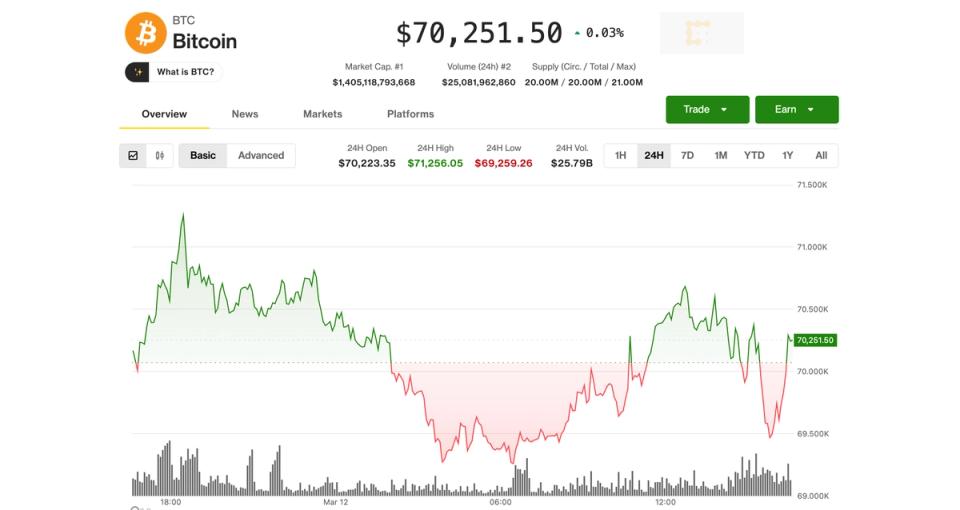
The stock is volatile, but bitcoin For the moment it continues to hold just above $70,000, even as other risk assets generally sell off.
Helping to lower stocks, crude oil prices have risen more than 10% and are approaching $100 a barrel amid concerns about the Strait of Hormuz, a key shipping route for oil tankers.
“Stopping Iran worries me more than oil prices,” President Trump said Thursday. Meanwhile, in his first public statement since being named Iran’s supreme leader, Mojtaba Khamenei said the Strait of Hormuz should remain closed.
“It is increasingly clear to everyone that the Strait is far from under control and is potentially impossible to control without severe concessions to Iran, boots on the ground or enormous military risks,” said Quinn Thompson, founder of Lekker Capital. “Things get complicated from here and when your back is against the wall, volatility increases.”
Near midday on the East Coast, the Nasdaq is near session lows, down 1.6% and the S&P 500 is down 1.2%.
Scrubbed from the front pages thanks to Iran, but continuing concerns about a collapse in private credit are still a major concern. Morgan Stanley (MS) was the latest in a growing series of financial giants to limit redemptions, in this case in its $8 billion North Haven Private Income Fund. Morgan Stanley shares fell 4% on Thursday, leading declines in the financial sector. JPMorgan, Citigroup and Wells Fargo fell about 3%.
In private equity, KKR, Apollo Global and Ares Management posted declines of 3% to 4%.
Meanwhile, gold fell 0.6% and the 10-year US Treasury yield rose three basis points to 4.23%.
Oil drives markets
Oil has become the main driver of cryptocurrency prices, according to CoinShares head of research James Butterfill. “The dominant variable in global asset pricing is no longer the labor market. It is oil and the geopolitical crisis that underpins it,” he said in a note. He argued that the U.S. government’s latest payrolls report, which missed expectations, would normally have pushed markets to price in faster rate cuts by the Federal Reserve, but the reaction was muted as investors focused instead on rising energy costs linked to the conflict in the Middle East.
Despite Thursday’s pullback, bitcoin has remained relatively resilient despite rising geopolitical tensions and increased market uncertainty, holding near the $70,000 level even as investors reassess global risks.
The reason could be that large investors are increasingly looking for more than just exposure to the price of bitcoin, according to Dom Harz, co-founder of layer 2 blockchain BOB. “Institutions want more than exposure to bitcoin and are increasingly looking for infrastructure designed to unlock the financial utility of Bitcoin,” he wrote in a note, noting growing interest in bitcoin-based financial applications that could allow users to spend, save and earn using the network.


