
Shah touts transparency, efficiency by raising Rs 12.8 billion, paperless system and ‘Sindh Pay’ as upcoming projects
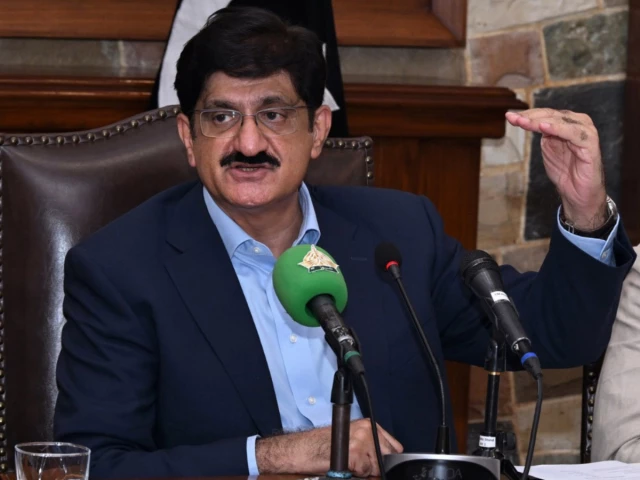
Sindh Chief Minister Syed Murad Ali Shah speaks during a press conference on Wednesday. Photo: NNI
KARACHI:
Chief Minister Murad Ali Shah on Tuesday said technology-led reforms are essential to establish a transparent, efficient and citizen-centric system of government, while presiding over a ceremony marking the expansion of e-stamping system in the province.
The event, held at the Chief Minister House, witnessed the signing of a framework service level agreement and service order between the Sindh Board of Revenue (BoR) and the Sindh Information Technology Company (SITC) to ensure continuity and expansion of the e-stamping platform.
Speaking on the occasion, the Prime Minister said that the initiative was part of a broader strategy to modernize governance in Sindh through digital transformation, aimed at improving transparency, efficiency and public access to government services.
He revealed that in just five months since SITC took over the system, more than 730,000 challans had been processed, while Rs 12.8 billion had been collected through the e-stamping platform in a transparent manner.
CM Shah said the reform was not limited to revenue generation but also targeted long-standing irregularities in the documentation system. “The electronic stamping system is helping to eliminate the fake stamp paper mafia, curb retroactive documentation and prevent citizens from standing in long queues in front of government offices,” he added.
He announced that the next phase of the initiative would introduce a completely paperless system, allowing citizens to generate stamp documents online through mobile devices and computers. “This is not simply a technological improvement but a step toward restoring public confidence in government institutions,” he said.
Highlighting the importance of digital governance in a province like Sindh, he noted that its large population and economic activity required modern administrative tools for effective management. He added that the CUCI had established itself as an institutional driver to accelerate digital transformation across all government departments.
The Prime Minister also referred to the recently approved government-to-government (G2G) framework, under which departments can interact directly with the CUCI through service level agreements and memorandums of understanding, eliminating lengthy procurement procedures and accelerating project implementation.
He said the simplified framework would allow departments to address technical challenges more efficiently and significantly improve the pace of digital reforms.
CM Shah further announced upcoming initiatives including the launch of ‘Sindh Pay’, a unified digital payment platform that will allow citizens to pay taxes, fees and other government dues through mobile devices. He added that a provincial data center was also being established to ensure that sensitive government and citizen data remains securely stored within the country.
He said the government was also exploring the responsible use of artificial intelligence to provide round-the-clock digital assistance to citizens in English, Sindhi and Urdu.


